Monday, June 30, 2008

Is Thornburg Playing Politics with the November Ballot?

Is Kansas Secretary of State Ron Thornburgh playing politics with the November ballot?

Ballot Access News reports

The ballot-qualified Kansas Reform Party held its state convention back on May 31, and nominated candidates for office, including presidential electors pledged to Chuck Baldwin for president. On June 27, the party turned in the paperwork for these nominations.

The Kansas Secretary of State has hinted that he won’t allow the party to do this. He has not ruled definitively, however. Now that the party has finalized its choice, he will need to either honor the nominations, or explain precisely what provision of Kansas law purports to tell the party that it cannot nominate the presidential candidate of the Constitution Party. In 1980, the American Party of Kansas was allowed to nominate Frank Shelton for president, even though the national convention of the American Party had chosen Percy Greaves. Also, in 1968, the Conservative Party of Kansas was permitted to nominate George Wallace as its presidential candidate, even though the Conservative Party was not affiliated with George Wallace’s American (also called American Independent) Party.


I'm certainly no friend of the Reform or Constitution Parties and I think Chuck Baldwin is a creepy right-wing theocrat, but Thornburgh's actions seem very questionable. The Kansas Reform Party has been on the ballot ever since Ross Perot's first Presidential campaign. They have run numerous candidates for federal and state office. In the last two elections, they have filed candidates in a number of legislative districts where one of the major parties has failed to field a candidate. Moreover, in 2004, Thornburgh placed on the ballot a number of Presidential candidates for non-ballot qualified candidates. (They received, 4, 33,5 and 5 votes)

UPDATE SEPT 17 Ballot Access News reported on Sept 15
...Kansas held an administrative hearing to determine the presidential nominee of the Reform Party of Kansas. The committee holding the hearing consisted of the Secretary of State, the Lieutenant Governor, and the Attorney General. After taking testimony, the group voted to place Chuck Baldwin on the ballot as the presidential nominee of the Reform Party of Kansas. The state party had unambiguously desired this outcome, but a doubt had been raised because a national Reform Party convention had chosen Ted Weill.

Tuesday, June 24, 2008

Slattery Questions Roberts’ Role in Removal of Buy American Provisions

At a press conference in Wichita today Jim Slattery criticized incumbent senator Pat Roberts’ role in the removal of a precisely worded Buy American provision from the 2006 Defense Authorization Bill. The removal of the provision allowed EADS to compete with Boeing for the Air Force tanker contract.

“Roberts had two chances to fight for Boeing and Kansas,” Slattery said. “First as a member of the Senate Armed Services Committee and then as a member of the conference committee for the 2006 Defense Authorization bill. On both occasions, Roberts failed.”

The explicit purpose of the provision was to prevent EADS from competing against Boeing for the Air Force tanker contract.
“This is not just about Buy American provisions,” Slattery said. “This is about a narrowly written section of the bill aimed at preventing EADS from winning the Air Force tanker contract over Boeing, its American rival.”

In an article published in the Wichita Business Journal last week, a Roberts’ spokesperson claimed Buy American provisions were “protectionist” and “impractical.”

In response, Slattery said, “Roberts should have protected the 3,800 new jobs the contract would have brought to Wichita. What was truly impractical was Boeing being forced to spend hundreds of thousands of dollars cleaning up a mess Roberts could have prevented in the first place. Roberts should have known that it was unfair to ask Boeing to compete with a company subsidized by European governments.”

Roberts’ office also argued that President Bush would have vetoed the defense bill had it contained the Buy American provisions.

“It’s time Roberts put the best interests of Kansas ahead of old party politics,” Slattery said. “Roberts had an obligation to do his job and stand up to President Bush on behalf of Boeing and Wichita.”

Slattery said Roberts should be fired for failing to protect Kansas jobs. “It is time to replace Roberts with a senator who will care about Kansans and champions the issues important to them,” Slattery said.

Friday, June 20, 2008

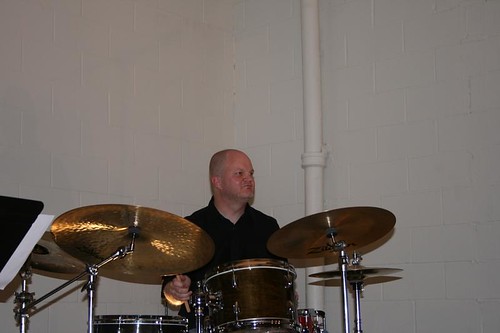
Steve Hatfiield/Wichita Creative Music Society


Tuesday night I dropped by B-side Gallery above Rewound Sounds (817 W. Douglass) to hear one of the summer concerts being put on by Wichita's Creative Musice Society.

Drummer Steve Hatfield led the group, played a bunch of tunes from his CD Just Being Wally, which I bought. It's a great CD. Post-fusion electric jazz. Electric guitar, keyboards and bass.

There are shows on Tuesday nights 8-10 for the rest of the summer. Well worth checking out.

Blogged with the Flock Browser

Monday, June 16, 2008

Kansas Federal Democratic Candidate Web Sites

US Senate
Jim Slattery KSDP Info page website

Lee Jones KSDP Info page Website
Candidate for US Senate
US Congress

James Bordonaro
Candidate for US House 1st District KSDP Info Page Website

Congresswoman Nancy Boyda
Candidate for US House 2nd District KSDP Info Page Website

Congressman Dennis Moore
Candidate for US House 3rd District KSDP Info Page Website

Senator Donald Betts
Candidate for US House 4th District KSDP Info Page Website

Updated: June 24, 2008

Thursday, June 12, 2008

Why Won't Tiahrt Endorse McCain?

Via Daily Kos, the Washington D.C. insider newspaper The Hill reports that 14 GOP Senators or Representatives have declined to endorse John McCain for President. Among them is Wichita's Todd Tiahrt. (Another dozen won't comment.)

Doolittle’s and Tiahrt’s offices did not specify their disagreements with McCain, but both lawmakers were ardent opponents of McCain’s push for campaign finance reform six years ago
.

Tuesday, June 10, 2008

Kansas election outlook after the filings

Today noon was the filing deadline for Republican and Democratic primaries in Kansas.

Kansas Democrats are is an upbeat mood with a

full slate of candidates running this year for federal office and the State Board of Education and will also have more legislative candidates on the ballot than ever before.

In 2004, Kansas Democrats contested 62 Republican-held legislative seats. This year, the Kansas Democratic Party has candidates running in 134 seats, including 77 seats currently held by Republicans.
The Lawrence Journal World reports that 4 of 40 Senate seats and 44 of 125 House seats will be uncontested. They then quote Republican Secretary of State Ron Thornburg as saying, "I think it’s getting tougher and tougher to get people to run for office." But, neither Thornburg or the LJW provide any evidence. Are there more or less contested general election races this year than in 2006 or 2004? Seems like we ought to know before passing judgment that it is harder to get candidates. Maybe it's just harder to get Republicans.


Wichita area races here.

Lawrence area here

State Board of Education Races

The narrow 6-4 moderate margin on the State Board of Education is up for grabs again this year.

The Topeka Capital Journal has a run-down on the State Board of Education races here. Looks like there will be moderates vs. creationists battles in each of the 5 districts. At least two open evolution opponents--incumbent Kathy Martin and Alan Detrich have filed. There are two GOP candidates in two other districts, so there's a good chance of evolution battles there as well. In a surprise, creationist Steve Abrams isn't running for re-election, but is running for the State Senate. Iris Van Meter, a former creationist BOE member who didn't run for re-election in 2006 in order to spend more time with her family is running for another Senate seat.


Roberts--Intelligence Failure

Jon Stewart skewers Kansas Senator Pat Roberts over his failures as chair of the Senate Intelligence Committee.

Saturday, June 07, 2008

Income inequality becoming a issue around the globe

From the Financial Times

Public opinion across Europe, Asia and the US is strikingly consistent in considering that the gap between rich and poor is too wide and that the wealthy should pay more taxes.

Income inequality has emerged as a highly contentious political issue in many countries as the latest wave of globalisation has created a "superclass" of rich people.

A United National Development Programme report in 2005 estimated that the world's richest 50 people were earning more than the 416m poorest. [emphasis added]

According to the latest FT/Harris poll, strong majorities in five European countries - ranging from 76 per cent in Spain to 87 per cent in Germany - consider that income inequality is too great. But 78 per cent of respondents in the US, traditionally seen as more tolerant of income inequality, also think the gap is too wide.

A flawed history of international communism

The best book reviews are those that steer you to a book you wouldn't have discovered on your own or warn you away from a book that won't live up to expectations.

Werner Cohn reviews Robert Service's Comrades: A History of International Communism and finds it slipshod despite the author's anti-Communist stance and academic standing.

First problem emerges in Service's comments on Paul Robeson.

Speaking of the famous African-American baritone Paul Robeson, Professor Service tells us (p. 278), without benefit of footnotes of any kind: "He never joined the Communist Party of the USA. (Not that this saved him from investigation by Joe McCarthy.)"

...

But what about the substance of the claim that Robeson never was a Party member? How does Professor Service know that this is so? True, Robeson always claimed, throughout his life, that he was not a member. But those who know about the American CP -- this is the main point -- also know that there always were secret members in addition to the open ones. Robeson's unfailing support of every twist of the Party line, including his support of the Stalin-Hitler pact, always led to the strong suspicion, among those who understood the Party, that he most probably was under Party discipline, i.e. that he was a member. If Professor Service has no such suspicion, I would say that he knows little about American communism.

Of course, in the case of Robeson, we can go beyond suspicion. We have evidence, from the very mouth of one of the horses, that he was a Party member: "My own most precious moments with Paul were when I met with him to accept his dues and renew his yearly membership in the CPUSA. I and other Communist leaders like Henry Winston, the Party's late, beloved national chair, met with Paul to brief him on politics and Party policies and to discuss his work and struggles." (Gus Hall, "Paul Robeson: An American Communist," published by CPUSA, 1988.)

A detail, but telling. And Service misses some very big issues.

But Professor Service's complete misunderstanding of the political alignments of the 1930's is more than a detail: "But undoubtedly it was the socialists in Europe and North America who bowed lowest in their admiration of Stalin." This goes with Professor Service's ignoring of the profound anti-Stalinism of the Weimar-era SPD in Germany, of the inter-war SFIO of France (think Leon Blum!), of the anti-Bolshevism of British Labour, of the anti-Communist struggles of the CCF in Canada and the Socialist Party of the US (think Norman Thomas!).

A reader looking for further reading about, say, the French or German Communist parties will find no help at all in Professor Service's sparse footnotes. Take the rich historiography on the French CP. It seems that Professor Service is completely innocent of any knowledge here. The important "Histoire" by Courteois and Lazar is not on the bibliography. There is no title by Annie Kriegel. There is no mention of Robrieux. And, as far as Professor Service is concerned, the German scholars who spent so many years studying the KPD (Ossip Flechtheim, Hermann Weber, etc.) might as well have saved their trouble.

Thursday, June 05, 2008

Another poll shows Slattery in good position

Research 2000 for Daily Kos. 6/2-4. Likely voters. MoE 4% (No trend lines). * denotes incumbent.

Roberts* (R) 50
Slattery (D) 38

Roberts is right at the 50% mark, teetering on the edge of the danger zone. Slattery trails by twelve points, an almost direct confirmation of an earlier Rasmussen poll which showed Roberts leading 52% to 40%.

I thought that Rasmussen poll was almost too good to be true, despite the twelve-point gap. Roberts is a two-term incumbent from a state that hasn't elected a Democrat to the Senate since the New Deal.

Slattery, meanwhile, has been out of politics since 1994, when he was thrashed in his race for Governor of Kansas. He has only just officially filed for the race, and started campaigning and raising money only in mid-March.

For him to be so competitive with Roberts, so quickly, in such a red state, is truly remarkable.

Meanwhile, McCain leads Obama 51% to 40%.


Read the entire poll here

Runners against genocide

On Monday, eight teenagers from Wichita's East High school began a 1,300 mile relay run to Washington D.C. to raise awareness about genocide. Each teen will run half a marathon (13 miles) each and everyday.

The runners hope to raise $100,000 for the Genocide Intervention Network's civilian protection program. They've already raised $16,000.

They've got a facebook page here.

Report by a local TV station here or watch a video here.

Songs of Kansas

Norm Geras of the popular normblog has started an interesting series devoted to songs that mention states in their lyrics. The list for Kansas come up yesterday. I hadn't been able to think of a single song that mentioned Kansas.--and web-searching didn't help either. The Jayhawk state fared better than I thought we might. Songs written or performed by Bob Dylan, Tammy Wynette, and Woody Guthrie.

No where as cool as the songs about Texas, but not bad.

Anybody think of a cool one Norm missed?

Songs of Kansas

[The series and its rules are explained here.]

16a. 40 Hour Week: 'Hello Kansas wheat field farmer'. (1, 2.)

16b. Have You Heard The News? - 'Well, they took him to Kansas to the home of an uncle'. (1.)

16c. We're Not The Jet Set: 'And you won't find Onasis / In Mullinville, Kansas'. (1, 2, 3.)

16d. Ballad of Donald White: 'I left my home in Kansas / When I was very young'. (1.)

16e. Do Re Mi: 'Oh, you better go back to... Kansas'. (1. 2.)


UPDATE JULY 3 Norm has added a few more Kansas songs.

6f. The Beehive State: 'Since you're the delegate from Kansas'. (1, 2.)

16g. The Nebraska Song: 'Well I came up from Goodland, Kansas'. (1, 2.)

16h. I'm A Man: 'I'm goin back down / To Kansas.' (1, 2.)

16i. Long Vermont Roads: 'In Kansas and in Missouri'. (1, 2.)

16j. Rhode Island Is Famous For You: 'And Kansas gets bonanzas from the grain'. (1, 2, 3, 4.)

Tuesday, May 20, 2008

Asiatic Mode of Production in the News

This is going to be a little arcane, but it is important.

National Public Radio is doing some very interesting reporting from China. Two of their top people were in China when the earthquake struck.

One of them, Melissa Block, filed a fascinating report the other day.

Looking back, it seems a bizarre coincidence that when I first visited Dujiangyan in April, there was a water-releasing ceremony — a happy occasion.
It was an over-the-top spectacle with thousands of actors and dancers dressed as ancient warriors and princesses. The annual event honors a visionary engineer named Li Bing.


In the third century B.C., Li designed Dujiangyan's legendary irrigation system, which is now a major tourist attraction.

The earthquake damaged the water system, though it is reported to be safe.

About 2,300 years ago, Li figured out a way to control the unpredictable, destructive Min River. He built a massive dike and irrigation system, channeling through a mountain and splitting the river in two.

His engineering masterpiece put an end to constant flooding, drought and famine in Sichuan province.
Here's why Li is still celebrated in grand style, after more than two millennia: People here will tell you that the Dujiangyan irrigation system transformed Sichuan into a powerhouse.
Without it, people say, Sichuan would never have flourished into the breadbasket it is now — it's known as "the land of plenty."

And great poets and writers arose from Sichuan. The Taoist religion sprang into being on a mountain overlooking the Min.
A neglected and suppressed (by Stalin) aspect of Marx's theory was what he termed the "Asiatic mode of production."

Here's what wikipedia says about the AMOP
...initially used to explain pre-slave and pre-feudal large earthwork constructions in China, India, the Euphrates and Nile river valleys (and named on this basis of the primary evidence coming from greater "Asia"). The Asiatic mode of production is said to be the initial form of class society, where a small group extracts social surplus through violence aimed at settled or unsettled band communities within a domain. Exploited labour is extracted as forced corvee labour during a slack period of the year (allowing for monumental construction such as the pyramids, ziggurats, ancient Indian communal baths or the Chinese Great Wall). Exploited labour is also extracted in the form of goods directly seized from the exploited communities. The primary property form of this mode is the direct religious possession of communities (villages, bands, hamlets) and all those within them. The ruling class of this society is generally a semi-theocratic aristocracy which claims to be the incarnation of gods on earth. The forces of production associated with this society include basic agricultural techniques, massive construction and storage of goods for social benefit (granaries).
Karl Wittfogel, member of the Frankfurt school, developed Marx's ideas further in his book Oriental Despotism and found some striking parallels with the Soviet Union and Maoist China.

There was a certain affinity between the theory of the Asiatic Mode of Production and the theory of bureaucratic collectivism developed by Joseph Carter, Max Shachtman, and others to explain the economic and social system of Stalin's Russia. The Soviet Union was not a superior (to capitalism) form of society. State ownership of the means of production was not the defining characteristic of socialism. If the state owned the means of production, these leftists argued, the question is who controls the state. Only through genuine democracy, including independent unions, can the people "own" the state. Democracy is the essence of socialism. They saw bureaucratic collectivism as a new form of class society with new forms of exploitation.

Returning to Block's story. She discusses the widespread opposition to the dam-building mania of the Chinese elite.
Ai's group, CURA, has been active in opposing the huge hydropower projects built all over southwestern China to feed the country's ever-rising demand for energy. More and more, he says, even before the earthquake, the Chinese people had been saying no to dams, with vocal public protests.

"Here's the contradiction: The country needs power for development," Ai says. "You open a map of China and you see that almost all of its rivers have been dammed. There are almost no rivers that flow naturally.

"Of course, a certain number of dams make sense," he says. "But all in all, too many dams have been built. So these days the voice of opposition to dams is strong."

The Chinese people don't benefit from building dams, Ai says. They're the ones uprooted from their homes by the millions. It's the developers who profit, he says, including a company run by the son of former Premier Li Peng.

"They're behind most of the hydropower projects in southwestern China," Ai says. "They are the ones who benefit the most.

"Most of the money is going to the developers and to local governments," he says. "Officials at all levels — starting with the village — are making money off this. Some of it is mismanagement, and some of it is just corruption."

Ai says the earthquake makes it even more urgent to reassess the wisdom of building so many dams.
And he adds one final thought to the mix, in this new appraisal of dams, and rivers, and who controls them.
Right after the earthquake, Ai says, the Chinese army was trying to reach people to rescue them, but the roads were blocked. If there weren't so many dams, more soldiers could have gone by boat. But the dams were in the way.

Jewish voters and Obama

Jeff Weintraub comments on Matt Yglesias post about the myth of Obama's Jewish problem.

they prefer either Democratic candidate over McCain by very large margins:

Clinton: 66%
McCain: 27%

Obama: 61%
McCain: 32%

=> OK, let's add a small qualification. The 61% figure estimated here does not match the proportions of the Jewish vote that have gone for the Democratic candidate in the most recent Presidential elections.
Jeff goes on to argue that the 61% is a "floor" not a "ceiling" for Obama. There's good reason to think he's right.

Kerry is estimated to have received in the mid-70s of the Jewish vote. But that was in November 2004. How was Kerry doing earlier in 2004? An American Jewish Committee poll in December 2007 showed Kerry with the support of 59 percent of the Jewish vote. By mid-September that had increased to 69 percent.

Friday, May 16, 2008

Rasmussen poll shows Slattery within striking distance

The first poll I've seen on the Kansas Senate race shows challenger Jim Slattery within striking distance. Rasmussen has just released the results of a telephone poll sowing Roberts with 52% and Slattery with 40%, This is a very respectable showing. Slattery has just started campaigning and is still putting the major part of his efforts into fund-raising.

Here's a little of the Rasmussen report

Election 2008: Kansas Senate
Kansas Senate: Roberts 52% Slattery 40%

Before March, the Unites States Senate election in Kansas was a shoe-in for Republican incumbent Pat Roberts. At that point there was no viable Democratic candidate in the race and the state has not elected a Democratic senator since 1932. However, the decision by Democratic Congressmen Jim Slattery to run for office has made the race potentially more interesting.

The latest Rasmussen Reports telephone survey of Kansas voters found Roberts leading Slattery 52% to 40%.

The incumbent leads Slattery by twenty-one points among male voters, but just six percent among women.

The Democratic challenger leads Roberts by three points among unaffiliated voters. Roberts earns the vote from 82% of Republicans while Slattery attracts 75% of Democrats.

Wednesday, May 07, 2008

John Edwards for VP?

Eric Lee is not only making the case that Barak Obama should pick John Edwards as VP, he is organizing a grass roots campaign to send that message to the Obama campaign.

Here's what Eric writes

It's the morning after the Indiana and North Carolina primaries. It now seems pretty clear to everyone that Barack Obama is going to be the Democratic nominee for President. The question now is -- what can we do to ensure that he defeats John McCain in November. And not only defeats McCain, but defeats him decisively.

We need more than a Democratic victory in November -- we need a landslide. We need huge Democratic majorities in the House and Senate. We can only achieve that if we have the kind of unbeatable team at the top that unites the party and the nation.

It's obvious that Hillary Clinton is not going to be Obama's running mate. Obama has to choose from among many outstanding Democrats, including some who ran against him in the early primaries, to find a great Vice Presidential choice. But one man stands head and shoulders above all the others as the obvious choice: John Edwards.

John Edwards set the agenda for all the candidates in the early stages of the primary battles. He came up with the first and best comprehensive health care plan. He raised the issue of poverty as no leading politician has done for 40 years. His charisma, his abilities and his appeal to those voters Obama must win in November are beyond dispute.

An Obama-Edwards ticket in November is the Democratic party's best chance of winning a resounding victory. If you agree, please sign the form above. We'll make sure that Obama gets this message loud and clear from the many Democrats who we're sure agree with us.
If you agree, visit the Edwards for VP site and sign-on. BTW, Eric promises to have Obama-Edwards campaign materials available soon.

Most lists of potential VPs for Obama seem to be to excessively centrist and rather bland. Despite the importance of Ohio, no-one seems to mention Senator Sherrod Brown, a very forceful critic of the myths of fair trade (he's even written a book on the subject) or Governor Ted Strickland.

If Eric is right and Hillary out of the equation, it seems to me that Obama's advisors will present him with three options. First, a woman to win over Hillary's female supporters. Second, a balance-the-ticket moderate who will satisfy the media and the punditcrats. Third, as Eric argues pick a running mate who will give an economic populist punch to the ticket. This is the way to build an enduring, progressive Democratic majority.

Monday, May 05, 2008

Gallup poll shows support for re-dstribution

A new Gallup poll shows strong public support for re-distributing incomes,
April 25, 2008

Many Americans OK With Increasing Taxes on Rich
Most say upper-income households pay too little in taxes

by Frank Newport

PRINCETON, NJ -- Slightly over half of Americans believe the government should redistribute wealth by heavy taxes on the rich.

The percentage holding this view, similar to that found in Gallup polling last year, is up from 1998 and in particular is higher than was found in a Roper poll conducted for Fortune Magazine back in 1939. Although the methods and sampling of polling done in the 1930s may differ significantly from those of today, the rough comparison suggests that Americans appear to have become even more "redistributionist" in their views than they were at the tail end of the Depression.Other recent Gallup Poll questions underscore the finding that Americans are generally open to the idea of some type of effort to distribute wealth more evenly.

Asked if the distribution of money and wealth in this country is fair or if they need to be distributed more evenly, about two-thirds of Americans agree with the latter response. This is up slightly from last year and, by two points, is the highest "more evenly distributed" response to this question that Gallup has found over the eight times it has been asked since 1984.


The reference to public opinio in 1939 is intresting. From the 1930s until the mid-1970s, there was a long-term trend for the working- and middle-classes to share in prosperity. Income and wealth became more even distributed. Since the 1980s, there has been an opposite trend towards greater inequality. More and more the benefits of economic growth are going only to the very rich, while the vast majority are stuck on a treadmill or losing ground. The increase in two-earner households and the over-utilization of credit have masked this reality. But apparently, the mask is off.

Changing tax policy is one component of reversing this trend. But there are some other essential parts. Making it easier for workers to form unions and reversing the disastrous trade policies are two other essential tools towards creating economic justice.

Wednesday, April 23, 2008

Remembering the Warsaw Uprising

Leonard Zeskind reminds us that we must re-tell the story

On April 19, 1943—the day of the first night of Passover sixty five years ago—the Jewish resistance in the Warsaw Ghetto launched an armed revolt. Faced with little material help from the non-Jewish populations surrounding them, as well as open opposition from Polish anti-Semites, these Jews fought with pistols, hand grenades and Molotov cocktails the heavy artillery, noxious gas, fire and air power of the German army and its minions. Despite the fact that this was the first open urban revolt against Nazi rule in Europe, the bravery of these Jewish fighters was met with less than an enthusiastic response by the Allied command. These acts of armed opposition, and others like it, should put an end forever to the myth that the Jews of Europe walked quietly and without protest to their deaths. And their story must be told and retold in every generation.

Wednesday, April 02, 2008

Cesar Chavez Celebration

About 60 people gathered on Sunday March 30 to celebrate Cesar Chavez birthday ( a day early) at Connie's Mexico Cafe in Wichita. I took some picture and created this slide show on Photobucket, a photo-sharing site. It's the first slide-show I've created there. It's a pretty cool tool.


For more on Chavez, read this tribute by Duane Campbell on the Talking Union blog and the Cesar Chavez Information and Action Center created by the United Farm Workers.

Monday, March 31, 2008

Langston Hughes Peformance at WSU

Wichita State University is hosting a performance of a "Ask Your Mama" Langston Hughes project this Wednesday. It sounds like it'll be worth catching.

The Langston Hughes Project "Ask Your Mama: Twelve Moods for Jazz" is a College of Fine Arts Connoisseur Series bonus event with the WSU Office of Multicultural Affairs as co-sponsor.

"Ask Your Mama" will open at 7:30 p.m. Wednesday, April 2, in Miller Concert Hall.
Langston Hughes

Its mood is set in an 800-line suite of poems written by Hughes in the 1960s that reflect the writer's vision of the global struggle for freedom during the early years of the decade.

Illustrated by voice and accompanied by music from the nationally known McCurdy/Wright Consort, it will be lit up by on-screen visual illustrations of Hughes' Harlem Renaissance world by such collaborators and contemporaries as Gordon Parks, Jacob Lawrence and Romare Bearden.

I don't expect to to sound as great as the commercials on KMUW which feature some stirring Charles Mingus. Sounds to me like it is from Blues and Roots, the first Mingus LP I ever bought and one of his finest. Mingus did collaborate with Hughes on The Weary Blues, so it's not totally inappropriate.

Still, Hughes is one of the great American poets, so it should be a good show.

Congrats to the Jayhawks

It was a squeaker, but I'm sure glad they pulled it out. On the final four.

Friday, March 28, 2008

New or newly discovered blogs

I've been busy with other projects-web and otherwise-- and posting has been unexcusably light. So let's start with a round-up of websites I've just recently discoverd.

Sisyphus Sharp political analysis of international events and great jazz videos. From Richmond, Virginia.

Vietnamese workers abroad Launched to support Vietnamese workers in Jordan working in a Taiwanese-owned factory. One of the new and most pernicious forms of exploitation.

The Pump Handle public health and worker safety issues.

Third Party Watch

Consider the Evidence Lane Kenworthy is a professor of Sociology and Political Science at the
University of Arizona. His blog has great stuff on the causes and consequences of poverty, inequality, mobility, employment, economic growth, and social policy in the United States and other affluent countries.

Tuesday, March 11, 2008

Slattery might be back in Senate Race

I've argued that there is a real chance for a Democrat to upset Kansas Senator Pat Roberts. And, I still think so. The latest Survey USA shows Roberts with a less than stellar approval rating. But I was beginning to think I was the only one who saw it that way. First, Jim Slattery decided to pass. Then, businessman Greg Orman entered the race and had a good month of fundraising--$450,00 or so, probably several times what recent Democratic sacrificial lambs have had, but he rather abruptly left the race.

Now it appears that former Congressman Jim Slattery may be re-thinking his decision not to take on Roberts. The KC Star's Prime Buzz blog reports

Slatts just called. He's looking. He's thinking. "It's not going to take long," he said of making a decision.
He'd like some clarity on the presidential race before pulling the trigger. "That's not the sole consideration, but it's certainly a factor, as you can imagine."
***
Former 2nd District Kansas Congressman Jim Slattery tells Prime Buzz he's reconsidering his decision not to challenge two-term incumbent Sen. Pat Roberts this year.
Slattery, a Democrat, weighed the race last year before backing away.
The only Democrat in the race now is Lee Jones, a 56-year-old railroad engineer from Overland Park who ran unsuccessfully for the Senate in 2004.
Insiders say Jones is not positioned to give Roberts, a Republican, a major challenge.
Jonathon Singer comments on My DD
With Slattery in, this would likely be another one of those races that wouldn't be in the top-tier but would nevertheless potentially be competitive by November

Saturday, March 08, 2008

Leonard Zeskind on Minuteman in KC

I left Wichita about 6 AM Saturday to drive up to Kansas City to attend an all-day conference on immigration and racism and got back to Wichita around 9:00 PM. A very long day, but well worth it. I'll try to find time to write up some observations, but for now I want to bring to your attention an analysis of the recent national Minuteman conference held in Kansas City and the impetus for yesterday's conference.

For those who don't know Zeskind, he is a legendary observer and analyst of the racist, far right.

He recently started a website, which has his writings over the years.

Zeskind promises new articles as part of the Zeskind fortnight, with the Minuteman report being the first.

Zeskind reports that at the Minuteman public rally, attended by over 500.

[Minuteman founder Chris] Simcox urged, first, an executive order to secure the borders (and build a bigger thicker fence line). Second, he wanted to put several thousand National Guard troops on the border. Both ideas were met with mild applause. When he proposed making English the official language, the crowd was a bit more enthusiastic. But the idea to abolish “birthright citizenship” for the children of “illegal aliens” made the crowd go wild.
And, this Zeskind points out is where the claim that the Minutemen and the anti-immigrant is not racist falls apart.

Any person or organization that advocates turning citizens into non-citizens, or that seeks to abridge the Fourteenth Amendment is, by any fair standard, a racist person or organization. They need not parade around in white sheets or swastika armbands; or spout racist obscenities like a barroom bigot; or make clever statements about the biological or cultural inferiority of certain peoples. They need only touch one hair on the Constitutional Amendment that guaranteed the citizenship rights of freed slaves after the Civil War, and they are ipso facto a racist.
And, there's reason to be worried.

... the Minutemen were well pleased with their performance at the Uptown Theater. Since that meeting they have been pushing hard for legislation in Kansas sponsored by Sen. Peggy Palmer (R. Augusta) entitled the “Kansas Illegal Immigration Relief Act.” A set of publicity ads they produced have been airing over the radio waves in southern Kansas, and they are gearing up for a recruitment drive at gun shows in the bi-state area.

Thursday, March 06, 2008

Stephen Marglin's Heilbroner Memorial Lecture

Just came across this interesting lecture on Fora.tv, which looks like You Tube for intellectuals.


View Stephen Marglin on the Future of Capitalism on FORA.tvView Stephen Marglin on the Future of Capitalism on FORA.tv

"The Future of Capitalism: How Thinking Like an Economist Undermines Community with Stephen Marglin.

This was the third annual Robert Heilbroner Memorial Lecture at the New School in New York. Heilbroner wrote, "Capitalism's uniqueness in history lies in its continuously self-generated change, but it is this very dynamism that is the system's chief enemy." In recognition of what Heilbroner identified as "the deep human need to be situated with respect to the future," The New School is sponsoring a lecture series in his memory that focuses on capitalism's future. This year, we will host Stephen Marglin, Walter S. Barker Professor of Economics at Harvard University and author of The Dismal Science: How Thinking Like an Economist Undermines Community - New School

Saturday, March 01, 2008

KC Conference on Immigration and Racism

There's an interesting conference next Saturday in Kansas City.

Saturday March 8 9 am- 4 pm
Cristo Rey School 211 West Linwood Kansas City Missouri

Learn the truth about immigration and the rise of groups that target immigrants and people of color and practice the politics of division. Hear ideas on how to fix our broken immigration system and how to stop the hate spread by the Minutemen and FAIR.

Download a flyer
Para un
volante en español

Plenaries .
Voices of KC Immigrants
Strategizing & Framing
How to Get Involved

Bilingual Workshop Who’s Stealing Whose Job?

Workshops In Spanish

Your Workplace Rights
Your Immigration Rights

Workshops (selected)

Why Don’t They Just Get Legal?
The Political Climate That Discourages Inclusion
Retreat from Civil Rights
How To Get Involved
The Minutemen & FAIR
Youth Activism & Civil Rights
Immigration Wedge Politics
Immigration History

Cost: $15 or $5 low income Donations needed Lunch included

Spanish translation
Children welcome
Register ! Call 816-235-1470 Email: ancelj@umkc.edu


Sponsors: All Souls Immigration Taskforce, American Immigration Lawyers Association, Cristo Rey School, Cross Border Network, Institute for Labor Studies, Interfaith Worker Justice, Latino Civil Rights Task Force, Missouri Immigrant & Refugee Advocates, New Sanctuary Movement, Sons and Daughters of Immigrants, Southern Christian Leadership Conference.

March 6 Day of Acton in Solidarity with Iranian Workersi

On 6 March, trade unions around the world are holding an international day of action in solidarity with the workers of Iran. The day will include protests, meetings, and other actions. An on-line petition has been launched to support the campaign.

The Iranian government has been arresting workers who have stood up and tried to organize unions -- including Mansour Osanloo and Mahmoud Salehi, who both languish in jails despite continuing health problems. There is a YouTube video which tells the story of Osanloo and the bus drivers of Tehran.


Wednesday, February 20, 2008

Castro steps down

Wise comments from Dave Osler, a British leftist who spent time in Cuba last year

Stay in one of the five star hotels, and Cuba is a fabulous place for a holiday. Sit down by that swimming pool and bask in the Caribbean sunshine, light up a cigar from beyond the wilder shores of Freudian symbolism and knock back cocktails blended from the finest rum on earth. And if it’s nightlife you want, there’s hot jazz and salsa clubs that stay open until four am. That’s on the weeknights. Convertible pesos only, of course.

But for most ordinary Cubans, life is pretty damn grim. I saw that for myself two years ago, when I spent four weeks in an ordinary home in Havana while studying Spanish. Even such basic foodstuffs as rice are rationed. Water supplies are sporadic, and power cuts regular occurrences. The housing stock is badly run down. Many everyday items are simply unobtainable.

Yes, of course the US blockade and the economic effects of the collapse of the USSR are part - although by no means all - of the explanation. But there is no getting away from the conclusion that Cuban society is deeply polarised.

Beyond a layer of older people who lived through the revolution in the late fifties, there are few strong supporters of the government. The younger a person is - and the darker the colour of their skin - the more likely they are to be hostile. Many of those at the sharp end of the multiple hardships would rather be living in Miami, and don’t think twice about saying that to a foreign journalist.


David Corn on the Mother Jones blog

Please, no tears for Comrade Castro, as he finally gives up power in Cuba. It's a good thing he's going. But his departure has taken far too long (in fact, decades too long) and, alas, in all that time he did little to ease the transition to the free society that Cuba will eventually be. His exit leaves Cuba a repressive state and a nation not prepared for the future.
Sam Farber, in an interview last year in Solidarity, detailed the indications that after Fidel Castro's death Cuba may follow the path towards the world capitalist market initiated by Deng Xiaoping in China.

Farber reported that Raul Castro (Fidel's presumed successor) has praised the "Chinese model", and notes "the role of the Cuban army, Raul's stronghold, as a big player in joint enterprises, including the tourist industry."

Message of the Kansas Caucuses


Everybody knows that Barack Obamma and Mike Huckabee were the big winners in the Kansas caucuses last week, but there were some other winners and losers.

Big losers were citizens of Kansas who were denied the opportunity to vote in a primary. Secretary of State Ron Thornburg estimated that 800,000 would have voted in a primary. That's 20 times that number that took part in the caucuses. The projected cost to taxpayers was a measly $ 2 million.

Looking at the caucus data shows that Democrats may have been big winners and Republicans big losers.

Nearly twice as many Democrats as Republicans caucused in Kansas--and the Democrats did it on a weekday night in the middle of a snowstorm instead of a warm-for- winter Saturday morning.

In raw numbers that was 37,089 Democrats versus 19,432 Republicans. The State GOP had predicted a turnout of 35,000. State Senator Phil Journey, a leader in the Republican right-wing went even further saying he expected a turnout of 50,000. This may have been more spin than real expectations; some caucus sites were overwhelmed and said they had many more than expected.

The contrast is even more striking when compared to party registration. 8.4 percent of Demorats participated as compared to 2.6 percent of Republicans. That's 1 of 12 Democrats and 1 of 38 Republicans.

Monday, February 18, 2008

Blog humor

Every once in a while, I stumble across some humorous posts on blogs. Here's some recent one's


Taner Edis writes a "cynic's guide to academic departments" on Secular Outpost

The Official Judeosphere Drinking Game (TM)

Requirements: A bottle of your favorite libation

Rules:

Drink one shot whenever...

• An opinion piece opens with the declaration, “You can’t criticize Israel without being accused of anti-semitism” (Note: Drink a second shot when the rest of the article inevitably degenerates into anti-semitism)

• Someone mentions the “cover-up” of the attack on the USS Liberty

• An author of a best-selling book criticizing Israel says that it’s impossible to publish a book or article criticizing Israel

Saturday, February 16, 2008

Bigotry in Kansas athletics

It's no longer our state Board of Education which is giving Kansas a black eye, now it's our sports teams which are giving the state a bad reputation.

First, a "traditionalist Catholic" high school refuses to play if a women serves as referee. ("Traditionalist Catholics" regard the Catholic Church as having gone the wrong track ever since Vatican II.)

Then, the winning basketball coach at Heston College, a small Mennonite college, is reportedly told that his team with seven African American players looks "too much like a community college team and not enough like a Mennonite college team." The coach is told his contract won't be renewed. There are 14 African American students among the 430 at Heston.

Sunday, February 10, 2008

Cain's Ballroom celebrates Bob Wills birthday

This is great. Cain's Ballroom in Tulsa has two special shows on Feb 29 and March 1 to celebrate Bob Wills birthday. Cains was--and is--known as the home of Bob Wills. His actual birthday was March 6.

Bob Wills is one of the giants of American music. Not quite the creator of Western swing, but certainly its most prominent and enduring pioneer.

I just recently got the 2-CD set Boot Hill Drag: the MGM Years. This 50 track set from 1947-1954 is really great stuff, though not rated his best.

And, if you can't make the drive to Tulsa, Ray Price, who kept Western Swing alive and evolving, though sometimes straying to other styles, will be at Wichita's Cotillion on April April 18. I don't know much about Price's shows. He's one of the great singers in American--not just country--music--so it ought to be very worthwhile.

Tuesday, February 05, 2008

Kansas Caucus Report


Wow. It was an amazing evening. Turnout at my caucus was about six times the 2004 turnout. And this was with very bad weather. The picture to the right is at the end of the night. It was this bad when the evening began. My candidate John Edwards dropped out of the race before Super Tuesday. I decided to go to the caucus anyway, even though I haven't yet been persuaded to back either Hillary or Barack.

Four years ago, on a Saturday afternoon, there were about 80 people who turned out for the 28th Senate District caucus. It was held at a mid-sized church. This year, our caucus was moved to the Machinist Hall on south Meridian.

And good thing it was. There were 502 people registered to participate. There were a handful of die-hard Edwards supporters--and some other folks I know who told me the had been Edwards supporters but had decided to caucus with one of the big candidates.

We had a very close caucus 253 Barack 249 Clinton (if I wrote it down correctly). Barack got 4 delegates to the next level, and Clinton got three.

Thursday, January 31, 2008

Woody's turning in his grave: Arlo endorses Ron Paul

I heard this when briefly listening to one of the idiot, ring-wing radio hosts and thought it was just a joke, but I checked it out and it is sure enough true.


Arlo Guthrie, son of the legendary folksinger and songwriter, has endorsed Ron Paul for President.

According to the Wall Street Journal, Arlo said

“I love this guy,” Guthrie declared in a press release issued by the Paul campaign. “Dr. Paul is the only candidate I know of who would have signed the Constitution of the United States had he been there.”
Really? It's just as likely that Ron Paul would have opposed the Constitution and supported the Articles of Confederation.

It is clear that Ron Paul has allied himself with racists, that he supports a reactionary interpretation of the Constitution, opposes unions, and anti-discrination legislation, social security, the TVA, the Grand Coulee Dam.

It's hard to think of anyone more removed from the spirit of Woody Guthrie than Ron Paul.

Saturday, January 26, 2008

Favorite English-language novelists

It's time to take part in the latest Normblog poll--this time it's favorite English-language novelists. Not only are the polls always interesting, but they are a good ocassion for a blog post. Norm emphasizes that it is "favorite" not best. Now my friend G. W. Clift who has kept a list of all the books he has read since college, who reads all of Dicken's novels--in order, and who reads when he walks his dog, might be better qualified to make a favorites list that could claim to be the best. But his list wouldn't be my list, though it would probably contain someone I'll inadvertently leave off. But that doesn't excuse me from trying.


At first, I thought a favorite lists would be easier, but I've changed my mind. Do I pick novelists that I was once crazy about (Kurt Vonnegut, Norman Mailer, Tom Robbins), but haven't read in years? I've gone through periods when I've read lots of detective and crime novels, should I include them. On the positive side, my list of favorite crime novelists would have a better gender balance than this list is going to have. But it's going to hard to include Sue Grafton and leave out Sarah Paretsky, not to mention Evan Hunter, Lawrence Block, Elmore Leonard, or James Elroy. Well, there's a good chance Norm will do another poll on crime writers. Do I include Ralph Ellison? His Invisible Man is a classic, but he never finished another novel.

So here's my criteria. Favorites have to have written more than one novel and I have to read and really enjoyed at least two of their novels. I was going to add without having hated or been unable to finish reading one or more, but that's really not fair. I'm thinking that every great novelists, whether for money or to fulfill a contract, has written a howler. Crime novelists are out. I would be interested in reading more novels by author and would be interested in re-reading.

So, at long last, here's the list. Norm asked for up to 10. I've come up with 8. You're also supposed to pick your top three and rank them. (They'll get extra points


1.Mark Twain
2. James Cain
3. Jane Austin
John Updike
Joseph Conrad
Charles Dickens
William Kennedy
George Orwell


PS: Wikipedia has list of American and British novelists

"Canadian " is the new N-word

The persistence and adaptability of racism in American life has been much in evidence recently. Some of it is familiar. Minister and Republican contender Mike Huckabee makes a totally crass appeal for white racist votes in South Carolina by defending the Confederate flag and, in the process, the anti-gay preacher expressed his desire to stick his pole up the a** of flag critics. Ron Paul, popular among some self-styled leftists, as well as freaked out libertarians.

Some of it is totally new.

According to an article in the National Post, a leading Canadian newspaper , it turns out that racists in the South and elsewhere have taken to using "Canadian" as code-word for African Americans.

a blogger in Cincinnati going by the name CincyBlurg reported that a black friend from the southeastern U.S. had recently discovered that she was being called a Canadian. "She told me a story of when she was working in a shop in the South and she overheard some of her customers complaining that they were always waited on by a Canadian at that place. She didn't understand what they were talking about and assumed they must be talking about someone else," the blogger wrote.

"After this happened several times with different patrons, she mentioned it to one of her co-workers. He told her that ‘Canadian' was the new derogatory term that racist Southerners were using to describe persons they would have previously referred to [with the N-word.]"

Tuesday, January 22, 2008

Brownback and Moran: what part of the frist amendment don't you undersrtand

According to an article in today's Kansas City Star, Senator Sam Brownback and Congressman Jerry Moran have gotten earmarks to give money to religious organizations.

Sam Brownback and Kit Bond used earmarks last year to direct about $1 million to an area group “empowering the un-churched urban poor for the kingdom of Christ.”
On the surface, the taxpayer-supported appropriations for World Impact Inc. raise constitutional questions about the separation of church and state.,,,

Brownback earmarked $850,000 to renovate the group’s Morning Star Ranch in Florence, Kan., and U.S. Rep. Jerry Moran, a Hays Republican, set aside $50,000 more. In the end, that money was whittled to $600,000.

Saturday, January 19, 2008

Huckabee's racist ties

I thought it was a little strange when Mike Huckabee picked up his electric bass and played "Sweet Home Alabama" the night of the Iowa primary. So it wasn't all that surprising to learn that Huck has been pandering to South Carolina racists by defending the confederate flag.

SHA is Lynyrd Skynyrd's answer song to Neil Young's "Southern Man" and has been named of the 50 greatest conservative rock songs by the National Review

The lyrics say

Well, I hope Neil Young will remember
A Southern man don't need him around anyhow

[They also extoll George Wallace and minimize Watergate]
Pretty much echoes Huck's stance on the Confederate flag.

What I didn't know was that the Huckster has a long relationship with the neo-confederate movement. Max Blumenthal discusses the connection on the Nation website

well before he was a nationally known political star, Huckabee nurtured a relationship with America's largest white supremacist group, the Council of Conservative Citizens. The extent of Huckabee's interaction with the racist group is unclear, but this much is known: he accepted an invitation to speak at the group's annual conference in 1993 and ultimately delivered a videotaped address that was "extremely well received by the audience."
The person behind the independent ads promoting the Huckster's flag stance is a neo-confederate. According to Right Wing Watch

a belated Civil War battle is being fought in this year’s Republican primary in South Carolina. But if advocates of flying the Confederate battle flag over the state capitol hope to convince people it’s unrelated to racism, they could hardly have a worse spokesman than Ron Wilson.

Wilson is the man behind the eloquently-named Americans for the Preservation of American Culture, which is running radio ads lambasting John McCain and Mitt Romney for their stances on the flag issue while praising Mike Huckabee.

The Southern Poverty Law Center says

Wilson is a former member of the League of the South and the Council of Conservative Citizens, both hate groups. His education expertise is limited to the business he ran out of his home selling textbooks to home-schoolers. One of these, Barbarians Inside the Gates, theorized that Jews are working towards world domination — and was specially touted by Wilson's Web site, which insisted, "You MUST READ THIS BOOK."

In his role heading the 32,000-member SCV, Wilson was part of a takeover attempt by extremists, and led efforts to purge more than 300 members for publicly condemning racism in the SCV. Since Wilson left that post in August 2004, the SCV has started to implode as the raging internal controversy continues.

Note: The intention of Lynyrd Synyrd in making Sweet Home Alabama may not have been racist as this webpage argues, but it can be a good indicator.

Presidential Matching

A friend told me he leaned towards one of the candidates, but wasn't really sure where s/he stood on the issues. So I thought I'd compile a list of on-line quizzes that claim to match your views with the candidates.

My experience is similar to that of the Seattle Times asked four readers to try several of the quizzes and concluded that the "results were all over the map."

Here are some of the quizzes I've found.

USA Today/ABC News Candidate Match Game

Comment: Very technically sophisticated. Gives a bar chart or matrix comparison, not a percentage comparison. Allows user to rate importance of issues. Doesn't seem to have caught Huckabee's shift to a strong anti-immigrant position.

No question about worker's rights or poverty.


Vote Match Quiz Not so high tech, everything on one page.

No workers right question. If you answer question "teach moral values in school" that means you favor official prayer in schools and believe "Judeo-Christian values are American valuea." Says that Ron Paul supports increased federal funding for health care.


Select Smart Presidential Candidate Selector.


This is not done by a big media company, there are annoying ads. Does have a labor question. Allow user to rate issues as more or less important. Last updated August 2007.

Didn't match well with my views.


Minnesota Public Radio

On education and other issues, it gives far too many options. Rates Ron Paul as being opposed to privatization of social security, but then explains "CANDIDATE'S POSITION: According to the Cato Institute, 'Paul contends that Congress must stop spending in order to best fix the problem of insolvency. Paul opposes personal accounts because he believes Social Security is unconstitutional. Instead, he believes that individuals should have total control over how to invest their money and is in favor of cutting payroll taxes to allow this to happen."'


Electoral Compass USA

From a Dutch company. High tech, rates user along economic and social axes.

It does show that the Democratic and Republican contenders are in two distinct clusters.

But there's something deeply flawed about this test. It shows John Edwards to the right of Hillary Clinton and Bill Richardson on the economic axis.It doesn't show Ron Paul--who wants to abolish social security, the Federal Reserve, anti-discrimination legislation--as furthest to the right on economics.

It doesn't ask a question about the right to form a union. It doesn't ask a question about so-called free trade.

Votematch USA


From another Dutch company. Has a question about teacher's unions. Has a question about trade, but it is framed in terms of protecting markets. Let's you rate issues as being of special importance. Gives a one-dimensional graph of how you compare to candidates. Shows the results for everyone who has taken the poll.

Tuesday, January 15, 2008

Latino Studies Conference at KU


This looks like an extremely interesting conference at Kansas University, February 8 -9. I don't think I'll be able to attend, but here are few sessions I would want to catch if I could. That should give you since of the conference.

The Friday morning plenary looks outstanding.

Juan Flores, New York University: "There Is No Americano Dream." Flores is author of From Bomba to Hip Hop: Puerto Rican Culture and Latino Identity and Divided Borders: Essays on Puerto Rican Identity
Pierrette Hondagneu-Sotelo, University of Southern California: "Migration Nation: Fronteras and Fences." Hondagneu-Sotelo is author of Doméstica: Immigrant Workers Cleaning and Caring in the Shadows of Affluence and Gendered Transitions: Mexican Experiences of Immigration
Emma Pérez, University of Colorado at Boulder: "Nuestra America: A Decolonial Landscape." Perez is author of Gulf Dreams and The Decolonial Imaginary: Writing Chicanas into History
Roberto Suro, Annenberg School for Communication at the University of Southern California: " The Humpty Dumpty Moment." Suro is author of Strangers Among Us: Latino Lives in a Changing America and Watching America’s Door: The Immigration Backlash and the New Policy Debate


Here's one panel I would like to hear.

Panel #3: Latinos/as in the Midwest (Kansas and Missouri)
3–4:20 p.m.Session IV —Friday, Feb. 8 Malott Room
Moderator: Lourdes Gouveia, University of Nebraska at Omaha
Donald D. Stull, University of Kansas, and Michael J. Broadway, Northern Michigan University: "Meatpacking and Mexicans on the High Plains: From Minority to Majority in Garden City, Kansas"
Lisa Y. Flores, Corinne B. Valdivia, Stephen C. Jeanetta, and Domingo Martinez, University of Missouri-Columbia: "Acculturation and Identity Development Among Latino Newcomers in Three Rural Communities in the Midwest"
Stephen C. Jeanetta, Corinne B. Valdivia, Lisa Y. Flores, and Domingo Martinez, University of Missouri-Columbia: "The Role of Social Capital in Latino Immigrants’ Efforts to Integrate in Rural Communities in the Midwest"
Katherine Acosta, University of Kansas: "New Immigrant Gateways: Latinos in the Heartland "


And another

Panel #1: No Mas Muertes and the New Sanctuary Movement: Humanitarian Immigrants Rights Groups
10:30–11:50 a.m.Session VI — Saturday, Feb. 9

Moderator: Marta Caminero-Santangelo, University of Kansas
Angela Ferguson, Missouri/Kansas American Immigration Lawyers Association: "Current Immigration Spectrum — The Left, the Right and the Middle"
Jane Juffer, Pennsylvania State University: "The Limits of Tolerance: Latino Immigration and Religion in the U.S."
James Diego Frazier, University of Kansas: "¿Agua? ¿Comida? ¿Atención médica?: Diary of a No Más Muertes Volunteer"
Mónica Russel y Rodríguez, Northwestern University: "Moving and Staying: the Gendered Choreography in the Immigration Movement in Chicago"

Saturday, January 12, 2008

Support Campaign To Stop Violence Against Iraqi Women

The British Trade Union Congress and others are supporting a new campaign to stop violence against Iraqi women. The campaign launched on January 3rd by the Iraqi Women's League (IWL) Co-ordinating Committee Abroad against violence against women in Iraq.

Their press release is below. You can sign the online petition at www.ahewar.org/camp/i.asp?id=111

Iraqi women are being killed and subjected to all forms of violence every day. What they have suffered in the city of Basra is perhaps something unprecedented in Iraqi society. Women have been killed and their bodies thrown in streets, especially since July 2007. According to Basra police chief Abdul Jalil Khalaf, the bodies of 50 women were found in different areas of the city during recent months. This may not be the real figure, as families of victims are often reluctant or too frightened to report these horrific crimes.

This phenomenon in particular, and violence against women in Iraq in general, has been a cause of great concern for us in the Iraqi Women's League. We have therefore launched this campaign to mobilize public opinion, exert pressure and intensify efforts to stop these inhuman and barbaric acts. It is also intended to allow the voice of Iraqi women, rejecting all forms of exploitation and abuse of dignity, to be heard by the world.

Your solidarity with Iraqi women will strengthen their resolve and their struggle to change this tragic reality. It will certainly contribute to speeding up the process of uncovering the perpetrators of heinous crimes and violence against women in Iraq, and help to put an end to this barbarism.

We appeal to all the people of free conscience in the world to uphold lofty humanitarian values and support our campaign.

The petition can be signed online in Arabic and English

Friday, January 11, 2008

The invisible candidate

My friend, Eric Lee, has an interesting column on the invisible candidate (John Edwards). You might also want to take a look at his post on which candidate should the unions back.

Implicit Presidential Preference


Okay, so you haven't been able to decide who to back for President. You could closely study the positions of the candidates, or you could take the Presidential Implicit Association Test.

The IAT is, according to Wikipedia, " an experimental method within social psychology designed to measure the strength of automatic association between mental representations of objects (concepts) in memory. The IAT requires the rapid categorization of various stimulus objects, such that easier pairings (and faster responses) are interpreted as being more strongly associated in memory than more difficult pairings (slower responses)."

Here's my Presidential IAT. On the intellectual and contribution level, I'm a strong Edwards supporter and no great fan of Hillary Clinton.

I've taken some of the IATs which deal with implicit prejudice, their first subject and felt more satisfied with the results.

Thursday, January 03, 2008

Best of year-end lists (in progress)

When the calendar turns, it is time not only for making resolutions, but also for the best of the the year lists. Here are some that I've come across.

Hatewatch's 1st Annual Smackdown Awards Southern Poverty Law Center's list of the very worst in hate in 2007.

Americans United presents some resolutions for the religious right.

Midwest Skeptic has a list of secular-oriented charities.

Judeosphere has the top ten Moonbats of 2007

Middle East Web's "prophet and loss statement for 2007" --what they got right and wrong.

Scott McLemmee, perhaps today's best intellectual, picked three best books of 2007 for Newsday's

Top ten under-reported humanitarian stories from Doctors without Frontiers.

Progressive economists for Edwards

Economists pick Edwards because he will fight for sustained growth, full employment and an end to poverty

Chapel Hill, North Carolina – Today, the John Edwards for President campaign announced that more than 30 leading U.S. economists have endorsed John Edwards for president. "Economists for John Edwards" includes such notable scholars as James K. Galbraith from the University of Texas at Austin; Deirdre McCloskey from the University of Illinois at Chicago; Thomas Palley, founder of the Economics for Democratic & Open Societies Project; Clyde Prestowitz, president of the Economic Strategies Institute; Harley Shaiken from the University of California, Berkeley; and Edward Wolff from New York University.

"I'm proud to endorse John Edwards and his campaign to build One America.," said James Galbraith, the Lloyd M. Bentsen, Jr. Chair in Government/Business Relations at the LBJ School of Public Affairs, University of Texas at Austin. "Edwards understands that in order for America to prosper, our economy needs to reward work as well as wealth – and he's proposed detailed and comprehensive policies to address the growing income gap, the health care crisis, job loss and the other critical social issues facing our nation."

"I am honored to have earned the support of this distinguished group of economists," said Senator Edwards. "Today, families across the country are working harder than ever, but struggling to make ends meet. To help middle-class families get ahead, we need a president who will fight for universal health care, smarter trade policies and a new energy economy."

In their endorsement of Edwards, the "Economists for Edwards" signed on to the following statement:

"As professional economists, we support John Edwards for President of the United States in 2008 because we believe that John Edwards has best demonstrated the capacity and the policies to be the next president of the United States.

"We support John Edwards because we believe his campaign is the single best expression of progressive political values in American politics today.

"We support John Edwards because we believe that as president he will best wage the hard fight that lies ahead for the principles and programs we endorse.

"We support John Edwards because as economists, we seek effective public policy aimed at sustained growth, full employment, an end to poverty, and progress toward solving the major social and environmental problems associated with health care, education, trade, taxation and climate change.

"John Edwards' approach to these issues has been uniquely serious, honest, and far-reaching. We urge all Americans – and particularly the Democratic voters of Iowa, New Hampshire, Nevada and South Carolina - to join us in supporting John Edwards for president."

A complete list of the members of "Economists for Edwards" is included below.
Economists for Edwards

Note that institutional affiliations are for identification purposes only.

Gar Alperovitz
Lionel R. Bauman Professor of Political Economy
University of Maryland-College Park

Lourdes Beneria
Professor of City and Regional Planning
Cornell University

Michael A. Bernstein
Provost
Tulane University

Martha Campbell
Associate Professor, Economics
SUNY Potsdam

Manuel Castells
Chair Professor of Communication Technology and Society
University of Southern California, and
Distinguished Visiting Professor of Science and Technology
MIT

Jane D'Arista
Former staff economist
U.S. House of Representatives

William Darity, Jr.
Arts & Sciences Professor of Public Policy Studies
Professor of African and Africa-American Studies and Economics
Duke University

Paul Davidson
Editor, Journal of Post Keynesian Economics
Bernard Schwartz Center for Economic Policy Analysis
The New School University

Gerald Epstein
Professor of Economics
University of Massachusetts, Amherst

Susan F. Feiner
Director of Women's Studies
Professor of Economics
University of Southern Maine

James K. Galbraith
Lloyd M. Bentsen, Jr. Chair in Government/Business Relations
LBJ School of Public Affairs
The University of Texas at Austin, and
Senior Scholar, Levy Economics Institute

Richard Garrett
Associate Professor of Economics
Division of Accounting and Business Management
Marymount Manhattan College

Mary King
Professor of Economics
Portland State University

Jan Kregel
Visiting Distinguished Research Professor of Economics
The University of Missouri - Kansas City

Peter Hans Matthews
Department of Economics
Middlebury College
Middlebury, Vermont 05753

Deirdre McCloskey
Professor of Economics
University of Illinois at Chicago

Richard McIntyre
Honors Program Director and Professor of Economics
University of Rhode Island.

Thomas Michl
Professor of Economics
Colgate University

David Miller
Assistant Professor of Economics
University of California, San Diego (UCSD)

John Miller
Professor of Economics
Wheaton College

Tracy Mott
Professor of Economics
University of Colorado at Boulder

Thomas Palley
Founder
Economics for Democratic & Open Societies Project

Dimitri Papadimitriou
President
Levy Economics Institute
Bard College

Chip Poirot
Associate Professor of Economics
Department of Social Sciences
Shawnee State University

Robert Pollin
Professor of Economics and Director,
Political Economy Research Institute (PERI)
University of Massachusetts-Amherst

Robert Prasch
Associate Professor of Economics
Middlebury College

Clyde Prestowitz
President
Economic Strategies Institute

Bruce Roberts
Professor of Economics
University of Southern Maine

J. Barkley Rosser
Professor of Economics
James Madison University

Harley Shaiken
Class of 1930 Professor
Graduate School of Education and Department of Geography
University of California, Berkeley

Nina Shapiro
Professor and Chair
Department of Economics and Finance,
Saint Peter's College

Edward Wolff
Professor of Economics
New York University

Martin Wolfson
Professor of Economics and Policy Studies
University of Notre Dame

L. Randall Wray
Research Director
Center for Full Employment and Price Stability
Department of Economics
University of Missouri-Kansas City, and
Senior Scholar, Levy Economics Institute

Wednesday, January 02, 2008

Serious reading on Islam and the democratic left

The magazine/website Reset: Dialogues on Civilization has a most interesting exchange of views between Nadia Urbinati and Michael Walzer on what approach the democratic left should take toward Islam. Four letter essays by Urbinati urging dialogue and three by Walzer saying there are limits to dialogue. Read them here. Warning these are not the easiest reading, but well worthwhile.

Here's a paragraph by Walzer that I like (from this essay.)

So, where does this leave us in the 21st century? What should Western leftists be doing with regard to Islam today? We should be strong critics of jihadist radicalism—and since we are, most of us, infidels and secularists, we are bound to be disconnected critics, focused on issues like life and liberty, which have universal resonance. We should befriend Muslim critics of religious zealotry, both inside Muslim countries and in exile, and try to understand the reasons for their critique and the experience out of which it comes. We should be happy to talk to Islamic intellectuals and academics—though we are not bound to “dialogue” with people whose public position is that we should be killed (or who make apologies for the zealots who hold that position). We should be tolerant of Islam in exactly the same way that we are tolerant of Christianity and Judaism—even as we maintain a general critique of, or skepticism about, religious belief. We should be connected critics of Western intellectuals who make excuses for religious zealotry and crusading fervor (Paul Berman provides an excellent model of how to engage in this critique). And we should defend leftist principles of democracy and equality on every possible occasion. Of course, we should also try to understand the material conditions of democratic politics, as Nadia urges, but we should not neglect the importance of polemical engagements with the defenders of oligarchy and clericalism. Democracy in Europe depended on engagements of that sort, and so does democracy in the world today. I don’t see anything intolerant or Manichean in this political position.
I have two reservations about the dialogue. First, it is a dialogue about a dialogue between Islam and the left. Urbinati, in particular, seems more concerned with the attitude that the left should have towards Islam, rather than actually beginning a dialogue. An example of one side of a real dialogue between liberal, Western values is Andrew F. March's, "Reading Tariq Ramadan: Political Liberalism, Islam, and 'Overlapping Consensus'".

A second reservation is that both Walzer and Urbinati draw a line between jihadi terrorists and the rest of Islam without confronting the pervasive and deeply-rooted opposition in Islamic theology and society to elementary rights of free citizens. The International Humanist and Ethical Union recounts the latest attacks on human rights by the Organization of the Islamic Conference at the UN.

Tuesday, January 01, 2008

Iowa reports

A few interesting reports from or about Iowa

Marc Cooper on the Edwards surge.

has toughened his tone, making him sound more like a Latin American populist than a genteel Southern Democrat. His speeches have become emotional incitements to "rise up" against the "small band of profiteers" who have clamped down an "iron grip" on American life. He has qualified any notion of politically investing in the Clinton campaign as an agent of change as "insanity" and has said that, unlike Obama, he would "never, ever" sit down to negotiate with powerful special interests like the health care lobby. "They will never give up power voluntarily," Edwards told a cheering crowd Saturday. "The only way they will ever give up power is when it is taken away from them." After listening to just such an Edwards speech this weekend, one veteran campaign observer quipped: "No Democrat has run a campaign like this since Fred Harris." In 1976 the former Oklahoma senator unsuccessfully challenged Jimmy Carter for the nomination from the left by running on an unabashedly populist platform
Thomas Edsall on will Edwards win?

As the race comes to a close on January 3, it has become increasingly apparent that Edwards and Obama are competing for the same constituency of anti-Clinton Democrats. Most importantly, Edwards has escalated his aggressive anti-corporate attacks, which are producing small, but potentially crucial, defections from the Obama camp of men who favor a bellicose response to their weakening economic position and to their lack of traction in the job market.


John Nichols in The Nation on Edwards having the right message at the right time.

Shiraz Socialist, a UK leftist, argues that US (as well as British) socialists should back Edwards.