Thursday, September 21, 2006

Joe Glazer "Labor's Trobadour" Dies

Joe Glazer died on September 19 at the age of 88. He was known as "labor's trobadour." Over the years Joe Glazer wrote over 100 labor and protest songs. He performed at union conventions, rallies and on picketlines, too numerous to mention. He sang at the historic merger of the AFL and CIO; he sang at Walter Reuther's funeral. He was the first to record "We Will (Shall) Overcome." He wrote some great anti-Stalinist songs.


"In 1950 Glazer made his first album, 'Eight New Songs for Labor,' for the C.I.O. It included We Will Overcome, the previously unrecorded labor version of the old hymn. During a Southern C.I.0. drive, Glazer taught the song to country singer Texas Bill Strength, who cut his own version on a custom pressing that later was picked up by 4-Star Records." [Strength was on the staff of the CIO which syndicated his transcriptions on 120 radio stations.] With a change in verbs, it became the song of the modern civil rights movement.
In 1952, Glazer and Bill Friedland responded to the "torturous twists and turns of the Communist Party line during the past thirty years" with Ballads for Sectarians.' A biting, satirical album it was one of the few folks recordings to emerge from the non-Communist left.
All but one song from Ballads is on the Bear Family collection, Songs for Political Action. Here are the songs included:
  • Old Bolshevik Cong
  • The Cloakmaker's Union
  • Land of the Daily Worker
  • Our Line's Been Changed Again
  • Unite for Unity
  • Bill Bailey (the Ultimate Sectarian)
  • The Last International (Joe Glazer)
The missing song is an anti-Stalin parody called "Little Joe the Rustler" written by Joe Glazer.

Those songs and some others performed by Glazer and Sovietologist Abram Brumberg can be found on a CD My Darling Party Line: Irreverent Songs, Ballads,and Airs available through Smithsonian Folkways.


Glazer founded Collector Records in 1970 to distribute his own recordings of labor songs and those of other younger and newer performers that he had met through his work. Many of these artists he met through the Labor Heritage Foundation, which he founded in 1978, and its yearly Great Labor Arts Exchange. He had been frustrated that his early recordings were for labels that had either gone out business or dropped the titles. Having his own label gave him control and guaranteed the music would be preserved.

The Collector Records catalogue is now available through Smithsonian Folkways. Many of his CD's can also be ordered through Labor Heritage

Wednesday, September 20, 2006

Sebelius' political DNA

A very nice profile of the father of Kansas Governor Kathleen Sebelius: John Gilligan.

Boyda internal poll shows lead over Ryun

The Lawrence Journal World reported last Friday


Democrat Nancy Boyda ... released an internal campaign poll that shows she is leading incumbent Republican Jim Ryun in the race to represent the 2nd congressional district, which includes west Lawrence.

“Ladies and gentlemen, the race is on,” Boyda said at a news conference. “David is beating Goliath. Grassroots democracy is beating big money.”

At the conclusion of the news conference, a Ryun campaign official handed out a statement criticizing Boyda.

“This is a desperate attempt to revive a fading campaign,” said Ryun’s spokesman Jeffrey Black.

The poll showed 42.5 percent favored Boyda; 41.2 percent favored Ryun and 16.2 percent were undecided. The poll’s margin of error was plus or minus 4.6 percent.

The poll was conducted Monday and surveyed 456 likely voters that were randomly selected from a voter registration file list from the 2nd congressional district. Poll officials said the sample represented the political makeup of the district.

Boyda said the only reason she was revealing the data was that on Thursday a front page story in the Kansas City Star downplayed her chances against Ryun because she was receiving little attention from the national Democratic Party in Washington, D.C.

Boyda said it has always been her strategy to run independent of the national party.

“When I go to Congress, I want to represent the people of Kansas, not the Washington Beltway crowd,” she said.

Josh Rosenau comments on the story seem about right to me

What's almost more interesting is Ryun's response. If his internal polling put him well out of Boyda's reach, that's all he'd say. He'd release a poll that put him up by the 15 points he won by last time, and put this to bed. Instead the Ryun people just point to a hit piece they planted in the Star a few days ago. Yes, Boyda is running an outside the Beltway campaign. She was saying that in the winter. It isn't news, and it isn't surprising. Kansas is pretty far from DC, and apparently from Jim Ryun. Boyda didn't ask for DCCC help, nor for backing from the big PACs. She's running a grassroots campaign, and that's praiseworthy.

Friday, September 15, 2006

Kansas Religious Group Loses Tax Exemption

Catholics for Free Choice reports that right-to-life religious group active in Wichita has lost its tax exemption.

On September 11, 2006, the IRS announced that it had revoked the nonprofit 501(c)(3) status of Youth Ministries, Inc., which did business as Operation Rescue West (ORW). While the IRS does not provide information on the circumstances that lead to revocations of any group’s tax-exempt status, a CFFC complaint filed in 2004 provided information on ORW’s electoral activities during the Boston Democratic Party convention that we considered to be violations of IRS regulations.

Our complaint referred to a full-page ad placed by the antichoice group on July 15, 2004, in the Wanderer, an ultra-conservative national Catholic weekly. In the ad, ORW called on readers to make what it said was a “tax-deductible donation to help pay the bills and affect the outcome of the election” and called for readers to give a tax-deductible donation to help “defeat [John Kerry] in November and enable President Bush to appoint a pro-life Supreme Court Justice to finally overturn Roe v. Wade.” In making its case, Operation Rescue West cited the statements of several cardinals and bishops who had attacked Catholic politicians for their support of a woman’s right to choose and invited the support of readers as they are “going into the middle of a war in Boston.” [Emphasis in original.] ORW said that the money raised would be spent in Boston during the Democratic Party convention, where it planned to distribute antiabortion, anti-Kerry materials and display highly visible ads on trucks at key sites.

This egregious violation of US tax laws was perhaps the most visible and vicious by various tax-exempt organizations opposed to abortion rights and, by extension, candidates who support these rights during the 2004 election season.

The national Talk-To-Action weblog disccuses the case and has nice things to say about a Wichita group of young abortion rights activists that helped bring down ORW. They're known as the "Maggot Punks", but based on my interactions with them, they are pretty nice people.

With Phil Kline basing his campaign on evangelical churches, there could be many more churches and religious organizations losing their tax exemption in the future. The Wichita Eagle and other observers seems to be taking the line that Kline's actios are unseemly and inappropriate, but not illegal. I'm not so sure. More on that later.

Wednesday, September 13, 2006

World Bank Promotes Elimination of worker protection

From the International Confederatio of Free Trade Unions

The International Confederation of Free Trade Unions strongly criticized the new edition of the World Bank's highest-circulation publication, Doing Business, for including recommendations that governments should do away with labour market regulations and emulate those countries that have almost no worker protection rules of any kind and are not members of the International Labour Organization (ILO).

The 2007 edition of Doing Business, prepared by the Bank's private sector development department, has declared the Marshall Islands to be the world's "Best Performer" for its almost total absence of labour regulation, displacing last year's champion, Palau. Both Marshall
Islands and Palau have in common that they are tiny Pacific island nations that have no labour code and are not members of the ILO. The World Bank's online Doing Business database explains that it has given top ranking for labour market regulations to these countries because,
among other exemplary features, both allow workers to be forced to work up to 24 hours per day and up to seven days per week and require no vacations or advance notice for dismissal.

Not being among the 179 member countries of the ILO, Marshall Islands and Palau are among the handful of countries not obliged to abide by the core labour standards (elimination of forced labour, child labour and iscrimination, and respect for freedom of association and right to
collective bargaining) as required of ILO members.

In light of the fact that World Bank presidents have expressed support for the core labour standards as being consistent with the Bank's development mission, the general secretary of ICFTU, Guy Ryder, finds it ironic that the World Bank's most highly-promoted annual publication holds up countries that offer almost no protection for their workers as "Best Performers" for their labour standards. One division of the World Bank, the International Finance Corporation, even stipulates that it will not lend to firms that do not apply the core labour standards.

Ryder stated: "The World Bank should get its message straight. If the Bank truly believes that the ILO's core labour standards are good for development, it can't turn around and praise countries that don't join the ILO and don't respect the core standards as the world's 'Best
Performer' for their labour standards. The Bank should remove the mandate of labour market regulation from the department that prepares Doing Business and stop using Doing Business as the basis for its labour market reform proposals."

Ryder noted that earlier editions of Doing Business have been used in World Bank and IMF country-level strategy documents to force countries to do away with various kinds of workers' protection. For example, a recent World Bank Economic Memorandum to Colombia demanded that the government make hiring and firing decisions more flexible in order to improve its Doing Business indicators, even though it is uncertain whether this will have a positive economic impact. These demands have furthermore been made a condition for World Bank loans to Colombia.

In South Africa, the IMF recommended in a recent policy report that the government improve its Doing Business indicators by "streamlining" its hiring and dismissal procedures. The changes would have required doing away with affirmative action rules that post-apartheid governments put in place in order to correct the legacy of several decades of racial discrimination. (These and several other cases of the IMF and World Bank's use of Doing Business to remove workers' protection are described in a detailed analysis prepared by the ICFTU:

http://www.icftu.org/www/PDF/doingbusinessicftuanalysis0606.pdf

Tuesday, September 12, 2006

Bob Dylan: loving the thief

Seems like just about every critic and hundreds of thousands of fans love Bob Dylan's Modern Times.

It's Bob's first number one album in thirty years--and a rare in that it debuted at #1.

For me, it's even a rarer event. I'm pretty sure it's the first album I bought when it was number one since the Beatles white album or the Rolling Stones Sticky Fingers. It might even the first number one album I've bought period since then.

It's a fine album, but there's something that really bothers me. Dylan takes composer's credit for "Rollin' and Tumblin'" which everyone knows is a Muddy Waters tune (though he may have taken it from an earlier bluesman) and "Someday Baby" which is not as closely identified with one bluesman, but which goes back to at least Ray Charles in the early 1950s. (Sleeply John Estes is said to be the original author.)

Dylan wrote some original lyrics to both those tunes, but surely he has enough dough and fame and could afford to share the credit.

Dylan borrowed the title of one of his recent CDs from historian Eric Lott's book Love and Theft which discussed the popular appropriation of black culture in the pre-civil war period. That CD had its own problems of attribution.

Albuquerque disc jockey Scott Warmuth that a number of songs contained words that were heavily inspired by the 19th century American poet Henry Timrod, with several lines directly quoting his work. Timrod was known as the "poet laureate of the confederacy."

Monday, September 11, 2006

Wha'ts Wrong with 9/11 conspiracy theories

There's lots in every media about the fifth anniversary of 9/11 not only today, but in the last week or so. What has caught my attention are a number of fine articles and resources debunking 9/11 conspiracy theories. Some of these go into detail refuting the extraordinary claims of the so-called 9/11 truth movement, and if you need that sort of thing check them out. I'm going to cite some of the interesting things said about the political and psychological function of the conspiracy theories.

Phil Molé "9/11 Conspiracy Theories: The 9/11 Truth Movement in Perspective" e-skeptic

Another reason for the appeal of 9/11 conspiracies is that they are easy to understand. As previously mentioned, most Americans did not know or care to know much about the Middle East until the events of 9/11 forced them to take notice. (The brilliant satirical newspaper The Onion poked fun at this fact with its article “Area Man Acts Like He’s Been Interested In Afghanistan All Along”).41 The great advantage of the 9/11 Truth Movement’s theories is that they don’t require you to know anything about the Middle East, or for that matter, to know anything significant about world history or politics. This points to another benefit of conspiracy theories — they are oddly comforting. Chaotic, threatening events are difficult to comprehend, and the steps we might take to protect ourselves are unclear. With conspiracy theory that focuses on a single human cause, the terrible randomness of life assumes an understandable order.
Debunking the 9/11 Movement Infoshop (anarchists)
The 9/11 movement also discredits activists and associates us with conspiracy whackjobs and religious nuts. Our views are not well-represented in mainstream discourse, so we cannot afford to associate with people who have a flimsy grasp on reality.
Scott McLemee, "All Plots Move Deathward" Inside Higher Education
The conspiratorial mentality or “paranoid style” — for which important events in public life are best understood as the product of hidden, malevolent forces controlling history — is strongly prone to assuming a scholarly form. As Hofstadter puts it: “One should not be misled by the fantastic conclusions that are so characteristic of this political style into imagining that it is not, so to speak, argued out along factual lines. The very fantastic character of its conclusions leads to heroic strivings for ‘evidence’ to prove that the unbelievable is the only thing that can be believed.”

The charge that conspiratorial thinking is incoherent simply will not hold up. “It is nothing if not coherent,” writes [Richard] Hofstadter. The conspiratorial understanding of history is actually “far more coherent than the real world, since it leaves no room for mistakes, failures, or ambiguities. It is, if not wholly rational, at least intensely rationalistic....”
John Prados "9/11 Conspiracies and Cons" TomPaine.com
The theories largely postulate that the Bush White House either made 9/11 happen, or this president knew all about what impended and let 9/11 happen. Neither is likely in my view.

There is no doubt that the events of 9/11 flowed from an immense chain of actions in many places by a host of actors. Orchestrating all this activity implies a level of skill that just does not track with the Bush administration’s demonstrated incompetence in Iraq, Afghanistan, Israeli-Palestinian matters, or on selling democracy in the Middle East, detention and torture, domestic wiretapping, actually finding Osama bin Laden and on so much else. What the Bushies were good at was at capitalizing on the 9/11 tragedy to push their domestic and foreign policy agendas.

At the same time, it is not necessary for there to have been a Bush 9/11 plot to explain the extreme deceitfulness of the administration afterwards. Obviously there was a ton of blame to avoid and a political vulnerability that President Bush wants to evade at all costs.

Websites Critical of 9/11

Thursday, September 07, 2006

Minuteman Movement comes to Kansas

Christina Woods reports in Wednesday's Wichita Eagle on the formation of a Minuteman chapter in Overland Park which apparently has intentions of going statewide. She writes

A retired police officer is recruiting Kansas residents to patrol the U.S.-Mexico border or to stay closer to home to identify and report illegal immigrants to federal authorities.

Ed Hayes is recruiting Kansans to join the state's first chapter of the Minuteman Civil Defense Corps, based in Overland Park.

Area Hispanics say they're concerned that the group will discriminate against legal and American-born residents, but Hayes says they shouldn't be.

"We will not accept bigots, racists of any kind, any members of extremist groups or anybody with a criminal background into our group," said Hayes, who began organizing the group in June.

In fact, the Minuteman movement and its leaders have been deeply intertwined with the racist, far right almost from their very inception. Nor do they have a track record of excluding people with criminal records.
  • Chris Simcox, co-founder of the Minuteman Project and a top national anti-immigration leader, was arrested in 2003 by federal park rangers for carrying a weapon illegally while tracking border-crossers on federal parkland.
  • When Minuteman co-founder Jim Gilchrist ran for Congress in a 2005 special election, he ran as an American Independent Party (AIP) candidate. The AIP was created to support the 1968 campaign of arch-segregationist George Wallace. AIP was founded by William K. Shearer, who also served on the National Executive Committee of the white supremacist Populist Party in the 1980s.
  • Neo-Nazis volunteered for [Minuteman co-founder] Jim Gilchrist's recent congressional campaign and distributed racist propaganda at Gilchrist rallies with the full knowledge of the Minuteman Project co-founder and his campaign managers, according to a former Gilchrist campaign volunteer whose account is supported by photographs, video footage and postings on the white supremacist Web site Stormfront.

    "They were basically allowing Skinheads and white nationalists to work the phone banks and do IT [computer work] and distribute National Alliance fliers targeting non-whites," Cliff May, a dance instructor in Orange County, Calif., told the Intelligence Report. "When I told Mary [Gilchrist's finance manager] and Eldon [Gilchrist's grassroots coordinator] that I didn't want to work for a campaign that was tainted by white supremacy in any way, they told me not to cause a stir."When I kept bringing it up, they kicked me out."

    --The Intelligence Report (Spring 2006) the Southern Poverty Law Center report
  • Early this year, white supremacist and neo-Nazi Web sites began openly recruiting for the Minuteman Project. In response, Gilchrist and Simcox proclaimed that neo-Nazi Skinheads and race warriors from organizations such as the National Alliance and Aryan Nations were specifically banned from participating. Pressured by journalists to explain exactly how they planned to keep these undesirables out, the two organizers said they were working with the FBI to carefully check the backgrounds of all potential Minuteman volunteers, only to have the FBI completely deny this was the case.

    Gilchrist and Simcox further claimed to the media prior to April 1 that the only volunteers who would be allowed to carry firearms would be those who had a concealed-carry handgun permit from their home states, an indication that they had passed at least a cursory background investigation. In fact, virtually no one was checked for permits.

--Intelligence Report Summer 2005

  • While most of the Minuteman volunteers were not organized racists, at least one member of Aryan Nations infiltrated the effort, and Johnny and Michael said they were two of six members of the Phoenix chapter of the National Alliance who signed up as Minuteman Volunteers. They said the other four had arrived separately in two-man teams in order to cover more ground and be less conspicuous. They said the Alliance members came out to support the Minuteman Project, but also to recruit new members
--Intelligence Report Summer 2005

  • In a torturous interview with labor reporter John Earl, Gilchrist revealed just how racialized his own view are, even while in the process of denying the he or the Minutemen are motivated by racism. When Earl calls Gilchrist to account for the Confederate flag present at a Minuteman rally, pictures of which are posted to the organizational website, Gilchrist first tries to deny it, then disclaims all knowledge, and finally agrees that it will be taken down. The photos, however, remain as of this date (August 14, 2005) on the website and there is no way to “take down” the presence of this symbol of white supremacy from the April 2, 2005 rallies that kicked off the Arizona project in the towns of Naco and Douglas.
    --Center for New Community, Building Democracy Initiative Shell Games: The “Minutemen” and Vigilante Anti-Immigrant Politics, p.8
  • Bill Parmley as leader of the Goliad, Texas Minuteman affiliate, as well as from his position as President of the newly forming Texas chapter as a whole is a case in point. In his resignation, Parmley cited racism in the ranks and a lack of organizational discipline as his prime reasons for quitting.
    --Edward Hegstrom, “Head of Texas Minutemen Quits, Cites Racism in Group,” Houston Chronicle (July 28, 2005), p. B1.
  • National Alliance pamphlets were distributed in Tombstone and this predominantly Hispanic community just two days before the Minuteman Project got going [in summer 2005]. "Non-Whites are turning America into a Third World slum," they read. "They come for welfare or to take our jobs. Let's send them home now."

    Many other white supremacists had promised to attend, including members of the neo-Nazi Aryan Nations, but it was difficult to know if they showed up.

    One well-known extremist did appear. Armored in a flak jacket and packing a .38-caliber snub-nosed revolver, Joe McCutchen joined other volunteers patrolling the barbed wire fence separating the United States and Mexico near Bisbee, Ariz.

    McCutchen is the recently appointed chairman of Protect Arkansas Now, a group seeking to pass legislation that would deny public benefits to undocumented workers in that state. More to the point, he was identified by the white supremacist Council of Conservative Citizens as a member in 2001 — a charge he denies, though he admits that he did give a speech that year to the group that has described blacks as "a retrograde species of humanity." As recently as summer 2003, McCutchen wrote anti-Semitic letters to his hometown newspaper in Fort Smith, Ark.

--Intelligence Project, "Nazis, Racists Join Border Project"

I don't know Mr. Hayes. For all I know he may not be a racist. But he is recruiting people to an organization with a sorry record of cooperation and alliance with racist and extremist groups.

[Here's another report on the Minuteman Project in Kansas and Missouri from Kansas City television station KMBC. Like Woods in the Eagle, it doesn't subject the Minuteman claim to be non-racist to the critical analysis it deserves. It even gives contact information.]

Reporters writing on deadline often don't have time to do extensive research--and sometimes their editors don't want them to dig too deep. Hopefully, if the Minuteman Project, the Eagle, KMBC, and others will do more in depth reporting.

Some background on the Minuteman Project and the New Nativism
Max Blumenthal "Vigilante injustice"

Susy Buchanan & David Holthouse "Locked and Loaded"

Suzy Buchanon and David Holthouse, "Minuteman leader has troubled past"

Center for New Community, Building Democracy Initiative Shell Games: The “Minutemen” and Vigilante Anti-Immigrant Politics

Wednesday, September 06, 2006

Dave Osler on Cuba

Dave Osler is a British leftist who is spending the summer in a language and education program in Cuba. Dave's to my left on a number of questions, but he often has interesting and provocative things to say. I wondered what he was going to write on Cuba and here's the answer.

If you stay in one of the five star hotels, Cuban is a fabulous place for a holiday. Sit down by that swimming pool and bask in the Caribbean sunshine as you light up a cigar from beyond the wilder shores of Freudian symbolism and knock back cocktails blended from the finest rum in the world. And if itĂ‚’s nightlife you want, thereĂ‚’s hot jazz and salsa clubs that stay open until four AM.

But for most ordinary Cubans, life is pretty damn tough. I saw that for myself this summer, when I spent four weeks in an ordinary home in Havana. Even such basic foodstuffs as rice are rationed. Water supplies are sporadic, and power cuts regular occurrences. The housing stock is badly run down. Many everyday items are simply unobtainable.

Yes, of course the US blockade and the economic effects of the collapse of the USSR are part - although by no means all - of the explanation. But there is no getting away from the conclusion that Cuban society is deeply polarised as a consequence.

Beyond a layer of older people who lived through the revolution in the late fifties, there are few strong supporters of the government. The younger a person is - and the darker the colour of their skin - the more likely they are to be hostile.
Read the rest here.

Especially pay attention to his conclusion
For the democratic left, then, the conclusions are clear. We should start from the position of opposing the US blockade on basic democratic grounds. Ironically from WashingtonĂ‚’s viewpoint, it could actually be holding back the development of an indigenous Cuban democratic opposition.

But at the same time, we need to stress that a democratic opening is essential if Cuba is to avoid the build up of discontent on the scale of 1980s Eastern Europe, and the eventual introduction of a particularly savage brand of neoliberal capitalism.
I would only add that I understand from an NPR broadcast from the time of Fidel's health crisis, that one of the most problematical parts of the blockade legislation is that it requires even a post -Castro Cuba to commit to fully pay all claims for nationalized property before trade can be resumed. This is a particularly onerous and stupid policy.

Monday, September 04, 2006

Labor Day

David Sirota

Bashing organized labor is a Republican pathology, to the point where unions are referenced with terms reserved for military targets. In his 1996 article, headlined "GOP Readies for War With Big Labor," conservative columnist Robert Novak cheered the creation of a "GOP committee task force on the labor movement" that would pursue a "major assault" on unions. As one Republican lawmaker told Novak, GOP leaders champion an "anti-union attitude that appeals to the mentality of hillbillies at revival meetings."

The hostility, while disgusting, is unsurprising. Unions wield power for workers, meaning they present an obstacle to Republican corporate donors, who want to put profit-making over other societal priorities.

Labor Day Executive Excess Report from United for a Fair Economy.

Jewish Labor Committee on Jewish values, the immigrant experience, and social justice in a consumer culture.

Workplace Fairness has a new report on The Good, the Bad, and Walmart

five developments that give us hope that working people will be able to reclaim some of the rights, status, and dignity they enjoyed in previous generations, and also be able to lead the way in solving some of our nation's most pressing workplace challenges. Of course, we can't forget the heartbreak of Hurricane Katrina and the Sago Mine Disaster, or ignore the increasing inequality between the haves and have-nots. And then there's Wal-Mart, in its own category, and it's not pretty.

Some of the good news included:
  • Immigrant rights were brought to the forefront of the American social consciousness in the past year, as the country witnessed the mobilization of immigrant groups in a dramatic and unprecedented show of solidarity.
  • When Congress refused to act, a growing number of states—with prodding from labor unions and community groups—took the initiative to raise their minimum wages.
  • Courts dealt with the white collar criminals and their corporate fraud that made headlines earlier in the decade, ushering in an era of greater accountability for corporate executives.
Less positive developments included.
  • While airlines and automobiles have long been considered the industries in which labor was strongest, these industries are now where labor seems most embattled, largely because of the companies' staggering financial losses.
  • As technology progresses, it becomes easier and easier for employers to pry into their employees' personal lives, making employees' concerns about privacy even more important.

Wal-Mart made headlines this past year at an unprecedented rate, but all too often, those headlines revolved around Wal-Mart's infamous employment practices.
There's lots of interesting stuff on the AFL-CIO blog including
Nathan Newman "The Brilliance of Labor" highlights innovative organizing and political strategies being used by American unions.

Bill Onasch, webmaster for the KC Labor website, has essays by Ed Bruno, Peter Rachleff
and Chris Townsend. During the coming week, Bill will be posting his comments daily on the critical issues facing the labor movement. Check them out here.

Joshua Rosenau, KU grad student in ecology and blogger at the always informative and entertaining Thoughts from Kansas, writes about his grandfather who rose to become secretary-treasurer of New York Typographical Union, Local 6 and his confrontation with Congressman Dick Nixon over Taft-Hartley.

James Green in the Boston Globe on "The Rise of the Immigrants" concludes that "immigrant worker centers have become a foundation for an emerging immigrant workers' rights movement, and they could be a building block for a new, multifaceted American labor movement.Such voluntary worker associations were, in fact, the forerunners of the first unions that formed a century ago, long before employees won the right to organize, strike, and bargain collectively. The Workmen's Circle, for example...."

J-spot, the blog of the Jewish Fund for Justice, jumps off from Green's column and suggests that "If Jews want to help today’s immigrants recreate our success, perhaps we should be investing in the modern day equivalent of the Workmen’s Circle."

Latest Rasmussen poll on Kansas Gov race

Rasmussen released its latest poll on the Kansas governor's race on Friday. It doesn't show much change.

Now that Republican State Senator Jim Barnett has won the August 1 primary, Governor Kathleen Sebelius leads her challenger 48% to 37%, a drop from seventeen percentage points to eleven.

The Governor's support has yet to rise much above 50% in any case. But the decline reflects the closer competition we often see in a final campaign stretch and have been seeing in races around the country.

Sebelius's current lead is comparable to what we saw in April, when her support was at 49%. A Democrat in a Republican-leaning state, the incumbent continues to enjoy high favorables and job ratings, with 35% viewing her "very favorably," only 11% "very unfavorably." Thirty-two percent (32%) "strongly approve" of her performance as Governor.

Barnett is viewed very favorably by only 19%, and although fewer (9%) see him very unfavorably than see the Governor that way, he's still an unknown to 18%. By contrast, only 3% are "not sure" what to think of the Governor (and only 1% abstain from assessing her performance).

Friday, September 01, 2006

Three Polls Find Workers Sensing Deep Pessimism

Steve Greenhouse, New York Times August 31, 2006

Three new opinion polls released yesterday found deep pessimism among American workers, with most saying that wages were not keeping pace with inflation and that workers were worse off in many ways than a generation ago.

The Pew Research Center found in a survey of 2,003 adults completed last month that an overwhelming majority said workers had less job security and faced more on-the-job stress than 20 or 30 years ago.

The nonpartisan Pew center, said, “The public thinks that workers were better off a generation ago than they are now on every key dimension of worker life —be it wages, benefits, retirement plans, on-the-job stress, the loyalty they are shown by employers or the need to regularly upgrade work skills.”

In a poll of 803 registered voters commissioned by the A.F.L.-C.I.O. , Peter D.Hart Research found that 55 percent said their incomes were not keeping up withinflation, 33 percent said their incomes were keeping even and 9 percent said their incomes were outpacing inflation.

“The split is not helping American workers,” he said. “But we are working very closely with many of the disaffiliated unions.”


A poll of 800 nonsupervisory workers released yesterday by Lake Research Partners found that 51 percent said the next generation would be worse off economically, 27 percent said the next generation would fare about the same and 18 percent said it would be better off.

The poll, for Change to Win, the coalition of unions that left the A.F.L.-C.I.O., found that 63 percent of respondents said the economy was on the wrong track and 28 percent said it was going in the right direction.

“These results tell us that five years into an economic recovery workingfamilies are feeling battered and are losing hope for the future,” said Anna Burger, chairwoman of Change to Win.


The Pew survey found that 69 percent said there was more on-the-job stress than a decade ago, 62 percent said there was less job security and 59 percent said Americans had to worker harder to earn decent livings. Thirteen percent said they did not have to work as hard, and 26 percent said they work about the same.

One factor increasing anxiety is the corporate trend to send job overseas. The Pew poll found that 31 percent of respondents said it would be possible for their employer to hire someone outside the country for their job. Seventy-seven percent said outsourcing jobs to other countries hurt American workers, while 13 percent said it helped.

Sunday, August 27, 2006

PBS Documentary Looks at Working Poor

With Labor Day rapidly approaching, a POV documentary "Waging a Living" is very timely. It will be shown of PBS stations (including KPTS Channel 8 in Wichita) this Tuesday August 29 at 9 PM Central time, 10 pm Eastern, etc. Here are the first several paragraphs on the show from the PBS website.

If you work hard, you get ahead. That's the American Dream in a nutshell — no matter what your race, color, creed or economic starting point, hard work will improve your life and increase your children's opportunities. Yet, this widely held dream is out of reach for an increasing number of working Americans.

Roger Weisberg's alarming and heart-wrenching new documentary, "Waging a Living," puts a human face on the growing economic squeeze that is forcing millions of workers into the ranks of the poor. Shot in the Northeast and California, the film profiles four very different Americans who work full-time but still can't make ends meet. Despite their hard work and determination, these four find themselves, as one of them observes, "hustling backwards."

One in four American workers — more than 30 million people — are stuck in jobs that pay less than the federal poverty level for a family of four. (i) Housing costs, to name just one of several essential living expenses, have tripled since 1979, while real wages for male low-wage workers are actually less than they were 30 years ago. But the new face of the working poor is overwhelmingly that of a woman struggling to support her children. Only 37 percent of single mothers receive child support, and that support averages just $1,331 per year. Nearly a quarter of the country's children now live below the poverty line.

What do these numbers mean in human terms? What is it really like to work full-time and remain poor? "Waging a Living" provides a sobering answer. Filmed over three years, the documentary offers intimate profiles of four working Americans — Jean Reynolds, Jerry Longoria, Barbara Brooks, and Mary Venittelli — as they struggle to lift their families out of poverty.

Sunday, August 20, 2006

Jerry Hahn Brotherhood in the New York Times

A real blast from the past. I would have missed this if I hadn't been in Philadelphia for the American Postal Workers Union convention. I picked up the New York Times on Saturday and there was a nice, long column on the Jerry Hahn Brotherhood.

Verlyn Klinkenborg writes:

The other day a song popped into my head, just a few up-tempo instrumental phrases — guitar, bass, drums and a Hammond B3 organ. I knew instantly what it was, though I hadn’t heard it in at least 20 years. It was a passing moment from “Martha’s Madman,” the first song on the first side of an LP called “The Jerry Hahn Brotherhood.” I bought the record when it was released in 1970. I was a freshman at Berkeley.

It would have been easy to see the Jerry Hahn Brotherhood performing that year, though I never did. Its lone record was a sunny mixture of straight-up jazz with a blues spine, a music that wants the latter-day word “fusion,” though that word does so little good. Above all, it was a reminder of the eclecticism of the time. Audiences that would soon diverge found themselves packed in a hall together all night long, like one October weekend at Fillmore West when the Jerry Hahn Brotherhood shared the bill with Van Morrison and Captain Beefheart and His Magic Band.

There will probably never be a movie based on the Jerry Hahn Brotherhood, no commercial incentive to remaster and rerelease this album. The story of the band is a good one but all too familiar — the inevitable clash between the artistic and business sides of the recording industry. The band fell apart disputing the honesty of its manager.

What’s left is an orphaned vinyl LP. The inner sleeve, a space for record company promotion, says, “If It’s in Recorded Form, You Know It’ll Be Available on Records.” Well, I wish it were available on CD.

I talked to Jerry Hahn the other day. He teaches jazz guitar in Wichita, his hometown. He’ll be 66 in September, with grandkids. He sounds good. “You should have heard us,” he said

Indeed! I heard the JHB live several times circa 1970. The album is very good, but live they were something else.

Klinkenborg concludes with this plea

...someone needs to find those master tapes, breathe some air into them, and do this minor masterpiece (and all the outtakes) justice at last
It would be also be nice if someone rescued the slightly earlier LP by Mike Finnegan and the Serfs. Finnegan was the Hammand B-3 player and vocalist for the JHB. Finnegan and a couple of his mates from the band are heard on the jam songs on Jimi Hendrix's Electric Ladyland.

Thursday, August 17, 2006

At the APWU convention

I'm in Philadelphia this week for the national convention of the American Postal Workers Union.
Consequently, posting may be a little light this week. This is in distinction to those weeks when posting is a little light and I'm not in Philadelphia or some other place doing something union or political.

Manager--convicted of homicide-- sentenced to teach safety class

Via the AFL-CIO NOW blog

Jordan at Confined Space has the story: Brent H. Weidman, former head of the Far West Water and Sewer Co., was convicted of two counts of negligent homicide in the 2001 deaths of two workers who were suffocated by toxic sewage gases while working on an underground sewer tank in Mesa Del Sol, Ariz. In addition to probation and a $250-a-month fine, poor Weidman got sentenced to 840 hours of teaching safety classes for the Arizona Occupational Safety and Health Administration in Yuma.

Saturday, August 12, 2006

Aerial Bombing of Beirut

Mark Grimsley has an interesting post on the History News Network bringing to our attention two interactive graphics of Beirut before July 12 and after July 31 which show the extent of the bombing. Be sure to look at the area maps to put the extent of the bombing in perspective.


MSNBC has an interactive graphic showing a satellite photo of a portion of Beirut as it appeared on July 12 and another satellite photo showing the same area on July 31. You can toggle back and forth between the two. Only four targets are captioned -- a highway overpass, Hezbollah offices, the municipal building and Al Manar television -- but if you examine the photos in their entirety, it's plain that a substantial number of other buildings were also targeted or at least struck. The graphic is a litmus test of sorts for one's appraisal of the IAF strikes. Do you see evidence of a discriminate, proportional air campaign; or something more extensive?

UPDATE, August 12, 2:02 PM - The New York Times ran a similar graphic last week. It labels the bombed zone, "Main area of Hezbollah offices (before attacks, this area was fenced off and surrounded by guards)," which to my mind removes the litmus test. So to that extent, never mind. But both graphics are worth a look. Interestingly, the NYT's "before" image is in color, the "after" image in black and white.

Wednesday, August 09, 2006

AFL-CIO and Day Laborer Group Announce Partnership

From the AFL-CIO Now Blog

The AFL-CIO and the National Day Laborer Organizing Network (NDLON) have reached a historic partnership agreement that will pave the way for AFL-CIO central labor councils and state federations and NDLON’s day laborer worker centers to work together on issues ranging from workplace rights to immigration reform to health and safety and other job-related concerns.

Two important figures on the American left , Dorothy Healey and John Cort, passed this week. Both were in their 90s. I had the pleasure of knowing both.

Marc Cooper has some words about Dorothy Healey

Legendary Communist and, later, legendary ex-Communist Dorothy Healey died last Sunday at age 91. At barely five feet tall, with piercing blue-gray eyes, a razor sharp-intellect, often a pipe or a panatela in her hand, Dorothy was a power-house orator, a relentless organizer, and fireball of political energy and optimism.

She was also a friend of mine.

The most notorious figure in the Southern California Communist Party, she had already made her mark as an agitator while in her teens. Steinbeck fashioned one of his farm labor organizer charatcters of his In Dubious Battle directly from Dorothy's real-life persona.

I first met her in the mid 1960's as an upcoming radical teenager. I sat transfixed in her South Central L.A. apartment and though she was 35 years older than I, we batted around for hours at a time what the meanings of socialism, communism and revolution were. She was still in the Party back then. Most of my New Left friends and I looked upon the CP'ers as dinosaur Stalinoids. But not Dorothy. Among the surviving Old Guard from the 1930's. she was the only one who showed us yunngin's any real respect. She knew she had something to offer us from her decades of battle, but also knew we had something to offer her.

No one, at least no one I knew, could conduct any ideological debate with half the gravitas and wit that Dorothy could conjure. She knew her stuff and was always ready to patiently prove it. She never recruited me or any of my close friends into the Party. We were way too rebellious and way too enamored of freedom to get sucked into that stuff. But we, nevertheless. considered Dorothy to be our Den Mother -- we were all proud to be known around L.A. as one of "Dorothy's Kids."

She was already having her doubts about the Party when the Soviets crushed the Czech students and intellectuals in the Summer of 1968. She started backing out of her life-long commitment to it and within a few years was totally out. Her principles led her then to directly challenge the Stalinist and authoritarian structures of the CP and of what was then called "actually existing socialism." Instead, Dorothy committed the rest of her life to working for a humane, just and democratic socialism which placed the notion of individual liberty above the interests of a Goliath state.

The Boston Globe had an obituary for religious socialist John Cort

Standing before a group of eager workers in Boston, John Cort hoped to send a powerful message that would rally the first state-sponsored service corps in the nation. It was the summer of 1965, and he had just been appointed the organization's executive director, so he wanted to find the words that would adequately convey his wishes for the new state program.

``The poor, the defeated, and the discouraged in the state are counting on you," he excitedly told the first batch of recruits. ``You are in a war against powers of darkness, against prejudice, disease, discouragement and despair. These are deadly enemies."

Over the years, Mr. Cort became a central figure in a variety of social movements, and his work to combat poverty, in particular, made him well known among academics, politicians, and community organizers.

He was also a familiar face in Boston media circles as a former business agent for the Newspaper Guild of Greater Boston, and an editor of a number of publications, including Commonweal, a Catholic journal.

He retired in the mid-1970s and turned his attentions to a book project, meticulously researching what would become ``Christian Socialism: An Informal History," published in 1988. In more recent years, he poured the ups and downs of his own journeys into ``Dreadful Conversions: The Making of a Catholic Socialist," published in 2003.

Mr. Cort was amiable in nature, had a fondness for singing sea shanties, and always had a quip at the ready, family and former colleagues said.

``Even though he was a little more formal, kind of a tall, straight, ramrod kind of guy, he was right there with the joking and the joshing," said Fuchs, now a professor emeritus at Brandeis.

``The thing about John is we could disagree so agreeably," Fuchs said. ``It was just wonderful to have somebody with such strong convictions and a good sense of humor at the same time."

``He was deeply religious and deeply committed to his belief that society and government have an obligation to ensure the welfare and well-being of everyone, and that's what he devoted his life to."

Monday, August 07, 2006

Leading Kansas Conservative Pastor Resigns Suddenly

Christina Woods reported in Monday's Wichita Eagle on the surprising and sudden resignation of conservative pastor Terry Fox.

The Rev. Terry Fox, who helped lead the successful push last year for a constitutional amendment to ban same-sex marriage, resigned Sunday as senior pastor of Wichita's Immanuel Baptist Church.
"I see a need for Christians to get involved in issues," Fox said during his resignation speech, which happened toward the end of the 10:30 a.m. service.
Fox, whose resignation took effect immediately, said he and church leaders agreed he should resign after 10 years as senior pastor. Neither Fox nor church officials would say what led Fox to resign.
This was a very sudden decision as reading between the lines of the Eagle story hints.
Deacons of the church met at length Sunday afternoon to discuss, among other issues, a possible interim replacement for Fox, who said he imagines a pastoral search committee will be created.
Maybe I'm reading too much into this but it looks to me very much like a crisis decision. Is Fox's resignation the result of a scandal? The other possibility which occurs to me is that there was an unresolvable clash of wills between Fox and the church lay leadership.

Fox is more than just a Wichita figure. He is a real national power among Southern Baptists. He was part of the trustees of a major Southern Baptist institution, the North American Mission Board which imposed "executive controls" over NAMB President Bob Record earlier this year. He made the nominating speech for one of the candidates for first VP of the SBC.

Alas, Kansas won't be free of Fox.
Fox said he plans to stay in Wichita and continue co-hosting a nationally syndicated radio show with Wright. The show, which airs from 7 to 9 p.m. Sunday evenings on KNSS, is expanding its format.
Earlier this year, when a Paul Mireki was forced to resign as chair of Kansas University's Religion Department after sending emails disparaging fundamentalists, Fox's congregation reportedly cheered on hearing the news. I imagine there are lots of folks in Kansas cheering Fox's departure--and not just atheists, agnostics, and free thinkers.

UPDATE August 9
A follow-up article in today's Eagle has Fox saying that some members were complaining about his travelling for out-of-state political causes. Up to 35 weeks a year according to the Rev. Fox.

Columnist Mark McCormick asks whether there is more to it.
That brings us back to the community's need for an explanation.


To have the details of this separation come out in dribs and drabs certainly won't help the church move beyond the pain of the split. And because Fox is a public figure and influential newsmaker, not talking about what happened will only lead to more speculation. And speculation can be far more damaging than the truth.

Fox appearing so talkative, and the church seeming so reticent, reflects how far apart the two sides have grown.

No matter who is saying what, the rest of us aren't getting the whole story.

Wednesday, August 02, 2006

Victory for science and kids

Half of the Kansas Board of Education is up for election this year. The primary results yesterday gave a strong rejection of the far right creationists who have a 6-4vote majority. Four of the five seats up for election this year are held by conservatives.

  • Moderate incumbent Janet Waugh (D) turned back a stealth challenge from an African-American. She faces no general election challenger.
  • In Western Kansas, Connie Morris (R) was called evolution a "fairy tale" and made many an anti-immigrant pitch was defeated by moderate Sue Cauble. Cauble will face Democrat Tim Cruz in the general election.
  • In the 9th District, moderate GOP Jana Shaver defeated Brad Paltz, the son-in-law the current creationist incumbent.
  • In the 7th District creationist Ken Willard defeated moderate Donna Viola. He'll have a Democratic opponent in November. He'll face former Rep. Jack Wempe in November.
  • In Johnson county, incumbent John Bacon narrowly defeated science teacher Harry McDonald. There was a third candidate in the primary, also pro-science as I undertand. Bacon received a little less than fifty percent. McDonald will be supporting Democrat Don Weiss in the general election.

After the primary, this is net gain of two for the moderates. Both of these gains took place in the more rural districts. There is a good chance for the Democratic candidates to win in both the 7th District (Hutchinson) and the 3rd. If so that would mean a 8-2 science and common sense majority.

Josh Rosenau has a summary

The Board is back in moderate hands no matter what. The night is, on balance, a victory. It'd be nice to further marginalize the extremists by winning the remaining races in November, but we've got a majority that will implement the science standards recommended by the scientists, educators and parents of the science standards committee. The Board can focus on bigger issues. They can dig into ways to address the special challenges of rural districts, and to find solutions to the problems faced by the students in poorer urban districts. Real challenges, not fake controversy. Helping kids, not fighting culture wars.

That's what tonight was about, and the kids won. This wasn't Dover rejecting a few municipal officials. It's a whole state turning against the divisiveness of the IDolators. Congratulations, Kansas!

GOP Minimum Wage Maneuver Slimier Than Eagle Says

Randy Schofield has an interesting comment on the Wichita Eagle WE blog:

House Republican leaders played a cheap political trick over the weekend when they tacked a proposed minimum wage increase, from $5.15 to $7.25, onto a bill of inheritance and other tax breaks for the rich.

The gambit allows moderate Republicans up for election to point out that they voted for a minimum-wage hike — denying Democrats a potent economic issue. Meanwhile, the bill has no chance of passing in the Senate.

An estimated 15 million American workers would benefit from the boost in the minimum wage, which, because of inflation, is at its lowest level of buying power since 1955, according to the Economic Policy Institute.

Meanwhile, in the last decade, lawmakers have approved cost-of-living wage hikes for themselves of about $35,000.

Working Americans aren’t getting a fair shake.
A good comment, and Schofield even provides a link to an Economic Policy Institute report.

What's my complaint then? Dean Baker states it well
[To] raise the minimum wage to $7.15 an hour in 2007, from 5.15 an hour at present, it would be helpful to tell readers that this is equal to approximately $5.32 in 1997 dollars, the year the last minimum wage hike took full effect. This means that minimum wage workers would get about a 3.0 percent increase in real wages from 1997 to 2007, if this bill was approved.

Tuesday, August 01, 2006

Could Sebelius Win GOP Primary?

Rasmussen's poll released just before Tuesday's primaries shows Democratic Gov Sebelius in very good shape. She has a 17 point lead in a hypothetical match-up with GOP front-runner State Senator Jim Barnett. She had an even larger lead over former House Speaker Robin Jennison. Rasmussen didn't ask about Christian conservative Ken Canfield who is also mounting a serious campaign.

Here are the truly amazing results which prompt our title. Sebelius is viewed favorably by 58% of Republicans, far ahead of Barnett who is viewed faborably by 42 percent and Jennison by 38 percent. In the hypothetical November match-up Sebelius garners thirty percent support from Republican voters. So, if Kansas allowed cross-filing, in a four-way race with Barnett, Jennison, and Canfield, Democratic Governor Kathleen might well win the Republican primary.

The Rasmussen poll

In our latest poll of the gubernatorial race here, conducted two weeks before the August 1 primaries, Democratic Governor Kathleen Sebelius maintains a comfortable lead over top candidates for the GOP nomination. The poll shows her with leads of 52% to 31% over former state House Speaker Robin Jennison, 51% to 34% over State Senator Jim Barnett.

..... In addition to attracting 87% support from Democrats in each match-up, the governor also wins more than 30% of Republicans, 50% or more of unaffiliated voters, two thirds of moderates.

Sebelius is viewed favorably by 70% of all voters, including 58% of Republicans. Her job approval numbers are also high—even 49% of conservatives at least "somewhat" approve.

Jennison is viewed favorably by 36%, Barnett by 42%. A third of voters don't know either GOP candidate well enough to offer an opinion.


Monday, July 31, 2006

Why Bomb UN observers?

On the list serve of a leading left-wing economist, the questiion was asked "why bomb UN observers?" Lots of speculation insued very little of it fact-based, and most displaying an anti-Israel animus.

It's actually amazingly simply to find the explanation. The United Nations Interim Force in Lebanon has a website and issues press releases, which can be found here.

I've excerpted some of the reports which appear below. I've added emphasis (bold + italics) to highlight the portions indicating Hizebollah firing from spots near the UN posts or on UN posts.

This is, as Jeff Weintraub, might put it, intended to be a small, modest contribution to lifting the fog of war and the smoke of bias.


July 20

Hezbollah firing was also reported from the immediate vicinity of the UN positions in Naqoura and Maroun Al Ras areas at the time of the incidents.

July 24

One unarmed UN military observer, a member of the Observer Group Lebanon (OGL), was seriously wounded by small arms fire in the patrol basein the Marun Al Ras area yesterday afternoon. According to preliminary reports, the fire originated from the Hezbollah side during an exchange with the IDF.

July 25

This morning, Hezbollah opened small arms fire at a UNIFIL convoy consisting of two armored personnel carriers (APC) on the road between Kunin and Bint Jubayl. There was some damage to the APCs, but no casualties, and the convoy was obliged to return to Kunin.


July 26

Another UN position of the Ghanaian battalion in the area of Marwahin in the western sector was also directly hit by one mortar round from the Hezbollah side last night. The round did not explode, and there were no casualties or material damage. Another 5 incidents of firing close to UN positions from the Israeli side were reported yesterday. It was also reported that Hezbollah fired from the vicinity of four UN positions at Alma ash Shab, Tibnin, Brashit, and At Tiri.

The number of troops in some Ghanaian battalion positions is somewhat reduced because of the increased safety risk for the troops due to frequent incidents of Hezbollah firing from the vicinity of the positions, and shelling and bombardment close to the positions from the Israeli side.

July 27

Hezbollah firing was also reported from the immediate vicinity of the UN positions in Naqoura and Maroun Al Ras areas at the time of the incidents.

July 28

There were two direct impacts on UNIFIL positions from the Israeli side in the past 24 hours. Eight artillery and mortar rounds impacted inside an Indian battalion position in the area of Hula, causing extensive material damage, but no casualties. One artillery round impacted the parameter wall of the UNIFIL Headquarters in Naqoura. There were five other incidents of firing close to UN positions from the Israeli side. It was also reported that Hezbollah fired from the vicinity of five UN positions at Alma Ash Shab, At Tiri, Bayt Yahoun, Brashit, and Tibnin.

July 29

There were two incidents of firing close to UNIFIL positions from the Israeli side in the area of Marwahin and Deir Mimess in the past 24 hours. At the same time, it was reported that Hezbollah fired from the vicinity of six UN positions at Tibnin (2), At Tiri, Beit Yahoun, and Alma Ash Shab (2). UNIFIL strongly protested all these incidents to the Israeli and Lebanese authorities respectively.

July 30

It was reported that Hezbollah fired rockets from the vicinity of three UN positions in the area of Tibnin, At Tiri and Brashit. They also fired small arms fire from the vicinity of two UN positions in the area of Alma Ash Shab and Al Duhayyra. UNIFIL strongly protested all these incidents to the Israeli and Lebanese authorities.

It was reported that Hezbollah fired rockets from the vicinity of this UNIFIL position prior to the aerial bombardment. Hezbollah also fired small arms fire from the vicinity of the same position. They also fired rockets from the vicinity of two UNIFIL positions in the area of Tibnin and At Tiri in the central sector. There was one more incident of firing from the Israeli side close to UNIFIL position in the area of Mays al Jabal, when 10 tank rounds impacted 100 meters from the UN position. UNIFIL strongly protested all these incidents to the Israeli and Lebanese authorities respectively.

July 31

Two tank rounds from the Israeli side impacted directly on a UNIFIL position in the general area of Hula yesterday afternoon, causing extensive material damage, including the ammunition shelter, but no casualties. One aerial bomb impacted in the vicinity of a UN position in the area of Alma Ash Shab yesterday morning, causing damage to the parameter wall. It was reported
that Hezbollah fired rockets from the vicinity of this UNIFIL position prior to the aerial bombardment. Hezbollah also fired small arms fire from the vicinity of the same position. They also fired rockets from the vicinity of two UNIFIL positions in the area of Tibnin and At Tiri in the central sector.

(My computer has been a little balky today, so it possible I have some of the segments under the wrong date. If anyone catches an error, please let me know.)

Saturday, July 29, 2006

How much damage in Beirut?

A letter to the Wichita Eagle earlier this week complained that there had been previous letters backing Israel and said that all that was needed was to see the pictures of Lebanon on television.

I know the writer. He's a decent guy, which might be too much to say of some other letter writers.

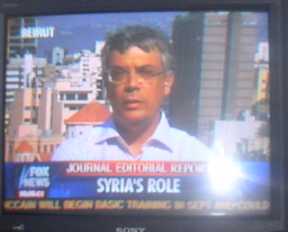
Tonight after work, some errands, book store shopping, and supper at the Church's chicken buffet, I turned on the tube and, not finding any entertainment worth watching I took a look at the cable news stations. Imagine my surprise when I saw Michael Young, editor of the Daily Star being interviewed against a Beirut skyscape. Nary a bomb crater or demolished building in sight.

According to Deborah Gordon, one of Wichita's leading Israel's bashers, Israel is bombing Lebanon back into the stone age.

Some stone age!


From what I've caught of TV news coverage, it has done a very poor job of putting the bombing in proper perspective. I've seen lots of pictures of bombed buildings, but I've not seen a single map of Beirut showing the areas that have been bombed, nor an aerial survey of the city. Admittedly, I'm not a cable news junkie, so I might have missed it.

But Israeli pharmacist Shimon Zachary Klein, who blogs on the Israel-Palestinian conflict has located a very helpful map. (Hat tip: Jeff Weintraub


Klein writes:
The actual damage is only confined to those areas where the Hisbollah terrorist organization is active: command, military, and logistics locations used for weapons transport....
[The media goal seems to be] to convey the idea that the entire city has been destroyed when 99% is untouched.

only Hizbollah command and weapons centers and weapons transport sites have been attacked. [This is] Less than 1% of the entire city.
I've come across reports in recent days that tend to confirm Klein's analysis.
  • In a radio interview retired Canadian General Lewis MacKenzie said that only a 15 block square area of Beirut had been bombed. Now in my hometown of Winfield, Kansas (population 12,000) that would be an enormous area. In New York city, or Beirut, Lebanon, not so huge. (I'll try to track down the link to the interview.)
  • A NPR report noted that the new conflict had put a halt to the building boom in Beirut. Many buildings and areas had still not been rehabbed from the civil war twenty years ago.
  • A CNN reporter has revealed that he and others are able only to visit and photograph what Hezbollah wants them to.
  • J. Michael Kennedy of the LA Times wrote an article which put things in perspective.
Swaths of the southern suburbs are in ruins after 11 days of Israeli attacks. The main road from the south is bombed out and impassable. The main road to Damascus is knocked out. Hotels have emptied. Electric power comes and goes.

But the main shopping street of Hamra in west Beirut was jammed with cars Saturday morning. Stores were open, at least for a few hours -- even clothing shops that sold no clothes.

"Now is not the time to be buying clothes. Now is the time to buy food," said Fouad Naim, manager of the Antonio Baldan men's store. "But some who have been wearing the same thing for the last 10 days have come to get something new. You can smell them when they come in."

The newly built center of the city, with its fashionable shops and banking center, was eerily empty, save for a smattering of people in what few cafes were open. The tourists who made it one of the busiest parts of the city have long since gone, either by sea or overland to Syria or Jordan.

But on the main highway going north up the coast, more stores and restaurants were open, including fast-food standbys such as Hardee's, KFC, Subway and Burger King.

On Saturday afternoon, the road was jammed with cars as it passed the port and headed north, past modern shopping malls and other developments that are a part of the rebuilt Beirut. A turnoff to the right leads to the mountains above. Virtually all of this territory is home to the Christians of Lebanon, who allied themselves with the Israelis during the invasion of the country in 1982.

In Bikfayya, the roads were more crowded than usual, because this is one of the routes to the Syrian border now that the main highway has been knocked out by Israeli jets.

Even with that, the scene was almost pastoral, with a neat town square surrounded by small, well-kept shops. At her fruit and vegetable stand, Lena Bochebel said that the trauma of the city below was a world away.

"Here there is no war, and all people are happy because we all get along," she said. "We're taking care of people. We are all Lebanese people."

She pointed to the street leading off to the right, where the high school was perched on a hill overlooking the valley below. She said the school, the church and the local hotels were filled, many with people who had fled from the south.
Even though, the media may not be doing a stellar job putting the damage into perspective, there is tremendous human suffering in Lebanon and Israel. Please take a look at my previous post on some ways to help. And, then help.

How to help in the Middle East Crisis

Some suggestions for responding to the humanitarian crises in the current Middle East conflict.

URGENT APPEAL FROM LEBANESE TEACHERS' UNIONS

The Education International, representing teachers' unions around the world, has issued an urgent action appeal in support of requests for humanitarian assistance from two Lebanese teachers' unions.

LabourStart is assisting by providing a secure online way to donate in your own currency using your credit or debit card. Please give generously today:

http://www.labourstart.org/docs/en/000351.html

MeretzUSA recommends three projects in Israel

The Israel Center for the Treatment of Psychotrauma at Herzog Hospital is working with residents of northern Israel to help them cope with the current situation of violence and dislocation. The Center’s trauma psychologists are providing trauma counseling to families in shelters throughout the north, as well as workshops for parents and children who have fled northern Israel and have come to Jerusalem. Plans are underway to use the Trauma Center’s website (www.traumaweb.org ) both as a “moderated forum” to help Israelis deal with the psychological impact of the current security situation, and as a “chatroom”, so that people can feel together, even if they are stuck in their separate shelters or safe rooms.

The Brit Olam organization’s “Mobile Summer Camp” is helping children in northern Israel who are confined to bomb shelters this summer due to the current fighting. Many community shelters in the north are run-down, and often the children lack adult supervision. Brit Olam volunteers – including post-traumatic stress experts, educators, storytellers, and professional childcare workers – are going to the shelters, talking and playing with the children, entertaining them and bringing food and toys. In the Arab sector, which lacks community bomb shelters, Brit Olam is working with social service divisions in towns and villages, providing packages of food and toys for distribution to individual homes. Brit Olam (http://www.britolam.org/), in which many Young Meretz people are active, is a social action partnership of Israelis and Jews around the world, working together to reduce poverty, hardship, and vulnerability in fragile communities and to advance equality of opportunity, freedom, and self-expression.

Wingate Institute for Physical Education and Sport: At the request of the Israeli government and the Jewish Agency, Wingate has been housing, feeding and providing summer activities for 200 children from northern Israel – and is seeking to take in 200 more. For general information about Wingate, go to http://www.wingate.org.il/Index.asp?CategoryID=478&ArticleID=661.

Should you wish to contribute to any of these projects, please send us a check made out to Meretz USA, noting in the memo section which of the projects you would like to donate to. They will make sure that the full amount of your contribution goes to the purpose so designated.

Checks should be mailed to:
Meretz USA
114 West 26th St., Suite 1002
New York, NY 10001


Friday, July 28, 2006

Dirty Tricks in Kansas GOP Primary

The race to be the Republican to lose to Kathleen Sebelius in the Kansas governor's race is apparently getting dirty. And the culprit appears to be Ken Canfield, who is running as the "Christian" "prolife" and "family values" candidate (to distinguish himself from Jim Barnett who is the "Christian" "prolife" and "family values" candidate who is a doctor and promises to be a part-time Governor).

It seems that a Canfield-aligned group has sent a mailing attacking the Barnett, former GOP Speaker Robin Jennison and incumbent Governor Kathleen Sebelius with some very questionable charges.

The most offensive statment says that Republican primary voters should reject Barnett because he has a gay son.

The blog Kansas Governor's Race 2006 had the story, complete with scans from the mailing. But it was hacked by an apparent Canfield supporter.

The KGR folks have resumed control of the blog and are reconstructing it.

Friday, July 21, 2006

I am profiled

Norm Geras, a British-based academic of the democratic left, has one of the most viewed and most controversial blogs around. Normblog not only has perceptive political commentary, but some great cultural stuff, like polls (e.g. Bob Dylans best-loved songs and the "Momma and Daddy Collection" of country lyrics). Another regular feature is a Friday blogger profile. I have the great honor of being featured this week.

It's a lot of fun to read the profiles especially of bloggers you read. But, for me at least, it was a real challenge to do the profile. Norm sends a list of about fifty entertaining and provactive questions form which he asks you to answer about thirty. Even the questions I decided not to answer caused me to do lots of thinking. In the end, it was a little easier to decide on my favorite movie than on the philosophical proposition I thought it most important to promote or combat.

Norm also does the extra work of adding some relevant links. (Apparently, Norm thinks that George Brett, is not a household word among the cricket-watching fans of his blog.)


Here's my profile.

Stuart Elliott was born in Winfield, Kansas. He moved to New York and worked with Bayard Rustin. Later he moved a little to the 'left'. He works at a US Postal Service facility and is active in his union (American Postal Workers Union). Stuart is webmaster for the Wichita/Hutchinson Labor Federation and a correspondent for LabourStart. He blogs at New Appeal to Reason, which is named after the great American radical newspaper published in Girard, Kansas in the early 20th century.


Why do you blog? > To change the world and express myself.

What has been your best blogging experience? > Being asked to do a normblog profile

What has been your worst blogging experience? > Actually writing my normblog profile.

What would be your main blogging advice to a novice blogger? > Jump in, write on a regular schedule, but don't feel you have to write daily unless your schedule permits. Make a commitment to write at least ten posts before deciding to do it or not.

What are your favourite blogs? > My favourite labour blogs are the AFL-CIO Now blog, Confined Space and Nathan Newman. I would find it nearly impossible to select only three favourite political blogs.

Who are your intellectual heroes? > Irving Howe and Michael Harrington.

What are you reading at the moment? > Boris Souvarine, Stalin: A Critical Survey of Bolshevism, and Alexander Keyssar, The Right to Vote: The Contested History of Democracy in the United States.

Who are your cultural heroes? > Charlie Parker, Bob Wills, Charles Mingus, Thelonious Monk.

What is the best novel you've ever read? > Mark Twain, The Adventures of Huckleberry Finn - and not just because I was assigned it three times between 7th and 10th grades. When confronted with a choice between a developing friendship with a runaway slave and fealty to society's racism, Huck makes a fateful decision: 'I was a-trembling, because I'd got to decide, forever, betwixt two things, and I knowed it. I studied a minute, sort of holding my breath, and then says to myself, "All right, then, I'll GO to hell."'

What is your favourite movie? > Chinatown or Fargo.

What is your favourite song? > B.B. King, 'How Blue Can You Get'.

Who is your favourite composer? > Duke Ellington.

Can you name a major moral, political or intellectual issue on which you've ever changed your mind? > Detente and the first neocon foreign policy project of the 1970s and 1980s. In the last year, I've come to a much more positive view of John Brown after reading David Reynolds' biography.

Can you name a work of non-fiction which has had a major and lasting influence on how you think about the world? > Michael Harrington, Toward a Democratic Left, which I read in the 10th or 11th grade. It showed me that there was a way to be radical without being crazy.

Who are your political heroes? > A. Philip Randolph (organizer of the Brotherhood of Sleeping Car Porters, both Marches on Washington, etc), George Orwell, Frank Walsh, Caroline Lowe.

If you could effect one major policy change in the governing of your country, what would it be? > I would make the number of seats in the Senate proportional to population.

What would you do with the UN? > Reform it, not abolish it.

Do you think the world (human civilization) has already passed its best point, or is that yet to come? > Either is possible. Barbarism or global social democracy.

What would be your most important piece of advice about life? > Be wary of anyone who pretends to have all the answers.

Do you think you could ever be married to, or in a long-term relationship with, someone with radically different political views from your own? > No.

What do you consider the most important personal quality? > Empathy.

In what circumstances would you be willing to lie? > Like most people, probably in far more circumstances than I would admit. To save a life and to avoid needlessly hurting feelings are two instances.

Do you have any prejudices you're willing to acknowledge? > Yes, I detest racists, bigots and hypocrites, and disdain postmodernists and cultural relativists.

What is your favourite proverb? > 'Anything worth doing is worth doing half-way.'

Where would you most like to live (other than where you do)? > Kansas City.

What would your ideal holiday be? > A jazz or blues festival.

What do you like doing in your spare time? > Playing my guitar or doing computer graphics.

What is your most treasured possession? > My great grandfather's civil war army discharge papers. He came from Canada to serve in the Union Army, was discharged in Texas, became a citizen, and settled in Kansas. And a coffee table made by my father.

If you had to change your first name, what would you change it to? > Since my parents almost named me 'Rockwell', I've generally been satisfied with my name.

What talent would you most like to have? > Not so much a talent, but an ability - colour vision. I am red-green colour blind.

Who is your favourite comedian or humorist? > Matt Groening.

Who are your sporting heroes? > George Brett.

Which basketball team do you support? > Kansas University Jayhawks.

How, if at all, would you change your life were you suddenly to win or inherit an enormously large sum of money? > I would quit my job and become a political philanthropist.

If you could have any three guests, past or present, to dinner who would they be? > My father, who died when I was five, and my two younger brothers.