If like me you avoid those annoying polls and quizzes on Face book but have never overcome that school-induced infatuation with polls, you might be interested in two on-line quizzes I took today.
I scored great on one and lousy on the other.
The Pew Research Center periodically does a survey that measures what the public knows about events and they give interested folks an opportunity to take the quiz as well as reporting on the results of their scientific poll. I liked this poll--I got 12 of 12 right, better than 98% of the population.
Bill Clinton's foundation has a challenging 10 question quiz to determine what you know about urgent world issues. I only got 3 or 4 right. It's a tough one. Except for the last one, which is all about how great Bill is. Someone should a more cynical version of that question.
Wednesday, October 21, 2009
A tale of two on-line quizes


Monday, January 26, 2009
Hillary's smart move
Hilary Clinton made a deft verbal move during her Secretary of State hearing. Instead of talking about the importance of using "soft power" to achieve US foreign policy goals, she taled about smart power.
If you aren't familiar with soft power check out the link above or keep in mind this short definition
Soft power is the ability to obtain what you want through co-option and attraction rather than the hard power of coercion and payment.
Sunday, February 18, 2007
New Issue of Engage
Issue 4 (February 2007)of Engage's Journal is available on-line. Engage is a British-based group which "challenges contemporary antisemitism. Contemporary antisemitism nearly always appears using the language of anti-Zionism. 'Anti-racist' anti-Zionism is often reckless about creating an ideological foundation for, and licensing, more openly antisemitic discourses and movements."
Engage's Journal is for rigorous, academic and political writing on antisemitism. There is also a very fine blog or Forum for shorter, topical comments.
Making Emotional Sense of the Proposed Boycotts against Israeli Academics and Intellectuals - Catherine B. Silver
The Left and the Holocaust - David Rich
Dealing with Anti-Semitism in Britain - Shalom Lappin
Cure worse than the disease: academic boycott of Israel in the light of the academic boycott of South Africa - Mira Vogel
The Abuse of Holocaust Memory: The Far Right, the Far Left and the Middle East – Michael Ezra
The Australia/Israel Jewish Affairs Council: Good or Bad for Australian Jewry? - Philip Mendes
Globalization & Antisemitism: Muslim Judeophobia in Europe - Avram Hein
Saturday, January 13, 2007
Analyzing the Bush speech
Several valuable analysis I've seen:
- Anthony Cordesman senior fellow at the Center for Strategic and International Studies in Washington in the New York Times. This is an interactive analysis. Scroll through Bush's speech, click on the highlighted sections, and read Cordesman's comments.
- Martin Thomas of the UK's left-wing Alliance for Worker's Liberty "Bush Blunders Towards More Bloodshed in Iraq"
George W Bush's "new policy" in Iraq is a recipe for more bloodshed on the lines of the assault on Fallujah in November 2004 - but also, so it seems more and more, a botched compromise which makes no sense from any angle at all.
Bush's basic line - a "surge" of 20,000 more US troops into Iraq, raising the numbers there to the highest level since 2003 - comes from right-wing wonks Jack Keane and Fred Kagan, the sort of people who believe that the USA could have won the Vietnam war with "one more push".
But Keane and Kagan have written: "Bringing security to Baghdad - the essential precondition for political compromise, national reconciliation and economic development - is possible only with a surge of at least 30,000 combat troops lasting 18 months or so. Any other option is likely to fail..." - in fact, in their view, to make things worse. (Washington Post, 27 December 2006).
What Keane and Kagan see as needing at least 30,000 more combat troops - a nearly 50% increase on the 70,000 combat troops (140,000 total) currently in Iraq - is much more limited than Bush's stated objectives with his smaller "surge".
...using US withdrawal as a threat to make Maliki shape up is stupid, and not only because Bush obviously has no intention of carrying out the threat. The collapse of the Maliki government would trouble the government ministers much less than it would trouble the USA. The government ministers would mostly flee back to London, or some other city of exile, or retreat to an area of Iraq securely under their (Shia or Kurdish) control. The USA would be left with one of the world's most pivotal regions, the oil-rich Gulf, convulsed in all-out war and chaos.
And the workers and the peoples of Iraq? They lose out either way. Their only hope is the emergence of a secular and democratic pole within Iraqi politics, led by the labour movement, which can fight both the US/UK and the sectarian militias. Our duty is solidarity with the much-harassed Iraqi labour movement trying to do that.
- Paul Starr, "The Power Party vs. the Peace Party"
Far from making the United States stronger, Bush’s policies have dissipated American power. In his speech, the president suggested that if the United States failed in Iraq, Iran would be emboldened. But Iran has obviously already been emboldened because its leaders believe that an America mired in Iraq can make only empty threats.
To use power ineffectually is to destroy it.
- Paul Rogers (Professor of Peace Studies at Bradford University and is openDemocracy’s International Security Editor)
the continuing presence of 140,000 US troops (and now, after Bush's speech of 10 January, quite probably 20,000-30,000 more) for years to come is an unbelievable "gift" to the al-Qaida movement, presenting the far enemy to them on what is, to a large extent, home territory (see Mohammad-Mahmoud Ould Mohamedou, "The dividends of asymmetry: al-Qaida's evolving strategy", 18 December 2006).
Iraq is already providing a first-rate jihadi combat training-zone and, from an al-Qaida perspective, this is without any risk of changing. They (and many western analysts) simply do not believe that the United States can win in Iraq. Therefore, the longer it loses the better. In light of the fact that al-Qaida deals in decades, it has the prospect of decades of training for jihadi cohorts.
- John Robb of the Glogal Guerillas blog
The latest US "strategy" for Iraq, a small increase in manpower focused on controlling sections of Baghdad, has generated substantial debate/commentary in the US. The reason for this has vastly more to do with domestic political issues than anything substantive in the military sphere. To wit, almost nothing in the current plan -- from troops to tactics -- has changed in any meaningful way. Further, the general situation of country-wide chaos will not change due to any efforts to pacify select Baghdad neighborhoods ...The Power and Interest News Report
Of course, the failure of these periodic efforts may be due to an inability to revisit a key assumption upon which the present US effort is based: that strong states tend to form naturally if provided the right minimalist conditions. I believe the opposite is true: that states, once broken, tend to remain hollow and in perpetual failure. The reason is that in the current environment minimalist conditions yield social disintegration.
With U.S. President George W. Bush's new Iraq strategy unveiled, it is clear that the administration is running out of options. The "surge" policy that will now be implemented is an attempt to somewhat stabilize the situation in Baghdad. This is the most that the new policy can hope for -- temporary stabilization -- because a surge in troops does little to address the issues that are fomenting the insurgency. Once the surplus soldiers are called back, or once the insurgents adapt to the increased numbers, attacks will escalate again and Washington will be in the same position that it is in now.
Monday, September 11, 2006
Wha'ts Wrong with 9/11 conspiracy theories
There's lots in every media about the fifth anniversary of 9/11 not only today, but in the last week or so. What has caught my attention are a number of fine articles and resources debunking 9/11 conspiracy theories. Some of these go into detail refuting the extraordinary claims of the so-called 9/11 truth movement, and if you need that sort of thing check them out. I'm going to cite some of the interesting things said about the political and psychological function of the conspiracy theories.
Phil Molé "9/11 Conspiracy Theories: The 9/11 Truth Movement in Perspective" e-skeptic
Another reason for the appeal of 9/11 conspiracies is that they are easy to understand. As previously mentioned, most Americans did not know or care to know much about the Middle East until the events of 9/11 forced them to take notice. (The brilliant satirical newspaper The Onion poked fun at this fact with its article “Area Man Acts Like He’s Been Interested In Afghanistan All Along”).41 The great advantage of the 9/11 Truth Movement’s theories is that they don’t require you to know anything about the Middle East, or for that matter, to know anything significant about world history or politics. This points to another benefit of conspiracy theories — they are oddly comforting. Chaotic, threatening events are difficult to comprehend, and the steps we might take to protect ourselves are unclear. With conspiracy theory that focuses on a single human cause, the terrible randomness of life assumes an understandable order.Debunking the 9/11 Movement Infoshop (anarchists)
The 9/11 movement also discredits activists and associates us with conspiracy whackjobs and religious nuts. Our views are not well-represented in mainstream discourse, so we cannot afford to associate with people who have a flimsy grasp on reality.Scott McLemee, "All Plots Move Deathward" Inside Higher Education
The conspiratorial mentality or “paranoid style” — for which important events in public life are best understood as the product of hidden, malevolent forces controlling history — is strongly prone to assuming a scholarly form. As Hofstadter puts it: “One should not be misled by the fantastic conclusions that are so characteristic of this political style into imagining that it is not, so to speak, argued out along factual lines. The very fantastic character of its conclusions leads to heroic strivings for ‘evidence’ to prove that the unbelievable is the only thing that can be believed.”John Prados "9/11 Conspiracies and Cons" TomPaine.com
The charge that conspiratorial thinking is incoherent simply will not hold up. “It is nothing if not coherent,” writes [Richard] Hofstadter. The conspiratorial understanding of history is actually “far more coherent than the real world, since it leaves no room for mistakes, failures, or ambiguities. It is, if not wholly rational, at least intensely rationalistic....”
The theories largely postulate that the Bush White House either made 9/11 happen, or this president knew all about what impended and let 9/11 happen. Neither is likely in my view.
There is no doubt that the events of 9/11 flowed from an immense chain of actions in many places by a host of actors. Orchestrating all this activity implies a level of skill that just does not track with the Bush administration’s demonstrated incompetence in Iraq, Afghanistan, Israeli-Palestinian matters, or on selling democracy in the Middle East, detention and torture, domestic wiretapping, actually finding Osama bin Laden and on so much else. What the Bushies were good at was at capitalizing on the 9/11 tragedy to push their domestic and foreign policy agendas.
At the same time, it is not necessary for there to have been a Bush 9/11 plot to explain the extreme deceitfulness of the administration afterwards. Obviously there was a ton of blame to avoid and a political vulnerability that President Bush wants to evade at all costs.
Websites Critical of 9/11
9/11 Myths
Debunking 9/11 Conspiracy theories
Journal of Debunking 911 Conspiracy Theories
Loose Change Second Edition Viewer Guide
Popular Mechanics: 9/11: Debunking The Myths
Snopes debunks the claim that a missile, not AA77, hit the Pentagon
That's Just Stupid
The Truth about the “9/11 Truth Movement” [PDF]
Wednesday, September 06, 2006
Dave Osler on Cuba
Dave Osler is a British leftist who is spending the summer in a language and education program in Cuba. Dave's to my left on a number of questions, but he often has interesting and provocative things to say. I wondered what he was going to write on Cuba and here's the answer.
If you stay in one of the five star hotels, Cuban is a fabulous place for a holiday. Sit down by that swimming pool and bask in the Caribbean sunshine as you light up a cigar from beyond the wilder shores of Freudian symbolism and knock back cocktails blended from the finest rum in the world. And if itÂ’s nightlife you want, thereÂ’s hot jazz and salsa clubs that stay open until four AM.Read the rest here.
But for most ordinary Cubans, life is pretty damn tough. I saw that for myself this summer, when I spent four weeks in an ordinary home in Havana. Even such basic foodstuffs as rice are rationed. Water supplies are sporadic, and power cuts regular occurrences. The housing stock is badly run down. Many everyday items are simply unobtainable.
Yes, of course the US blockade and the economic effects of the collapse of the USSR are part - although by no means all - of the explanation. But there is no getting away from the conclusion that Cuban society is deeply polarised as a consequence.
Beyond a layer of older people who lived through the revolution in the late fifties, there are few strong supporters of the government. The younger a person is - and the darker the colour of their skin - the more likely they are to be hostile.
Especially pay attention to his conclusion
For the democratic left, then, the conclusions are clear. We should start from the position of opposing the US blockade on basic democratic grounds. Ironically from WashingtonÂ’s viewpoint, it could actually be holding back the development of an indigenous Cuban democratic opposition.I would only add that I understand from an NPR broadcast from the time of Fidel's health crisis, that one of the most problematical parts of the blockade legislation is that it requires even a post -Castro Cuba to commit to fully pay all claims for nationalized property before trade can be resumed. This is a particularly onerous and stupid policy.
But at the same time, we need to stress that a democratic opening is essential if Cuba is to avoid the build up of discontent on the scale of 1980s Eastern Europe, and the eventual introduction of a particularly savage brand of neoliberal capitalism.
Saturday, August 12, 2006
Aerial Bombing of Beirut
Mark Grimsley has an interesting post on the History News Network bringing to our attention two interactive graphics of Beirut before July 12 and after July 31 which show the extent of the bombing. Be sure to look at the area maps to put the extent of the bombing in perspective.
MSNBC has an interactive graphic showing a satellite photo of a portion of Beirut as it appeared on July 12 and another satellite photo showing the same area on July 31. You can toggle back and forth between the two. Only four targets are captioned -- a highway overpass, Hezbollah offices, the municipal building and Al Manar television -- but if you examine the photos in their entirety, it's plain that a substantial number of other buildings were also targeted or at least struck. The graphic is a litmus test of sorts for one's appraisal of the IAF strikes. Do you see evidence of a discriminate, proportional air campaign; or something more extensive?
UPDATE, August 12, 2:02 PM - The New York Times ran a similar graphic last week. It labels the bombed zone, "Main area of Hezbollah offices (before attacks, this area was fenced off and surrounded by guards)," which to my mind removes the litmus test. So to that extent, never mind. But both graphics are worth a look. Interestingly, the NYT's "before" image is in color, the "after" image in black and white.
Saturday, July 29, 2006
How much damage in Beirut?
A letter to the Wichita Eagle earlier this week complained that there had been previous letters backing Israel and said that all that was needed was to see the pictures of Lebanon on television.
I know the writer. He's a decent guy, which might be too much to say of some other letter writers.
Tonight after work, some errands, book store shopping, and supper at the Church's chicken buffet, I turned on the tube and, not finding any entertainment worth watching I took a look at the cable news stations. Imagine my surprise when I saw Michael Young, editor of the Daily Star being interviewed against a Beirut skyscape. Nary a bomb crater or demolished building in sight.
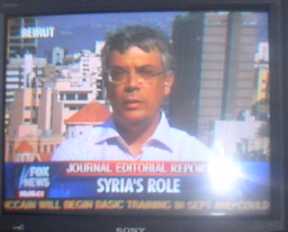 According to Deborah Gordon, one of Wichita's leading Israel's bashers, Israel is bombing Lebanon back into the stone age.
Some stone age!
From what I've caught of TV news coverage, it has done a very poor job of putting the bombing in proper perspective. I've seen lots of pictures of bombed buildings, but I've not seen a single map of Beirut showing the areas that have been bombed, nor an aerial survey of the city. Admittedly, I'm not a cable news junkie, so I might have missed it.
But Israeli pharmacist Shimon Zachary Klein, who blogs on the Israel-Palestinian conflict has located a very helpful map. (Hat tip: Jeff Weintraub
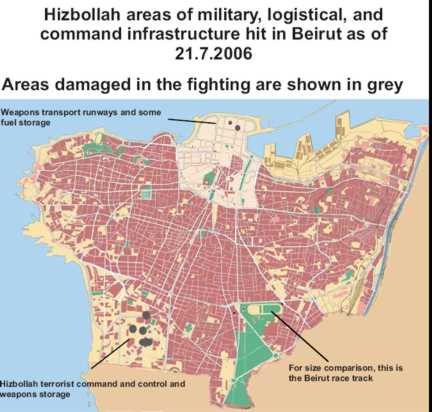
Klein writes:
The actual damage is only confined to those areas where the Hisbollah terrorist organization is active: command, military, and logistics locations used for weapons transport....I've come across reports in recent days that tend to confirm Klein's analysis.
[The media goal seems to be] to convey the idea that the entire city has been destroyed when 99% is untouched.
only Hizbollah command and weapons centers and weapons transport sites have been attacked. [This is] Less than 1% of the entire city.
- In a radio interview retired Canadian General Lewis MacKenzie said that only a 15 block square area of Beirut had been bombed. Now in my hometown of Winfield, Kansas (population 12,000) that would be an enormous area. In New York city, or Beirut, Lebanon, not so huge. (I'll try to track down the link to the interview.)
- A NPR report noted that the new conflict had put a halt to the building boom in Beirut. Many buildings and areas had still not been rehabbed from the civil war twenty years ago.
- A CNN reporter has revealed that he and others are able only to visit and photograph what Hezbollah wants them to.
- J. Michael Kennedy of the LA Times wrote an article which put things in perspective.
Swaths of the southern suburbs are in ruins after 11 days of Israeli attacks. The main road from the south is bombed out and impassable. The main road to Damascus is knocked out. Hotels have emptied. Electric power comes and goes.Even though, the media may not be doing a stellar job putting the damage into perspective, there is tremendous human suffering in Lebanon and Israel. Please take a look at my previous post on some ways to help. And, then help.
But the main shopping street of Hamra in west Beirut was jammed with cars Saturday morning. Stores were open, at least for a few hours -- even clothing shops that sold no clothes.
"Now is not the time to be buying clothes. Now is the time to buy food," said Fouad Naim, manager of the Antonio Baldan men's store. "But some who have been wearing the same thing for the last 10 days have come to get something new. You can smell them when they come in."
The newly built center of the city, with its fashionable shops and banking center, was eerily empty, save for a smattering of people in what few cafes were open. The tourists who made it one of the busiest parts of the city have long since gone, either by sea or overland to Syria or Jordan.
But on the main highway going north up the coast, more stores and restaurants were open, including fast-food standbys such as Hardee's, KFC, Subway and Burger King.
On Saturday afternoon, the road was jammed with cars as it passed the port and headed north, past modern shopping malls and other developments that are a part of the rebuilt Beirut. A turnoff to the right leads to the mountains above. Virtually all of this territory is home to the Christians of Lebanon, who allied themselves with the Israelis during the invasion of the country in 1982.
In Bikfayya, the roads were more crowded than usual, because this is one of the routes to the Syrian border now that the main highway has been knocked out by Israeli jets.
Even with that, the scene was almost pastoral, with a neat town square surrounded by small, well-kept shops. At her fruit and vegetable stand, Lena Bochebel said that the trauma of the city below was a world away.
"Here there is no war, and all people are happy because we all get along," she said. "We're taking care of people. We are all Lebanese people."
She pointed to the street leading off to the right, where the high school was perched on a hill overlooking the valley below. She said the school, the church and the local hotels were filled, many with people who had fled from the south.

