Wednesday, September 06, 2006

Dave Osler on Cuba

Dave Osler is a British leftist who is spending the summer in a language and education program in Cuba. Dave's to my left on a number of questions, but he often has interesting and provocative things to say. I wondered what he was going to write on Cuba and here's the answer.

If you stay in one of the five star hotels, Cuban is a fabulous place for a holiday. Sit down by that swimming pool and bask in the Caribbean sunshine as you light up a cigar from beyond the wilder shores of Freudian symbolism and knock back cocktails blended from the finest rum in the world. And if itÂ’s nightlife you want, thereÂ’s hot jazz and salsa clubs that stay open until four AM.

But for most ordinary Cubans, life is pretty damn tough. I saw that for myself this summer, when I spent four weeks in an ordinary home in Havana. Even such basic foodstuffs as rice are rationed. Water supplies are sporadic, and power cuts regular occurrences. The housing stock is badly run down. Many everyday items are simply unobtainable.

Yes, of course the US blockade and the economic effects of the collapse of the USSR are part - although by no means all - of the explanation. But there is no getting away from the conclusion that Cuban society is deeply polarised as a consequence.

Beyond a layer of older people who lived through the revolution in the late fifties, there are few strong supporters of the government. The younger a person is - and the darker the colour of their skin - the more likely they are to be hostile.
Read the rest here.

Especially pay attention to his conclusion
For the democratic left, then, the conclusions are clear. We should start from the position of opposing the US blockade on basic democratic grounds. Ironically from WashingtonÂ’s viewpoint, it could actually be holding back the development of an indigenous Cuban democratic opposition.

But at the same time, we need to stress that a democratic opening is essential if Cuba is to avoid the build up of discontent on the scale of 1980s Eastern Europe, and the eventual introduction of a particularly savage brand of neoliberal capitalism.
I would only add that I understand from an NPR broadcast from the time of Fidel's health crisis, that one of the most problematical parts of the blockade legislation is that it requires even a post -Castro Cuba to commit to fully pay all claims for nationalized property before trade can be resumed. This is a particularly onerous and stupid policy.

Monday, September 04, 2006

Labor Day

David Sirota

Bashing organized labor is a Republican pathology, to the point where unions are referenced with terms reserved for military targets. In his 1996 article, headlined "GOP Readies for War With Big Labor," conservative columnist Robert Novak cheered the creation of a "GOP committee task force on the labor movement" that would pursue a "major assault" on unions. As one Republican lawmaker told Novak, GOP leaders champion an "anti-union attitude that appeals to the mentality of hillbillies at revival meetings."

The hostility, while disgusting, is unsurprising. Unions wield power for workers, meaning they present an obstacle to Republican corporate donors, who want to put profit-making over other societal priorities.

Labor Day Executive Excess Report from United for a Fair Economy.

Jewish Labor Committee on Jewish values, the immigrant experience, and social justice in a consumer culture.

Workplace Fairness has a new report on The Good, the Bad, and Walmart

five developments that give us hope that working people will be able to reclaim some of the rights, status, and dignity they enjoyed in previous generations, and also be able to lead the way in solving some of our nation's most pressing workplace challenges. Of course, we can't forget the heartbreak of Hurricane Katrina and the Sago Mine Disaster, or ignore the increasing inequality between the haves and have-nots. And then there's Wal-Mart, in its own category, and it's not pretty.

Some of the good news included:
  • Immigrant rights were brought to the forefront of the American social consciousness in the past year, as the country witnessed the mobilization of immigrant groups in a dramatic and unprecedented show of solidarity.
  • When Congress refused to act, a growing number of states—with prodding from labor unions and community groups—took the initiative to raise their minimum wages.
  • Courts dealt with the white collar criminals and their corporate fraud that made headlines earlier in the decade, ushering in an era of greater accountability for corporate executives.
Less positive developments included.
  • While airlines and automobiles have long been considered the industries in which labor was strongest, these industries are now where labor seems most embattled, largely because of the companies' staggering financial losses.
  • As technology progresses, it becomes easier and easier for employers to pry into their employees' personal lives, making employees' concerns about privacy even more important.

Wal-Mart made headlines this past year at an unprecedented rate, but all too often, those headlines revolved around Wal-Mart's infamous employment practices.
There's lots of interesting stuff on the AFL-CIO blog including
Nathan Newman "The Brilliance of Labor" highlights innovative organizing and political strategies being used by American unions.

Bill Onasch, webmaster for the KC Labor website, has essays by Ed Bruno, Peter Rachleff
and Chris Townsend. During the coming week, Bill will be posting his comments daily on the critical issues facing the labor movement. Check them out here.

Joshua Rosenau, KU grad student in ecology and blogger at the always informative and entertaining Thoughts from Kansas, writes about his grandfather who rose to become secretary-treasurer of New York Typographical Union, Local 6 and his confrontation with Congressman Dick Nixon over Taft-Hartley.

James Green in the Boston Globe on "The Rise of the Immigrants" concludes that "immigrant worker centers have become a foundation for an emerging immigrant workers' rights movement, and they could be a building block for a new, multifaceted American labor movement.Such voluntary worker associations were, in fact, the forerunners of the first unions that formed a century ago, long before employees won the right to organize, strike, and bargain collectively. The Workmen's Circle, for example...."

J-spot, the blog of the Jewish Fund for Justice, jumps off from Green's column and suggests that "If Jews want to help today’s immigrants recreate our success, perhaps we should be investing in the modern day equivalent of the Workmen’s Circle."

Latest Rasmussen poll on Kansas Gov race

Rasmussen released its latest poll on the Kansas governor's race on Friday. It doesn't show much change.

Now that Republican State Senator Jim Barnett has won the August 1 primary, Governor Kathleen Sebelius leads her challenger 48% to 37%, a drop from seventeen percentage points to eleven.

The Governor's support has yet to rise much above 50% in any case. But the decline reflects the closer competition we often see in a final campaign stretch and have been seeing in races around the country.

Sebelius's current lead is comparable to what we saw in April, when her support was at 49%. A Democrat in a Republican-leaning state, the incumbent continues to enjoy high favorables and job ratings, with 35% viewing her "very favorably," only 11% "very unfavorably." Thirty-two percent (32%) "strongly approve" of her performance as Governor.

Barnett is viewed very favorably by only 19%, and although fewer (9%) see him very unfavorably than see the Governor that way, he's still an unknown to 18%. By contrast, only 3% are "not sure" what to think of the Governor (and only 1% abstain from assessing her performance).

Friday, September 01, 2006

Three Polls Find Workers Sensing Deep Pessimism

Steve Greenhouse, New York Times August 31, 2006

Three new opinion polls released yesterday found deep pessimism among American workers, with most saying that wages were not keeping pace with inflation and that workers were worse off in many ways than a generation ago.

The Pew Research Center found in a survey of 2,003 adults completed last month that an overwhelming majority said workers had less job security and faced more on-the-job stress than 20 or 30 years ago.

The nonpartisan Pew center, said, “The public thinks that workers were better off a generation ago than they are now on every key dimension of worker life —be it wages, benefits, retirement plans, on-the-job stress, the loyalty they are shown by employers or the need to regularly upgrade work skills.”

In a poll of 803 registered voters commissioned by the A.F.L.-C.I.O. , Peter D.Hart Research found that 55 percent said their incomes were not keeping up withinflation, 33 percent said their incomes were keeping even and 9 percent said their incomes were outpacing inflation.

“The split is not helping American workers,” he said. “But we are working very closely with many of the disaffiliated unions.”


A poll of 800 nonsupervisory workers released yesterday by Lake Research Partners found that 51 percent said the next generation would be worse off economically, 27 percent said the next generation would fare about the same and 18 percent said it would be better off.

The poll, for Change to Win, the coalition of unions that left the A.F.L.-C.I.O., found that 63 percent of respondents said the economy was on the wrong track and 28 percent said it was going in the right direction.

“These results tell us that five years into an economic recovery workingfamilies are feeling battered and are losing hope for the future,” said Anna Burger, chairwoman of Change to Win.


The Pew survey found that 69 percent said there was more on-the-job stress than a decade ago, 62 percent said there was less job security and 59 percent said Americans had to worker harder to earn decent livings. Thirteen percent said they did not have to work as hard, and 26 percent said they work about the same.

One factor increasing anxiety is the corporate trend to send job overseas. The Pew poll found that 31 percent of respondents said it would be possible for their employer to hire someone outside the country for their job. Seventy-seven percent said outsourcing jobs to other countries hurt American workers, while 13 percent said it helped.

Sunday, August 27, 2006

PBS Documentary Looks at Working Poor

With Labor Day rapidly approaching, a POV documentary "Waging a Living" is very timely. It will be shown of PBS stations (including KPTS Channel 8 in Wichita) this Tuesday August 29 at 9 PM Central time, 10 pm Eastern, etc. Here are the first several paragraphs on the show from the PBS website.

If you work hard, you get ahead. That's the American Dream in a nutshell — no matter what your race, color, creed or economic starting point, hard work will improve your life and increase your children's opportunities. Yet, this widely held dream is out of reach for an increasing number of working Americans.

Roger Weisberg's alarming and heart-wrenching new documentary, "Waging a Living," puts a human face on the growing economic squeeze that is forcing millions of workers into the ranks of the poor. Shot in the Northeast and California, the film profiles four very different Americans who work full-time but still can't make ends meet. Despite their hard work and determination, these four find themselves, as one of them observes, "hustling backwards."

One in four American workers — more than 30 million people — are stuck in jobs that pay less than the federal poverty level for a family of four. (i) Housing costs, to name just one of several essential living expenses, have tripled since 1979, while real wages for male low-wage workers are actually less than they were 30 years ago. But the new face of the working poor is overwhelmingly that of a woman struggling to support her children. Only 37 percent of single mothers receive child support, and that support averages just $1,331 per year. Nearly a quarter of the country's children now live below the poverty line.

What do these numbers mean in human terms? What is it really like to work full-time and remain poor? "Waging a Living" provides a sobering answer. Filmed over three years, the documentary offers intimate profiles of four working Americans — Jean Reynolds, Jerry Longoria, Barbara Brooks, and Mary Venittelli — as they struggle to lift their families out of poverty.

Sunday, August 20, 2006

Jerry Hahn Brotherhood in the New York Times

A real blast from the past. I would have missed this if I hadn't been in Philadelphia for the American Postal Workers Union convention. I picked up the New York Times on Saturday and there was a nice, long column on the Jerry Hahn Brotherhood.

Verlyn Klinkenborg writes:

The other day a song popped into my head, just a few up-tempo instrumental phrases — guitar, bass, drums and a Hammond B3 organ. I knew instantly what it was, though I hadn’t heard it in at least 20 years. It was a passing moment from “Martha’s Madman,” the first song on the first side of an LP called “The Jerry Hahn Brotherhood.” I bought the record when it was released in 1970. I was a freshman at Berkeley.

It would have been easy to see the Jerry Hahn Brotherhood performing that year, though I never did. Its lone record was a sunny mixture of straight-up jazz with a blues spine, a music that wants the latter-day word “fusion,” though that word does so little good. Above all, it was a reminder of the eclecticism of the time. Audiences that would soon diverge found themselves packed in a hall together all night long, like one October weekend at Fillmore West when the Jerry Hahn Brotherhood shared the bill with Van Morrison and Captain Beefheart and His Magic Band.

There will probably never be a movie based on the Jerry Hahn Brotherhood, no commercial incentive to remaster and rerelease this album. The story of the band is a good one but all too familiar — the inevitable clash between the artistic and business sides of the recording industry. The band fell apart disputing the honesty of its manager.

What’s left is an orphaned vinyl LP. The inner sleeve, a space for record company promotion, says, “If It’s in Recorded Form, You Know It’ll Be Available on Records.” Well, I wish it were available on CD.

I talked to Jerry Hahn the other day. He teaches jazz guitar in Wichita, his hometown. He’ll be 66 in September, with grandkids. He sounds good. “You should have heard us,” he said

Indeed! I heard the JHB live several times circa 1970. The album is very good, but live they were something else.

Klinkenborg concludes with this plea

...someone needs to find those master tapes, breathe some air into them, and do this minor masterpiece (and all the outtakes) justice at last
It would be also be nice if someone rescued the slightly earlier LP by Mike Finnegan and the Serfs. Finnegan was the Hammand B-3 player and vocalist for the JHB. Finnegan and a couple of his mates from the band are heard on the jam songs on Jimi Hendrix's Electric Ladyland.

Thursday, August 17, 2006

At the APWU convention

I'm in Philadelphia this week for the national convention of the American Postal Workers Union.
Consequently, posting may be a little light this week. This is in distinction to those weeks when posting is a little light and I'm not in Philadelphia or some other place doing something union or political.

Manager--convicted of homicide-- sentenced to teach safety class

Via the AFL-CIO NOW blog

Jordan at Confined Space has the story: Brent H. Weidman, former head of the Far West Water and Sewer Co., was convicted of two counts of negligent homicide in the 2001 deaths of two workers who were suffocated by toxic sewage gases while working on an underground sewer tank in Mesa Del Sol, Ariz. In addition to probation and a $250-a-month fine, poor Weidman got sentenced to 840 hours of teaching safety classes for the Arizona Occupational Safety and Health Administration in Yuma.

Saturday, August 12, 2006

Aerial Bombing of Beirut

Mark Grimsley has an interesting post on the History News Network bringing to our attention two interactive graphics of Beirut before July 12 and after July 31 which show the extent of the bombing. Be sure to look at the area maps to put the extent of the bombing in perspective.


MSNBC has an interactive graphic showing a satellite photo of a portion of Beirut as it appeared on July 12 and another satellite photo showing the same area on July 31. You can toggle back and forth between the two. Only four targets are captioned -- a highway overpass, Hezbollah offices, the municipal building and Al Manar television -- but if you examine the photos in their entirety, it's plain that a substantial number of other buildings were also targeted or at least struck. The graphic is a litmus test of sorts for one's appraisal of the IAF strikes. Do you see evidence of a discriminate, proportional air campaign; or something more extensive?

UPDATE, August 12, 2:02 PM - The New York Times ran a similar graphic last week. It labels the bombed zone, "Main area of Hezbollah offices (before attacks, this area was fenced off and surrounded by guards)," which to my mind removes the litmus test. So to that extent, never mind. But both graphics are worth a look. Interestingly, the NYT's "before" image is in color, the "after" image in black and white.

Wednesday, August 09, 2006

AFL-CIO and Day Laborer Group Announce Partnership

From the AFL-CIO Now Blog

The AFL-CIO and the National Day Laborer Organizing Network (NDLON) have reached a historic partnership agreement that will pave the way for AFL-CIO central labor councils and state federations and NDLON’s day laborer worker centers to work together on issues ranging from workplace rights to immigration reform to health and safety and other job-related concerns.

Two important figures on the American left , Dorothy Healey and John Cort, passed this week. Both were in their 90s. I had the pleasure of knowing both.

Marc Cooper has some words about Dorothy Healey

Legendary Communist and, later, legendary ex-Communist Dorothy Healey died last Sunday at age 91. At barely five feet tall, with piercing blue-gray eyes, a razor sharp-intellect, often a pipe or a panatela in her hand, Dorothy was a power-house orator, a relentless organizer, and fireball of political energy and optimism.

She was also a friend of mine.

The most notorious figure in the Southern California Communist Party, she had already made her mark as an agitator while in her teens. Steinbeck fashioned one of his farm labor organizer charatcters of his In Dubious Battle directly from Dorothy's real-life persona.

I first met her in the mid 1960's as an upcoming radical teenager. I sat transfixed in her South Central L.A. apartment and though she was 35 years older than I, we batted around for hours at a time what the meanings of socialism, communism and revolution were. She was still in the Party back then. Most of my New Left friends and I looked upon the CP'ers as dinosaur Stalinoids. But not Dorothy. Among the surviving Old Guard from the 1930's. she was the only one who showed us yunngin's any real respect. She knew she had something to offer us from her decades of battle, but also knew we had something to offer her.

No one, at least no one I knew, could conduct any ideological debate with half the gravitas and wit that Dorothy could conjure. She knew her stuff and was always ready to patiently prove it. She never recruited me or any of my close friends into the Party. We were way too rebellious and way too enamored of freedom to get sucked into that stuff. But we, nevertheless. considered Dorothy to be our Den Mother -- we were all proud to be known around L.A. as one of "Dorothy's Kids."

She was already having her doubts about the Party when the Soviets crushed the Czech students and intellectuals in the Summer of 1968. She started backing out of her life-long commitment to it and within a few years was totally out. Her principles led her then to directly challenge the Stalinist and authoritarian structures of the CP and of what was then called "actually existing socialism." Instead, Dorothy committed the rest of her life to working for a humane, just and democratic socialism which placed the notion of individual liberty above the interests of a Goliath state.

The Boston Globe had an obituary for religious socialist John Cort

Standing before a group of eager workers in Boston, John Cort hoped to send a powerful message that would rally the first state-sponsored service corps in the nation. It was the summer of 1965, and he had just been appointed the organization's executive director, so he wanted to find the words that would adequately convey his wishes for the new state program.

``The poor, the defeated, and the discouraged in the state are counting on you," he excitedly told the first batch of recruits. ``You are in a war against powers of darkness, against prejudice, disease, discouragement and despair. These are deadly enemies."

Over the years, Mr. Cort became a central figure in a variety of social movements, and his work to combat poverty, in particular, made him well known among academics, politicians, and community organizers.

He was also a familiar face in Boston media circles as a former business agent for the Newspaper Guild of Greater Boston, and an editor of a number of publications, including Commonweal, a Catholic journal.

He retired in the mid-1970s and turned his attentions to a book project, meticulously researching what would become ``Christian Socialism: An Informal History," published in 1988. In more recent years, he poured the ups and downs of his own journeys into ``Dreadful Conversions: The Making of a Catholic Socialist," published in 2003.

Mr. Cort was amiable in nature, had a fondness for singing sea shanties, and always had a quip at the ready, family and former colleagues said.

``Even though he was a little more formal, kind of a tall, straight, ramrod kind of guy, he was right there with the joking and the joshing," said Fuchs, now a professor emeritus at Brandeis.

``The thing about John is we could disagree so agreeably," Fuchs said. ``It was just wonderful to have somebody with such strong convictions and a good sense of humor at the same time."

``He was deeply religious and deeply committed to his belief that society and government have an obligation to ensure the welfare and well-being of everyone, and that's what he devoted his life to."

Monday, August 07, 2006

Leading Kansas Conservative Pastor Resigns Suddenly

Christina Woods reported in Monday's Wichita Eagle on the surprising and sudden resignation of conservative pastor Terry Fox.

The Rev. Terry Fox, who helped lead the successful push last year for a constitutional amendment to ban same-sex marriage, resigned Sunday as senior pastor of Wichita's Immanuel Baptist Church.
"I see a need for Christians to get involved in issues," Fox said during his resignation speech, which happened toward the end of the 10:30 a.m. service.
Fox, whose resignation took effect immediately, said he and church leaders agreed he should resign after 10 years as senior pastor. Neither Fox nor church officials would say what led Fox to resign.
This was a very sudden decision as reading between the lines of the Eagle story hints.
Deacons of the church met at length Sunday afternoon to discuss, among other issues, a possible interim replacement for Fox, who said he imagines a pastoral search committee will be created.
Maybe I'm reading too much into this but it looks to me very much like a crisis decision. Is Fox's resignation the result of a scandal? The other possibility which occurs to me is that there was an unresolvable clash of wills between Fox and the church lay leadership.

Fox is more than just a Wichita figure. He is a real national power among Southern Baptists. He was part of the trustees of a major Southern Baptist institution, the North American Mission Board which imposed "executive controls" over NAMB President Bob Record earlier this year. He made the nominating speech for one of the candidates for first VP of the SBC.

Alas, Kansas won't be free of Fox.
Fox said he plans to stay in Wichita and continue co-hosting a nationally syndicated radio show with Wright. The show, which airs from 7 to 9 p.m. Sunday evenings on KNSS, is expanding its format.
Earlier this year, when a Paul Mireki was forced to resign as chair of Kansas University's Religion Department after sending emails disparaging fundamentalists, Fox's congregation reportedly cheered on hearing the news. I imagine there are lots of folks in Kansas cheering Fox's departure--and not just atheists, agnostics, and free thinkers.

UPDATE August 9
A follow-up article in today's Eagle has Fox saying that some members were complaining about his travelling for out-of-state political causes. Up to 35 weeks a year according to the Rev. Fox.

Columnist Mark McCormick asks whether there is more to it.
That brings us back to the community's need for an explanation.


To have the details of this separation come out in dribs and drabs certainly won't help the church move beyond the pain of the split. And because Fox is a public figure and influential newsmaker, not talking about what happened will only lead to more speculation. And speculation can be far more damaging than the truth.

Fox appearing so talkative, and the church seeming so reticent, reflects how far apart the two sides have grown.

No matter who is saying what, the rest of us aren't getting the whole story.

Wednesday, August 02, 2006

Victory for science and kids

Half of the Kansas Board of Education is up for election this year. The primary results yesterday gave a strong rejection of the far right creationists who have a 6-4vote majority. Four of the five seats up for election this year are held by conservatives.

  • Moderate incumbent Janet Waugh (D) turned back a stealth challenge from an African-American. She faces no general election challenger.
  • In Western Kansas, Connie Morris (R) was called evolution a "fairy tale" and made many an anti-immigrant pitch was defeated by moderate Sue Cauble. Cauble will face Democrat Tim Cruz in the general election.
  • In the 9th District, moderate GOP Jana Shaver defeated Brad Paltz, the son-in-law the current creationist incumbent.
  • In the 7th District creationist Ken Willard defeated moderate Donna Viola. He'll have a Democratic opponent in November. He'll face former Rep. Jack Wempe in November.
  • In Johnson county, incumbent John Bacon narrowly defeated science teacher Harry McDonald. There was a third candidate in the primary, also pro-science as I undertand. Bacon received a little less than fifty percent. McDonald will be supporting Democrat Don Weiss in the general election.

After the primary, this is net gain of two for the moderates. Both of these gains took place in the more rural districts. There is a good chance for the Democratic candidates to win in both the 7th District (Hutchinson) and the 3rd. If so that would mean a 8-2 science and common sense majority.

Josh Rosenau has a summary

The Board is back in moderate hands no matter what. The night is, on balance, a victory. It'd be nice to further marginalize the extremists by winning the remaining races in November, but we've got a majority that will implement the science standards recommended by the scientists, educators and parents of the science standards committee. The Board can focus on bigger issues. They can dig into ways to address the special challenges of rural districts, and to find solutions to the problems faced by the students in poorer urban districts. Real challenges, not fake controversy. Helping kids, not fighting culture wars.

That's what tonight was about, and the kids won. This wasn't Dover rejecting a few municipal officials. It's a whole state turning against the divisiveness of the IDolators. Congratulations, Kansas!

GOP Minimum Wage Maneuver Slimier Than Eagle Says

Randy Schofield has an interesting comment on the Wichita Eagle WE blog:

House Republican leaders played a cheap political trick over the weekend when they tacked a proposed minimum wage increase, from $5.15 to $7.25, onto a bill of inheritance and other tax breaks for the rich.

The gambit allows moderate Republicans up for election to point out that they voted for a minimum-wage hike — denying Democrats a potent economic issue. Meanwhile, the bill has no chance of passing in the Senate.

An estimated 15 million American workers would benefit from the boost in the minimum wage, which, because of inflation, is at its lowest level of buying power since 1955, according to the Economic Policy Institute.

Meanwhile, in the last decade, lawmakers have approved cost-of-living wage hikes for themselves of about $35,000.

Working Americans aren’t getting a fair shake.
A good comment, and Schofield even provides a link to an Economic Policy Institute report.

What's my complaint then? Dean Baker states it well
[To] raise the minimum wage to $7.15 an hour in 2007, from 5.15 an hour at present, it would be helpful to tell readers that this is equal to approximately $5.32 in 1997 dollars, the year the last minimum wage hike took full effect. This means that minimum wage workers would get about a 3.0 percent increase in real wages from 1997 to 2007, if this bill was approved.

Tuesday, August 01, 2006

Could Sebelius Win GOP Primary?

Rasmussen's poll released just before Tuesday's primaries shows Democratic Gov Sebelius in very good shape. She has a 17 point lead in a hypothetical match-up with GOP front-runner State Senator Jim Barnett. She had an even larger lead over former House Speaker Robin Jennison. Rasmussen didn't ask about Christian conservative Ken Canfield who is also mounting a serious campaign.

Here are the truly amazing results which prompt our title. Sebelius is viewed favorably by 58% of Republicans, far ahead of Barnett who is viewed faborably by 42 percent and Jennison by 38 percent. In the hypothetical November match-up Sebelius garners thirty percent support from Republican voters. So, if Kansas allowed cross-filing, in a four-way race with Barnett, Jennison, and Canfield, Democratic Governor Kathleen might well win the Republican primary.

The Rasmussen poll

In our latest poll of the gubernatorial race here, conducted two weeks before the August 1 primaries, Democratic Governor Kathleen Sebelius maintains a comfortable lead over top candidates for the GOP nomination. The poll shows her with leads of 52% to 31% over former state House Speaker Robin Jennison, 51% to 34% over State Senator Jim Barnett.

..... In addition to attracting 87% support from Democrats in each match-up, the governor also wins more than 30% of Republicans, 50% or more of unaffiliated voters, two thirds of moderates.

Sebelius is viewed favorably by 70% of all voters, including 58% of Republicans. Her job approval numbers are also high—even 49% of conservatives at least "somewhat" approve.

Jennison is viewed favorably by 36%, Barnett by 42%. A third of voters don't know either GOP candidate well enough to offer an opinion.


Monday, July 31, 2006

Why Bomb UN observers?

On the list serve of a leading left-wing economist, the questiion was asked "why bomb UN observers?" Lots of speculation insued very little of it fact-based, and most displaying an anti-Israel animus.

It's actually amazingly simply to find the explanation. The United Nations Interim Force in Lebanon has a website and issues press releases, which can be found here.

I've excerpted some of the reports which appear below. I've added emphasis (bold + italics) to highlight the portions indicating Hizebollah firing from spots near the UN posts or on UN posts.

This is, as Jeff Weintraub, might put it, intended to be a small, modest contribution to lifting the fog of war and the smoke of bias.


July 20

Hezbollah firing was also reported from the immediate vicinity of the UN positions in Naqoura and Maroun Al Ras areas at the time of the incidents.

July 24

One unarmed UN military observer, a member of the Observer Group Lebanon (OGL), was seriously wounded by small arms fire in the patrol basein the Marun Al Ras area yesterday afternoon. According to preliminary reports, the fire originated from the Hezbollah side during an exchange with the IDF.

July 25

This morning, Hezbollah opened small arms fire at a UNIFIL convoy consisting of two armored personnel carriers (APC) on the road between Kunin and Bint Jubayl. There was some damage to the APCs, but no casualties, and the convoy was obliged to return to Kunin.


July 26

Another UN position of the Ghanaian battalion in the area of Marwahin in the western sector was also directly hit by one mortar round from the Hezbollah side last night. The round did not explode, and there were no casualties or material damage. Another 5 incidents of firing close to UN positions from the Israeli side were reported yesterday. It was also reported that Hezbollah fired from the vicinity of four UN positions at Alma ash Shab, Tibnin, Brashit, and At Tiri.

The number of troops in some Ghanaian battalion positions is somewhat reduced because of the increased safety risk for the troops due to frequent incidents of Hezbollah firing from the vicinity of the positions, and shelling and bombardment close to the positions from the Israeli side.

July 27

Hezbollah firing was also reported from the immediate vicinity of the UN positions in Naqoura and Maroun Al Ras areas at the time of the incidents.

July 28

There were two direct impacts on UNIFIL positions from the Israeli side in the past 24 hours. Eight artillery and mortar rounds impacted inside an Indian battalion position in the area of Hula, causing extensive material damage, but no casualties. One artillery round impacted the parameter wall of the UNIFIL Headquarters in Naqoura. There were five other incidents of firing close to UN positions from the Israeli side. It was also reported that Hezbollah fired from the vicinity of five UN positions at Alma Ash Shab, At Tiri, Bayt Yahoun, Brashit, and Tibnin.

July 29

There were two incidents of firing close to UNIFIL positions from the Israeli side in the area of Marwahin and Deir Mimess in the past 24 hours. At the same time, it was reported that Hezbollah fired from the vicinity of six UN positions at Tibnin (2), At Tiri, Beit Yahoun, and Alma Ash Shab (2). UNIFIL strongly protested all these incidents to the Israeli and Lebanese authorities respectively.

July 30

It was reported that Hezbollah fired rockets from the vicinity of three UN positions in the area of Tibnin, At Tiri and Brashit. They also fired small arms fire from the vicinity of two UN positions in the area of Alma Ash Shab and Al Duhayyra. UNIFIL strongly protested all these incidents to the Israeli and Lebanese authorities.

It was reported that Hezbollah fired rockets from the vicinity of this UNIFIL position prior to the aerial bombardment. Hezbollah also fired small arms fire from the vicinity of the same position. They also fired rockets from the vicinity of two UNIFIL positions in the area of Tibnin and At Tiri in the central sector. There was one more incident of firing from the Israeli side close to UNIFIL position in the area of Mays al Jabal, when 10 tank rounds impacted 100 meters from the UN position. UNIFIL strongly protested all these incidents to the Israeli and Lebanese authorities respectively.

July 31

Two tank rounds from the Israeli side impacted directly on a UNIFIL position in the general area of Hula yesterday afternoon, causing extensive material damage, including the ammunition shelter, but no casualties. One aerial bomb impacted in the vicinity of a UN position in the area of Alma Ash Shab yesterday morning, causing damage to the parameter wall. It was reported
that Hezbollah fired rockets from the vicinity of this UNIFIL position prior to the aerial bombardment. Hezbollah also fired small arms fire from the vicinity of the same position. They also fired rockets from the vicinity of two UNIFIL positions in the area of Tibnin and At Tiri in the central sector.

(My computer has been a little balky today, so it possible I have some of the segments under the wrong date. If anyone catches an error, please let me know.)

Saturday, July 29, 2006

How much damage in Beirut?

A letter to the Wichita Eagle earlier this week complained that there had been previous letters backing Israel and said that all that was needed was to see the pictures of Lebanon on television.

I know the writer. He's a decent guy, which might be too much to say of some other letter writers.

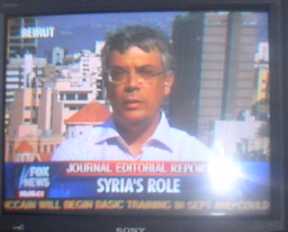
Tonight after work, some errands, book store shopping, and supper at the Church's chicken buffet, I turned on the tube and, not finding any entertainment worth watching I took a look at the cable news stations. Imagine my surprise when I saw Michael Young, editor of the Daily Star being interviewed against a Beirut skyscape. Nary a bomb crater or demolished building in sight.

According to Deborah Gordon, one of Wichita's leading Israel's bashers, Israel is bombing Lebanon back into the stone age.

Some stone age!


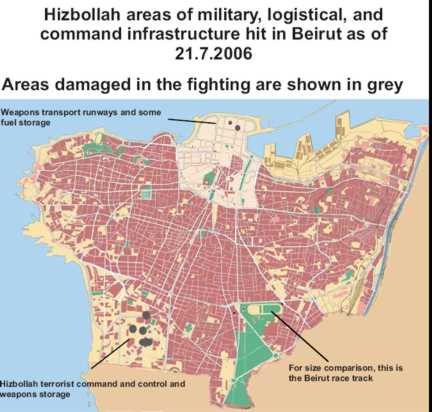
From what I've caught of TV news coverage, it has done a very poor job of putting the bombing in proper perspective. I've seen lots of pictures of bombed buildings, but I've not seen a single map of Beirut showing the areas that have been bombed, nor an aerial survey of the city. Admittedly, I'm not a cable news junkie, so I might have missed it.

But Israeli pharmacist Shimon Zachary Klein, who blogs on the Israel-Palestinian conflict has located a very helpful map. (Hat tip: Jeff Weintraub


Klein writes:
The actual damage is only confined to those areas where the Hisbollah terrorist organization is active: command, military, and logistics locations used for weapons transport....
[The media goal seems to be] to convey the idea that the entire city has been destroyed when 99% is untouched.

only Hizbollah command and weapons centers and weapons transport sites have been attacked. [This is] Less than 1% of the entire city.
I've come across reports in recent days that tend to confirm Klein's analysis.
  • In a radio interview retired Canadian General Lewis MacKenzie said that only a 15 block square area of Beirut had been bombed. Now in my hometown of Winfield, Kansas (population 12,000) that would be an enormous area. In New York city, or Beirut, Lebanon, not so huge. (I'll try to track down the link to the interview.)
  • A NPR report noted that the new conflict had put a halt to the building boom in Beirut. Many buildings and areas had still not been rehabbed from the civil war twenty years ago.
  • A CNN reporter has revealed that he and others are able only to visit and photograph what Hezbollah wants them to.
  • J. Michael Kennedy of the LA Times wrote an article which put things in perspective.
Swaths of the southern suburbs are in ruins after 11 days of Israeli attacks. The main road from the south is bombed out and impassable. The main road to Damascus is knocked out. Hotels have emptied. Electric power comes and goes.

But the main shopping street of Hamra in west Beirut was jammed with cars Saturday morning. Stores were open, at least for a few hours -- even clothing shops that sold no clothes.

"Now is not the time to be buying clothes. Now is the time to buy food," said Fouad Naim, manager of the Antonio Baldan men's store. "But some who have been wearing the same thing for the last 10 days have come to get something new. You can smell them when they come in."

The newly built center of the city, with its fashionable shops and banking center, was eerily empty, save for a smattering of people in what few cafes were open. The tourists who made it one of the busiest parts of the city have long since gone, either by sea or overland to Syria or Jordan.

But on the main highway going north up the coast, more stores and restaurants were open, including fast-food standbys such as Hardee's, KFC, Subway and Burger King.

On Saturday afternoon, the road was jammed with cars as it passed the port and headed north, past modern shopping malls and other developments that are a part of the rebuilt Beirut. A turnoff to the right leads to the mountains above. Virtually all of this territory is home to the Christians of Lebanon, who allied themselves with the Israelis during the invasion of the country in 1982.

In Bikfayya, the roads were more crowded than usual, because this is one of the routes to the Syrian border now that the main highway has been knocked out by Israeli jets.

Even with that, the scene was almost pastoral, with a neat town square surrounded by small, well-kept shops. At her fruit and vegetable stand, Lena Bochebel said that the trauma of the city below was a world away.

"Here there is no war, and all people are happy because we all get along," she said. "We're taking care of people. We are all Lebanese people."

She pointed to the street leading off to the right, where the high school was perched on a hill overlooking the valley below. She said the school, the church and the local hotels were filled, many with people who had fled from the south.
Even though, the media may not be doing a stellar job putting the damage into perspective, there is tremendous human suffering in Lebanon and Israel. Please take a look at my previous post on some ways to help. And, then help.

How to help in the Middle East Crisis

Some suggestions for responding to the humanitarian crises in the current Middle East conflict.

URGENT APPEAL FROM LEBANESE TEACHERS' UNIONS

The Education International, representing teachers' unions around the world, has issued an urgent action appeal in support of requests for humanitarian assistance from two Lebanese teachers' unions.

LabourStart is assisting by providing a secure online way to donate in your own currency using your credit or debit card. Please give generously today:

http://www.labourstart.org/docs/en/000351.html

MeretzUSA recommends three projects in Israel

The Israel Center for the Treatment of Psychotrauma at Herzog Hospital is working with residents of northern Israel to help them cope with the current situation of violence and dislocation. The Center’s trauma psychologists are providing trauma counseling to families in shelters throughout the north, as well as workshops for parents and children who have fled northern Israel and have come to Jerusalem. Plans are underway to use the Trauma Center’s website (www.traumaweb.org ) both as a “moderated forum” to help Israelis deal with the psychological impact of the current security situation, and as a “chatroom”, so that people can feel together, even if they are stuck in their separate shelters or safe rooms.

The Brit Olam organization’s “Mobile Summer Camp” is helping children in northern Israel who are confined to bomb shelters this summer due to the current fighting. Many community shelters in the north are run-down, and often the children lack adult supervision. Brit Olam volunteers – including post-traumatic stress experts, educators, storytellers, and professional childcare workers – are going to the shelters, talking and playing with the children, entertaining them and bringing food and toys. In the Arab sector, which lacks community bomb shelters, Brit Olam is working with social service divisions in towns and villages, providing packages of food and toys for distribution to individual homes. Brit Olam (http://www.britolam.org/), in which many Young Meretz people are active, is a social action partnership of Israelis and Jews around the world, working together to reduce poverty, hardship, and vulnerability in fragile communities and to advance equality of opportunity, freedom, and self-expression.

Wingate Institute for Physical Education and Sport: At the request of the Israeli government and the Jewish Agency, Wingate has been housing, feeding and providing summer activities for 200 children from northern Israel – and is seeking to take in 200 more. For general information about Wingate, go to http://www.wingate.org.il/Index.asp?CategoryID=478&ArticleID=661.

Should you wish to contribute to any of these projects, please send us a check made out to Meretz USA, noting in the memo section which of the projects you would like to donate to. They will make sure that the full amount of your contribution goes to the purpose so designated.

Checks should be mailed to:
Meretz USA
114 West 26th St., Suite 1002
New York, NY 10001


Friday, July 28, 2006

Dirty Tricks in Kansas GOP Primary

The race to be the Republican to lose to Kathleen Sebelius in the Kansas governor's race is apparently getting dirty. And the culprit appears to be Ken Canfield, who is running as the "Christian" "prolife" and "family values" candidate (to distinguish himself from Jim Barnett who is the "Christian" "prolife" and "family values" candidate who is a doctor and promises to be a part-time Governor).

It seems that a Canfield-aligned group has sent a mailing attacking the Barnett, former GOP Speaker Robin Jennison and incumbent Governor Kathleen Sebelius with some very questionable charges.

The most offensive statment says that Republican primary voters should reject Barnett because he has a gay son.

The blog Kansas Governor's Race 2006 had the story, complete with scans from the mailing. But it was hacked by an apparent Canfield supporter.

The KGR folks have resumed control of the blog and are reconstructing it.

Friday, July 21, 2006

I am profiled

Norm Geras, a British-based academic of the democratic left, has one of the most viewed and most controversial blogs around. Normblog not only has perceptive political commentary, but some great cultural stuff, like polls (e.g. Bob Dylans best-loved songs and the "Momma and Daddy Collection" of country lyrics). Another regular feature is a Friday blogger profile. I have the great honor of being featured this week.

It's a lot of fun to read the profiles especially of bloggers you read. But, for me at least, it was a real challenge to do the profile. Norm sends a list of about fifty entertaining and provactive questions form which he asks you to answer about thirty. Even the questions I decided not to answer caused me to do lots of thinking. In the end, it was a little easier to decide on my favorite movie than on the philosophical proposition I thought it most important to promote or combat.

Norm also does the extra work of adding some relevant links. (Apparently, Norm thinks that George Brett, is not a household word among the cricket-watching fans of his blog.)


Here's my profile.

Stuart Elliott was born in Winfield, Kansas. He moved to New York and worked with Bayard Rustin. Later he moved a little to the 'left'. He works at a US Postal Service facility and is active in his union (American Postal Workers Union). Stuart is webmaster for the Wichita/Hutchinson Labor Federation and a correspondent for LabourStart. He blogs at New Appeal to Reason, which is named after the great American radical newspaper published in Girard, Kansas in the early 20th century.


Why do you blog? > To change the world and express myself.

What has been your best blogging experience? > Being asked to do a normblog profile

What has been your worst blogging experience? > Actually writing my normblog profile.

What would be your main blogging advice to a novice blogger? > Jump in, write on a regular schedule, but don't feel you have to write daily unless your schedule permits. Make a commitment to write at least ten posts before deciding to do it or not.

What are your favourite blogs? > My favourite labour blogs are the AFL-CIO Now blog, Confined Space and Nathan Newman. I would find it nearly impossible to select only three favourite political blogs.

Who are your intellectual heroes? > Irving Howe and Michael Harrington.

What are you reading at the moment? > Boris Souvarine, Stalin: A Critical Survey of Bolshevism, and Alexander Keyssar, The Right to Vote: The Contested History of Democracy in the United States.

Who are your cultural heroes? > Charlie Parker, Bob Wills, Charles Mingus, Thelonious Monk.

What is the best novel you've ever read? > Mark Twain, The Adventures of Huckleberry Finn - and not just because I was assigned it three times between 7th and 10th grades. When confronted with a choice between a developing friendship with a runaway slave and fealty to society's racism, Huck makes a fateful decision: 'I was a-trembling, because I'd got to decide, forever, betwixt two things, and I knowed it. I studied a minute, sort of holding my breath, and then says to myself, "All right, then, I'll GO to hell."'

What is your favourite movie? > Chinatown or Fargo.

What is your favourite song? > B.B. King, 'How Blue Can You Get'.

Who is your favourite composer? > Duke Ellington.

Can you name a major moral, political or intellectual issue on which you've ever changed your mind? > Detente and the first neocon foreign policy project of the 1970s and 1980s. In the last year, I've come to a much more positive view of John Brown after reading David Reynolds' biography.

Can you name a work of non-fiction which has had a major and lasting influence on how you think about the world? > Michael Harrington, Toward a Democratic Left, which I read in the 10th or 11th grade. It showed me that there was a way to be radical without being crazy.

Who are your political heroes? > A. Philip Randolph (organizer of the Brotherhood of Sleeping Car Porters, both Marches on Washington, etc), George Orwell, Frank Walsh, Caroline Lowe.

If you could effect one major policy change in the governing of your country, what would it be? > I would make the number of seats in the Senate proportional to population.

What would you do with the UN? > Reform it, not abolish it.

Do you think the world (human civilization) has already passed its best point, or is that yet to come? > Either is possible. Barbarism or global social democracy.

What would be your most important piece of advice about life? > Be wary of anyone who pretends to have all the answers.

Do you think you could ever be married to, or in a long-term relationship with, someone with radically different political views from your own? > No.

What do you consider the most important personal quality? > Empathy.

In what circumstances would you be willing to lie? > Like most people, probably in far more circumstances than I would admit. To save a life and to avoid needlessly hurting feelings are two instances.

Do you have any prejudices you're willing to acknowledge? > Yes, I detest racists, bigots and hypocrites, and disdain postmodernists and cultural relativists.

What is your favourite proverb? > 'Anything worth doing is worth doing half-way.'

Where would you most like to live (other than where you do)? > Kansas City.

What would your ideal holiday be? > A jazz or blues festival.

What do you like doing in your spare time? > Playing my guitar or doing computer graphics.

What is your most treasured possession? > My great grandfather's civil war army discharge papers. He came from Canada to serve in the Union Army, was discharged in Texas, became a citizen, and settled in Kansas. And a coffee table made by my father.

If you had to change your first name, what would you change it to? > Since my parents almost named me 'Rockwell', I've generally been satisfied with my name.

What talent would you most like to have? > Not so much a talent, but an ability - colour vision. I am red-green colour blind.

Who is your favourite comedian or humorist? > Matt Groening.

Who are your sporting heroes? > George Brett.

Which basketball team do you support? > Kansas University Jayhawks.

How, if at all, would you change your life were you suddenly to win or inherit an enormously large sum of money? > I would quit my job and become a political philanthropist.

If you could have any three guests, past or present, to dinner who would they be? > My father, who died when I was five, and my two younger brothers.

Wednesday, July 19, 2006

Wichita Sit-ins Recognized by NAACP

Sit-ins at lunch counters are a well-known part of the civil rights movement. There is a an important part of that story is almost unknown.

During the 1940s, CORE, the Congress on Racial Equality, an organization of socialists, pacificists, and others, used sit-ins to desegregate a number of restaurants in the Chicago area. Almost two decades later, sit-ins by Negro students in Nashville, Tennessee, and then to hundreds of communities across the South caught the nation's attention and helped intensify the modern civil rights movement.

But, the first student sit-ins of the modern civil rights movement took place, not in Nashville, not in Greensboro, North Carolina, but in Wichita, Kansas and Oklahoma City.

Today the national NAACP is recognizing those pioneers.

Christina Woods writes about it in the Wichita Eagle

It was 48 years ago today that Ron Walters and other members of the local NAACP Youth chapter sat down inside Dockum Drugstore in downtown Wichita.
By silently sitting to demand service, the youths, ages 15 to 22, were protesting the discriminatory practice that pushed black people outside to eat while white people dined inside.
Less than four weeks later, the business agreed on Aug. 11, 1958, to desegregate all nine of its Wichita locations.
Wichita's sit-in story is largely unknown outside of Wichita, even though it sparked sit-ins by the NAACP youth chapter in Oklahoma City.
But much of that anonymity should change today.
The National NAACP is officially recognizing Wichita's sit-in as the first youth-led lunch counter sit-in that brought about widespread changes.
Walters and a representative from the Oklahoma sit-in, Clara Luper, will accept the honor tonight during the organization's annual convention in Washington D.C.
"They're going to be recognized as the youth councils that led some of the first protests," said John C. White, the NAACP's national spokesman.
The Eagle also has a very nice multimedia feature on the sit-ins.

After looking at the multimedia stuff, I thought, "gee, the Eagle should have reprinted some of their articles and photos from the period. Woods explains why they didn't.
The Eagle carried just one article on the local demonstration. No photos were published.
"Those stories never got in," said Mary Cooley Gardner, a former Eagle columnist and reporter from 1957 to 1961.
Staff was instructed not to write articles that would upset the downtown business community.
For more about the Wichita sit-ins and civil rights movement, read Gretchen Cassel Eick's Dissent in Wichita.

"Disproportionality" in Perspective

Most people acknowledge that Israel had a right to react militarily to armed attacks by Hezbollah from Lebanese territory. But it is said that Israel's response is "disproportionate. "

Becuase of diplomatic concerns and "oil," some criticism is necessary. But this has led to some confusion. Some simple-minded people think "proportionality" means that acting in self-defense, a nation can respond only on a tit for tat basis. To this way of thinking, if the enemy kills one of your soldiers, killing two in response is disproportionate. This is, of course, nonsense. The proportionality requirement is that military actions "should remain strictly proportional to the objective desired." (Source)

I'm not going to attempt that analysis today, instead I'd like to focus on a slightly different question.

Is the number of deaths in the current conflicts in Gaza and Lebanon disproportionate?

For the moment, let's leave aside places like Darfur and the Congo, Bosnia and Chechneya and look at deaths in conflicts in the Middle East not involving Israel and two cases of persecution of Muslims in China and Bulgaria. This is by no mean a comprehensive list


Middle East Casualties

Lebanese Civil War 1958 4000 killed
Source

Lebanese Civil War 1975-1976 44,000 killed

"deaths may have approached 44,000, with about 180,000 wounded; many thousands of others were displaced or left homeless, or had migrated. Much of the once-magnificent city of Beirut was reduced to rubble and the town divided into Muslim and Christian sectors, separated by the so-called Green Line."
Source

Algerian Civil War 1993-1998 70,000 civilians killed

"the Armed Islamic Group, was believed largely responsible for the series of village massacres that characterized the war. About 70,000 civilians were butchered (1993-98) in surprise raids throughout the country, especially in places where members of civil defense groups were believed by the militants to be located."
Source

Black September PLO vs. Jordan 1970-1971 3,500 killed
Source

Druze Revolt 1924-1927 9, 000 killed

4000 French, 5000 Druze

"News of the Druze rebellion spread throughout Syria and ignited revolts in Aleppo and Damascus among Syrian nationalists, who pleaded with Atrash to attack the Syrian capital. In October the Druzes invaded the Damascus region; nationalist leaders led their own demonstrations; and the French began systematic bombardment of the city, resulting in the death of 5,000 Syrians. The rebellion collapsed by the end of the year, and reluctant order replaced open revolt."
Source

Syrian Baath Vs. Muslim Brotherhood 1980-1982 20,000-50,000 killed

"The armed conflict between the Muslim Brethren and the regime culminated in full-scale insurrection in Aleppo in 1980 and in Hamah in February 1982. The government responded to the Hamah revolt with brutal force, crushing the rebellion by killing between 10,000 and 25,000 civilians and leveling large parts of the city...

"In February 1982, the Muslim Brotherhood ambushed government forces who were searching for dissidents in Hamah. Several thousand Syrian troops, supported by armor and artillery, moved into the city and crushed the insurgents during two weeks of bloodshed. When the fighting was over, perhaps as many as 10,000 to 25,000 people lay dead, including an estimated 1,000 soldiers.
Source


Turkey Vs. The Kurds 15,000 killed

"...between 1982 and 1995 some 15,000 people were killed, the great majority of whom were Kurdish civilians. Dozens of villages were destroyed and many of the inhabitants driven from their homes. Turkish forces also attacked PKK bases in Iraq, first from the air and then with ground forces; in an operation in late 1992 about 20,000 Turkish troops entered the safe havens, and in 1995 some 35,000 were employed in a similar campaign..."
Source

Bulgaria vs. Turkish Minority 1984-1985 500-1,500 killed

"500 to 1,500 people were killed when they resisted assimilation measures, and thousands of others went to labor camps or were forcibly resettled."
Source

Armenian Genocide 1915-1917 600,000-2,000,000 killed

"In the early stages of World War I, in 1915 Russian armies advanced on Turkey from the north and the British attempted an invasion from the Mediterranean. Citing the threat of internal rebellion, the Ottoman government ordered large-scale roundups, deportations, and systematic torture and murder of Armenians beginning in the spring of 1915. Estimates vary from 600,000 to 2 million deaths out of the prewar population of about 3 million Armenians. By 1917 fewer than 200,000 Armenians remained in Turkey."
Source

China: Shadian Incident 1975 5,000 killed

“....the Chinese army used artillery to crush a Muslim uprising in the village of Shadian in Yunnan, killing as many as 5,000 people."

Source: James Miles, The Legacy of Tiananmen: China in Disarray. Ann Arbor: University of Michigan Press,1997. p. 180.

UPDATE (Aug) 2, 2006

Turkey: Kurdish (PKK) Conflict 1984-2006 37,000 killed

More than 37,000 people have been killed 1984 since the PKK, listed as a terrorist group by Turkey, the European Union and the United States, took up arms to fight for self-rule in the mainly Kurdish southeast.

Source: AFP: Turkish President Signs Controversial Law, July 17, 2006

Tuesday, July 18, 2006

The Poor Pay More

A new study from the Brookings Institute shows that the poor in 13 major cities in the US tend to pay substantially more for the same consumer services.

By taking out higher-interest mortgages, shopping at rent-to-own furniture stores, using check-cashing businesses instead of banks and buying groceries at convenience stores, the nation’s working poor households pay much more than moderate- and high-income households for life’s essentials…

The report — “From Poverty, Opportunity: Putting the Market to Work for Lower-Income Families” — calls on government officials to create laws to curb services that gouge low-income consumers, and it proposes reproducing fledgling programs the authors found across the country.

The report finds that:

Reducing the costs of living for lower income families by just one percent would add up to over $6.5 billion in new spending power for these families. This would enable lower and modest-income families to save for, and invest in, incoming-growing assets, like homes and retirement savings, or to pay for critical expenses for their children, like education and health care.

To download the report go here.

Support Perscuted Gay Iranians

From Doug Ireland


COME OUT TOMORROW TO SUPPORT PERSECUTED GAY IRANIANS

A reminder: Tomorrow (Wednesday, July 19) is the International Day of Action Iran_noose_16 Against Homophobic Persecution in Iran, called on the first anniversary of the public hanging of two teenagers, Mahmoud Asgari and Ayaz Marhoni, for homosexuality.

There will be vigils and demonstrations on July 19 in 25 cities around the world -- including 10 in the U.S.

Three Views of Middle East Crisis

David Hirsch

Since before it even existed, Israel has been engaged in two wars with its neighbours. One is a just war, waged by Palestinian Arabs for freedom - which became a demand for Palestinian national independence; the other is a genocidal war that aims to end Jewish life in the Middle East.

The job of the left is to insist on the reality of this distinction and to stand against those who recognise the reality of only one or other of these two separate wars.


we must keep fighting against those who think that the only real war is an Israeli war of survival, as we keep fighting against those who think that the only real war is against the Israeli oppressor. The left has to think differently, and it has to create a different reality. We have to know which side we are on. We're on the side of the Palestinian struggle for independence and we're on the side of the Israeli struggle against the jihadists (not to mention the Palestinian, Iranian, Syrian, Egyptian and Lebanese struggle against the jihadists, as well as the trade union, socialist, democratic, lesbian and gay, feminist and secular struggles against them).


Eric Lee
No socialist group in Britain is saying what needs to be said today about the crisis in the Middle East. All the groups on the organised Left are busy denouncing Israel for its "aggression" against Gaza and Lebanon. Many are expressing their solidarity with the Palestinian and Lebanese peoples. None are saying that Israel needs and deserves the support of the Left.

But that is exactly what they should be saying.


Israel is under attack -- unprovoked, brutal attack. Attack by forces such as Hamas and Hizbollah with which socialists have nothing in common.

And Israel is responding in the way that any state, even a state with a workers' government, even an ideal socialist state, would respond. It is hitting back with all the firepower at its disposal, but doing so in a way to minimize civilian casualties. That is why it decided to flatten Hamas' foreign ministry building at 2:00 in the morning, when it was unoccupied. Or used targetted aerial bombardment to create craters in the runways of Beirut airport, rather than bombing terminals crammed with people. (Either way, they would have shut down the airport -- but they chose a way that saved innocent lives.)

Jo Ann Mort

As the well-respected Israeli journalist Avi Shavit recently wrote in Haaretz, the experiment of unilateral disengagement succeeded in confirming both that a majority of Israelis desire to end the occupation and that the republic is capable of acting on that majorities’ desire; but for the Palestinians and other Muslim populations in the area, the disengagement failed. “It strengthened the extremists among them, and weakened the moderates,” wrote Shavit. “It bolstered the ethos of an armed struggle, and brought Hamas to power; it undermined Israel's deterrence, and prompted Hezbollah to attack.” There are still voices of moderation in the region -- but they are not as moderate as Israel would like, nor as moderate as they once were. And they are in unlikely places.

Just as the situation in Gaza was escalating, many Palestinians were voicing support for a joint document, negotiated between factions of prisoners representing Hamas and Fatah, calling for a Palestinian state alongside Israel, set by the pre-1967 borders. The Fatah leader involved in the proposal is Marwan Barghouti, who was sentenced to five life terms for his role in the 2nd Intifada. These days, his name is on the tongues of many politicians, observers, and journalists, Israeli and Palestinian alike. There is hope that he may be someone with the capability to control the street while opening a political horizon for the Palestinians. Many are suggesting that the most useful prisoner exchange Israel could make would be one that frees Barghouti. One Palestinian businessman, close to the Fatah faction around Barghouti, told me that he thought the reason that actors in Syria -- and now Lebanon and perhaps Iran -- currently felt emboldened to strike was precisely because of the complete political vacuum in the Palestinian territories.

The dream of peace achieved unilaterally is clearly dead. Israel -- with international support -- must seek out voices in the region with which to engage, even ones that can’t quite accurately be described as “moderate,” and that discomfort Israelis. After all, an escalation of the current situation in the absence of such engagement -- with Hezbollah, Hamas, Syria, and Iran all involved in the mix -- offers an array of possible scenarios that are considerably worse than discomforting.

Monday, July 17, 2006

NAACP Honors John Brown

Harper's Ferry was the site of the second annual meeting of the Niagra Movement, the predecessor to the NAACP. In 1932, the NAACP attempted to place a plaque honoring Brown at a College in Harper's Ferry, but they were rebuffed. This year the NAACP honored Brown during a trip to West Virginia during their convention.

Here's the very moving speech by Julian Bond.

We are here today because this place and the martyrs who died here are inextricably tied to the NAACP and the unending struggle for freedom. There is an unbroken line leading from this place until today – a line and lineage we are come to commemorate and honor so that future generations will never forget.

John Brown’s biographer David S. Reynolds argues that no other white person, including President Lincoln, has been so widely admired among American blacks as John Brown.

One of our founders, Dr. W. E. B. DuBois wrote of Brown as "the man who of all Americans has perhaps become nearest to touching the real souls of black folk. John Brown worked not simply for black men – he worked with them; he was a companion of their daily life, knew their faults and virtues, and felt, as few white Americans have felt, the bitter tragedy of their lot."


Friday, July 14, 2006

Lop-sided Growth

Ezra Klein on the TAPPED blog riffs on Paul Krugman's look at the peculiar nature of the Bush recovery.

FOREHEAD GROWTH. Paul Krugman returns to the economics beat with an invaluable look at how our economy is growing:

Here’s what happened in 2004. The U.S. economy grew 4.2 percent, a very good number. Yet last August the Census Bureau reported that real median family income — the purchasing power of the typical family — actually fell. Meanwhile, poverty increased, as did the number of Americans without health insurance. So where did the growth go?

The answer comes from the economists Thomas Piketty and Emmanuel Saez, whose long-term estimates of income equality have become the gold standard for research on this topic, and who have recently updated their estimates to include 2004. They show that even if you exclude capital gains from a rising stock market, in 2004 the real income of the richest 1 percent of Americans surged by almost 12.5 percent. Meanwhile, the average real income of the bottom 99 percent of the population rose only 1.5 percent. In other words, a relative handful of people received most of the benefits of growth.


We should probably talk this one out for a moment. Growth is almost a misleading word for this phenomenon: When we think of growth, we imagine what happens to us during adolescence -- we get bigger. But imagine if all the growth happened in your forehead. Limbs, torso, weight -- all the exact same. But your forehead was now six inches long. Would you be excited about that change? Would you celebrate your newfound height? Would you categorize that as normal "growth"?

Woody Guthrie

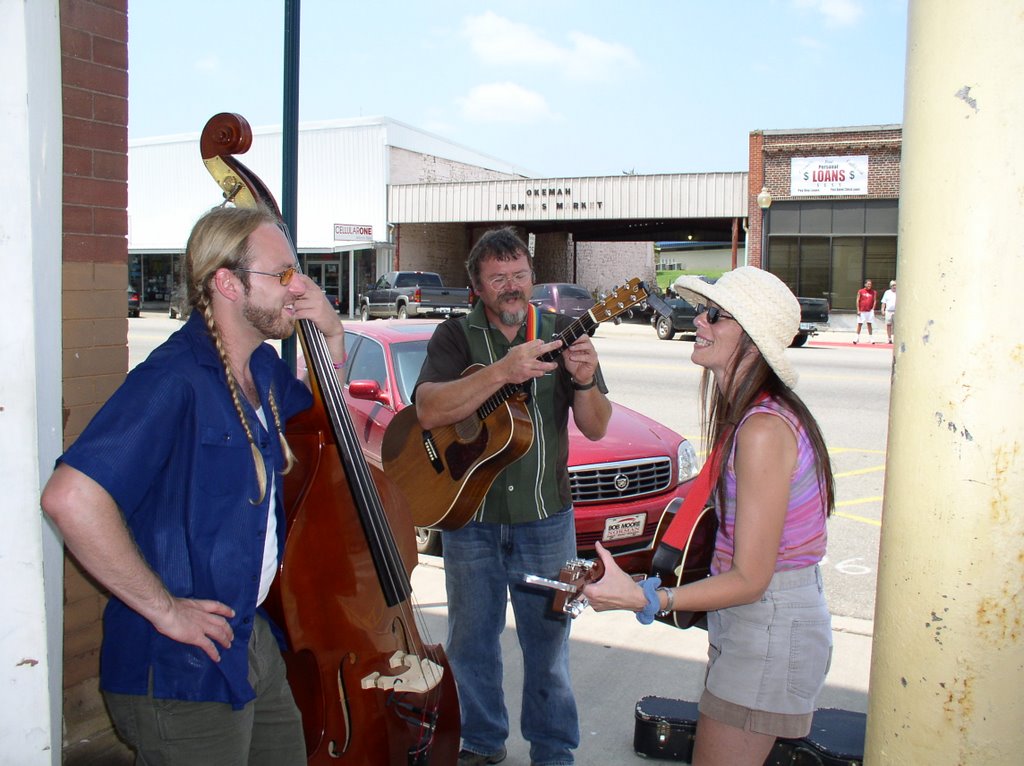
This is a photo from the 2005 Woody Guthrie Festival in Okemah, Oklahoma.

Essentially every American who has listened to the radio, or gone to summer camp, knows Woody Guthrie's “This Land is Your Land.”Public television’s “American Masters” series was devoted to Woody Guthrie this week. Wichita’s KPTS (Channel 8) aired the program this Wednesday July 11. I was only able to catch bits and pieces , but I was able to tape the program for close viewing later on.


And if you want a more contemporary take on Woody visit Woody's hometown of Okemah, Oklahoma sometime during annual Woody Guthrie Free Folk Music Festival. (July 12-16 this year.) With one exception everything about the festival is free. The exception is a Wednesday night fundraiser. This year features Arlo Guthrie's 40th Anniversary Alice's Restaurant Massacree Tour. Every event Thursday through Saturday is free. The musicians perform for free, but they are no amateurs. And don't let the July heat keep you away. Morning and afternoon sessions are held in the legendary Crystal Theater and the Brick Street Cafe in downtown Okemah.

I was able to go last year on Saturday and found it most enjoyable and I'm far from being a folk music fanatic. To top things off, I bought a raffle ticket and won a Taylor guitar.

If you’d like to know more about Woody, there’s a very nice article by Rob Collins from the Oklahoma Gazette or biographies by Joe Klein (Woody Guthrie: A Life) and Ed Cray (Ramblin’ Man). Two good sources for Woody CDs are Smithsonian Folkways and the Woody Guthrie Foundation.


Wednesday, July 12, 2006

Jack Krebs Responds to ID Smear Campaign

Red State Rabble. one of the two or three best blogs focusing on the wacky Kansas Board of Education and their attacks on the science of evolution has a statement that merits being posted in toto.


Jack Krebs, the president of Kansas Citizens for Science, has responded to a smear campaign against supporters of science education launched by John Calvert of the ID Network. Here's what Krebs had to say at the open forum session of the Kansas State Board of Education meeting in Topeka this morning:

Last month, the day after I spoke here, I was told that Kathy Martin handed out an article entitled “The Truth of Science and of Revelation” from the Catholic magazine “Columbia.”

I would like to thank Mrs. Martin for distributing this article, because it supports a major point that we at Kansas Citizens for Science believe: that there is not a conflict between accepting the theory of evolution and believing in God.

Here is what the article says about Catholic doctrine:

“Believing that God designed the world doesn’t mean you have to reject Darwinism or any other scientific explanation… The Church has always taught that natural processes and the laws that govern them are themselves part of God’s design. … It is quite acceptable to say that evolution by natural selection is the way God did it.”

However, the Intelligent Design advocates claim that one cannot accept both evolution and God. Currently, John Calvert is distributing a pamphlet entitled “Character Assassination and Denigration of Theism.” In it, he says that Kansas Citizens for Science has been a “tool” used to “promote a materialist world view that seeks to demean the idea of creation, … effectively promoting non-theistic religions and world views over traditional theistic views.”

This is categorically false. Kansas Citizens for Science does not promote any particular religious view. We do not promote materialism, nor do we promote non-theistic over theistic religions.

Board members of KCFS include an evangelical Christian, a Presbyterian minister, mainstream Protestants and Catholics, Unitarians, agnostics and atheists. Science can and does accommodate all those religious beliefs, and more. We believe that science is a limited form of knowledge, and that many essential matters of morals, values and spiritual belief fall outside the realm of science.

Calling us materialists and atheists just because we support mainstream evolutionary theory is a blatant falsehood, and we object to being characterized as such.

John Calvert has been instrumental in developing and promoting your science standards. Therefore, I want to go on public record here, in front of you, in asking that Calvert quit making these false accusations that those of us who accept modern science and evolutionary theory can’t also accept God. Many tens of thousands of religious Kansans are being painted as “tools of atheism” by these accusations, and they have a right to be insulted.

Kansas Citizens for Science firmly believes that science, as the “activity of seeking natural explanations about what we observe in the world around us,” is both the best way of learning about the physical world and is fully compatible with a wide diversity of religious beliefs, including traditional Christian beliefs about God.

Things I learned from Bill O'Reilly This Week

From just listening for less than one-hour on Monday and Tuesday.

"Christianity isn't a religions."

(Monday: It's a philosophy so it's okay for government buildings or war memorials to prominently display a cross. According to Bill, Catholicism, Presbyterianism, etc. are religions.)

"The New York Times isn't a newspaper"

(Tuesday.)

Sunday, July 09, 2006

Making the Case for US Grant

Nathan Newman

In 1854, abolitionist William Lloyd Garrison led a crowd celebrating Independence Day by burning the Constitution, denouncing it as "A Convenant With Death and an Agreement with Hell." His worthy point was that the founding fathers of the nation had make a mockery of their own words with the stain of slavery and deserved scorn for the constitutional product of their labors.

So as we celebrate the founding of our nation, maybe we should think more about the true founding of a nation with the Civil War where all men were to be "truly created equal" and the President who worked to make it so. No not Lincoln-- who didn't live to finish the job--but the General, Ulysses Grant, who won the Civil War and went on to be the President who would oversee the ratification of the 15th Amendment and enactment of the civil rights enforcement laws that -- after the interregnum of disuse under Jim Crow -- to this day are a backbone of civil rights in this nation.

It is odd that when liberals list the greatest Presidents, Grant rarely makes the list. Roosevelt of course is a worthy option, Kennedy gets the charisma-addict vote and Lincoln deserves respectable mention.


Tuesday, July 04, 2006

The Myth of a "Censored" Jungle

In 2003 See Sharp Press, a small Tucson publisher came out with what was billed as "the Uncensored Version" of Upton Sinclair classic The Jungle. The only problem is that the claims appear to have been overblown. Historian Christopher Phelps discusses the issues in great depth on the History New Network.

Is it any wonder that reviewers have found it impossible to resist the romance of a forgotten, authentic, suppressed version of The Jungle? Library Journal, in classifying the See Sharp edition as “essential,” deplores the novel’s “butchering” and claims “Sinclair later wanted to reinsert the expurgated material for a full-length version but that never came to fruition” (April 15, 2003). The People’s Weekly World, newspaper of the Communist Party USA, states, “If you have never read The Jungle, don’t waste your time on the 1906 censored version. Go right to the original, now available, at a reasonable price, and feel and experience the real message that Upton Sinclair so deeply desired to convey to his readers” (May 29, 2004).

Just one problem: none of the sensational claims made on behalf of the See Sharp edition is true. The Jungle was not censored. Sinclair did not revise the text to meet the coercive demands of a commercial publisher. He never wanted the 1905 serial version to become the standard edition. And the novel, as eventually published in book form, has a political message that is perfectly clear.

Phelps discusses the history of The Jungle in great depth and makes a most convincing case.

Before the Phelps posted his essay on HNN, Earl Lee defended the See Sharp edition from earlier criticisms from Phelps and others. But it seems to doesn't he doesn't really have much of case when he argues that The Jungle was "censored." Now, it is possible that the serialized version originally published in The Appeal to Reason in 1905--the basis for the See Sharp edition, is artistically superior, as Lee contends, but that's a different argument. Maybe the "original" version is the version that Sinclair should have preferred, but he didn't.

As Phelps notes there is value in having the 1905 version available. Moreover, See Sharp Press has made some important historical and current books available to the public. And, from reading the intro material to the See Sharp edition, it think it is easy to understand why that "censored" story resonated with Lee and Kathy DeGrave who prepared the edition.

Some Fourth Thoughts

Rich Shenkman, an editor at History News Network, points out that flag worship is a relatively recent development and not a measure of real patriotism.

No doubt the founders would be pleased to see that the flag is respected today. But they would not understand it being worshiped. Worship of the flag is strictly a modern development. A hundred years or so ago only a few self-appointed flag defenders conceived of it as a sacred object. Schools were not required to fly the flag until 1890. Americans did not begin pledging allegiance to the flag until 1892. They did not begin saluting the flag until around the Spanish-American War in 1898. Flag Day was not nationally observed until 1916. The flag code, prescribing the proper way to treat a flag and dispose of it, was not approved by Congress until 1942 and did not become part of federal law until 1976. The interesting thing is not that the rituals of flag worship go back only as far as the late nineteenth century but that Americans think they go back further. We have become so used to the idea that the flag is a sacred object that we cannot imagine a time when it was not considered one. However, there was a time when patriotism needed no such artificial braces. During the Revolution, when men were fighting and dying on the battlefield to establish a new nation, saluting the flag would have been regarded as an empty gesture. The thing to do was to go out and join the fighting. That was patriotism.
Frederick Douglass: What to the Slave Is the Fourth of July?

Fellow-citizens, I will not enlarge further on your national inconsistencies. The existence of slavery in this country brands your republicanism as a sham, your humanity as a base pretense, and your Christianity as a lie. It destroys your moral power abroad; it corrupts your politicians at home. It saps the foundation of religion; it makes your name a hissing and a byword to a mocking earth. It is the antagonistic force in your government, the only thing that seriously disturbs and endangers your union. It fetters your progress; it is the enemy of improvement; the deadly foe of education; it fosters pride; it breeds insolence; it promotes vice....

Allow me to say, in conclusion, notwithstanding the dark picture I have this day presented, of the state of the nation, I do not despair of this country.... While drawing encouragement from the "Declaration of Independence," the great principles it contains and the genius of American Institutions, my spirit is also cheered by the obvious tendencies of the age.
Rock historian Greil Marcus

It doesn't matter that, well, yes, of course, on the fourth of July, 1776, when the Declaration of Independence was presented, everyone understood that all men meant men, not women; whites, not blacks; Christians, not Jews or Hindi or heathen; decent people, not Sodomites. The idea that "all men are created equal" was not a "self-evident truth," Sen. John Pettit said on the floor of the Senate in 1853: it was "a self-evident lie." It was in the midst of the debates over the Kansas-Nebraska Act; Pettit was arguing for voiding the Missouri Compromise of 1820 and opening the territories to slavery. It was a debate: "The great declaration cost our forefathers too dear," Sen. Benjamin Franklin Wade of Ohio replied to Pettit, "to be so lightly thrown away by their children."

Abraham Lincoln read these debates from his oblivion in Springfield, Ill.; he was a 44-year-old lawyer who had served one term in Congress before being turned out of office. Pettit's words and the words against him brought Lincoln back to the world. Soon he was speaking as if the Declaration of Independence contained all the words the nation ever needed to hear -- and in a certain sense, it didn't matter that Lincoln did not believe that, once men and women left the hand of their creator, they were equal on earth. "Pettit called the Declaration of Independence a lie," Lincoln said in Peoria in 1854, answering a speech by Stephen Douglas. "If it had been said in old Independence Hall 78 years ago, the doorkeeper would have thrown him into the street." That might have been a fairy tale; the Declaration of Independence itself might be a fairy tale, but not one that can be given an ending, happy or not. The charge in the Declaration was boundless; no limits placed upon it hold.