Showing posts with label Middle East. Show all posts

Sunday, June 15, 2014

Flawed "Expert" for Presbyterian "Zionism Unsettled"


This week the  Presbyterian Church USA will vote on a controversial motion to divest from certain companies that do business with Israel.  The chief force behind the motion is the Israel Palestine Mission Network of the Presbyterian Church USA which earlier this year issued a controversial, biased,  and error- ridden report and DVD Zionism Unsettled.

While the study guide has been thoroughly critiqued, not as much attention has been given to the accompanying DVD.  The watchdog organization CAMERA notes

a DVD that accompanies Zionism Unsettled. In an on-camera interview, Irving Wesley Hall ... reports that prior to the Six Day War, Israelis and Jews did not care too much about Jerusalem.
Up until the 1967 conquest of Jerusalem, it was not regarded by any element of Israeli society or any of the streams of Judaism as somehow central to God's plan for the Jews. But that all changed in 1967.
The notion that the city was unimportant to Israel and to all of the "streams of Judaism" prior to the Six Day War is, to put it politely, an outrageous misstatement of fact.

Hall, apparently, has no academic expertise in the Middle East or Jewish history or theology, though he has made a video documentary "Onward Christian Zionists" and written a not- very-funny, 800 page political satire attacking Christian Zionism, which promoted by a bizarre series of videos with Hall wearing a clerical collar..\

A little web search would have shown the Presbyterians Hall's extreme and uniformed views.

In an article on the CrossCurrents website Hall asserts that Christian Identity and Zionism are equally racist theories. He favorably quotes at length from antisemitic authors Jonathon Cook and Gilad Atzmon on a book by Shlomo Sand (Zand) The Invention of the Jewish People,

Hall favorably quotes Atzmon
the largely accepted assumption that the Judaicised Khazars [14] constituted the main origins of the Jewish communities in Eastern Europe
Of course, the Khazar theory is not only not "largely accepted," it is widely discredited.

Hall even writes writes
Remarkably not one of Zand's academic colleagues has seriously disputed his findings. 
This, too is whopper.

Simon Schama, University Professor at Columbia University, wrote that Sand's book is characterized by
many such twists of historical logic and strategic evasions of modern research in this book. To list them all would try your patience.
his book prosecutes these aims through a sensationalist assertion that somehow, the truth about Jewish culture and history, especially the 'exile which never happened,' has been suppressed in the interests of racially pure demands of Zionist orthodoxy. This, to put it mildly, is a stretch.

Anita Shapira, head of the Weizmann Institute for the Study of Zionism at Tel Aviv University, wrote

Sand bases his arguments on the most esoteric and controversial interpretations, while seeking to undermine the credibility of important scholars by dismissing their conclusions without bringing any evidence to bear.
She adds that Sand
drag[s] history into a topical argument, and with the help of misrepresentations and half-truths to adapt it to the needs of a political discussion
Israel Bartal, dean of the humanities faculty of the Hebrew University, called Sand's book
bizarre and incoherent
and Sand's 
…treatment of Jewish sources is embarrassing and humiliating
 Hall seems to have asked the notorious, rabid antisemite Israel Shamir in 2008, well after Shamir had been widely denounced by Palestinian activists Ali Abunimah and Hussein Ibish warned pro-Palestinians to stay clear of him (2001) and well after British antifascist organizations Searchlight and Hope Not Hate reported on Shamir's antisemitism, holocaust denialism and links to far-right organizations (2004).


Hall is clearly a flawed expert for a flawed group that promotes a call for boycott, divest,and sanction pretending that it is about Israeli abuses while actually being a movement which fundamentally rejects the existence of Israel and the right of the Jewish people for self-determination.

More Resources:

Monday, March 24, 2014

BDS Factless Water Day Libel of Soda Stream

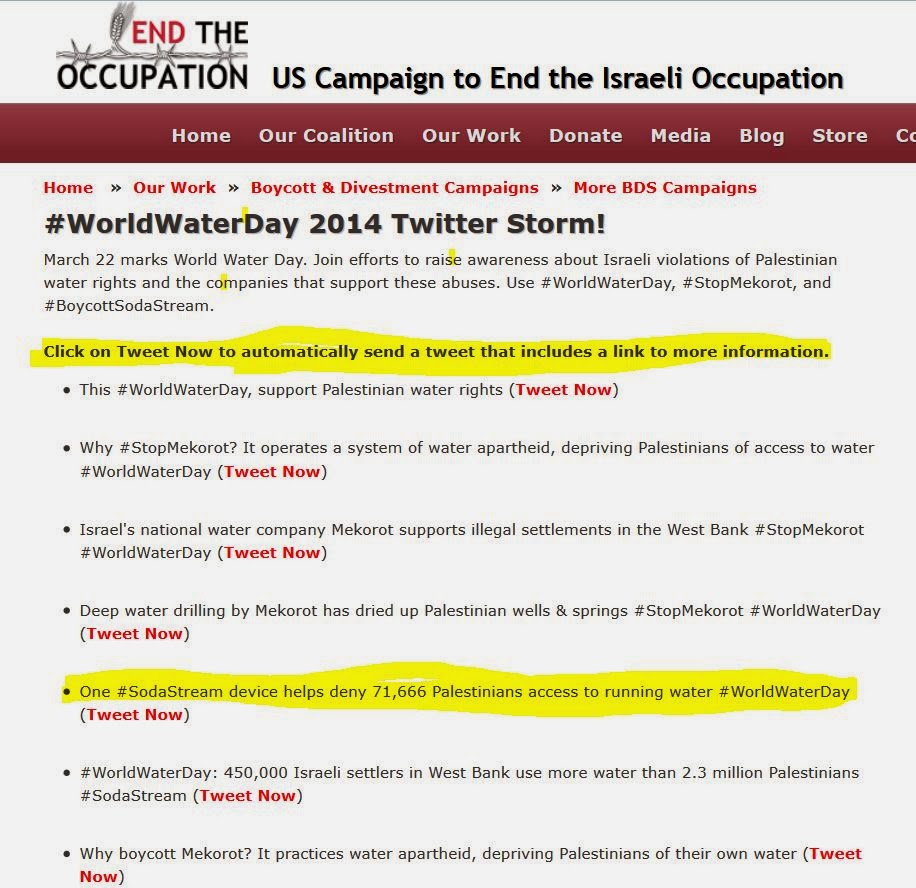
The BDS (Boycott, Divest, and Sanction) movement tried to make March 22 World Water Day an occasion to promote it's campaign to boycott Soda Stream.

There may well be a water crisis on the West Bank and there may be a case for boycotting Soda Stream.  But is there a real causal connection between Soda Stream and water problems on the West Bank?  Or is is just a convenient excuse to attack Soda Stream and demonize Israel?

You might have seen this tweet  on your timeline.


Not  surprising, since it was a part of an organized tweetstorm by the U.S. Committee to the End the Occupation.

 
I got to wondering about this claim. If one Soda Stream device "helps deny 71,622" Palestinians, things must be pretty dire since there are thousands and thousands of Soda Stream dispensers made at the factory.  And what exactly I wondered was the factual nexus between the production of Soda Stream devices and the lack of running water access.  Since Soda Stream production has been growing, there must be a growing number of Palestinians without access to water.

So I clicked on the link to see what the promised "more information" provided.  It took me to a page from the respected Israeli watchdog group B'Tselem - The Israeli Information Center for Human Rights in the Occupied Territories. Funny thing, there was no mention of Soda Stream on the page of statistics about the Palestinian Water Crisis.

It turns out the number of West Bank Palestinians in 2011 who lacked access to running water was 71,622 or 2.6 percent of the West Bank population.  But in 2008, the figures were much larger: 188,922 residents without access to running water or 10.4 percent.  

That's a reduction of over 117,000 and 7.8 percent.

(Incidentally, before the 1967 war, only 10 percent of West Bankers were connected to running water.)

There is another thing that stands out in the statistics.  About 30 percent of the water on the West Bank is wasted due to defective pipes or theft.  This is a failure of the Palestinian Authority.
 

Saturday, September 28, 2013

Those Bogus Pro-Assad Polls

Listening to NPR's Diane Rehm show on Friday, I heard a caller claim that a poll has shown that 70 percent of Syrians support Bashar Assad. Regrettably, none of the experts on the show had enough knowledge or guts to refute this claim which has gotten wide circulation on Facebook and the internet. After all,  Syria, like most police states doesn't allow independent polls.

The 70 percent figure has been pushed hard by the official Iranian Press TV.

An opinion poll, conducted by the US daily news service World Tribune, shows that 70 percent of Syrians support President Bashar al-Assad, 20 percent say they do not support either side involved in the ongoing unrest in the country, and only 10 percent back the opposition. 
Big problem. Not only is the World Tribune a shadowy, obscure, web publication, but it clearly states it did not conduct a poll.

The sources said no formal polling was taken in Syria, racked by two years of civil war in which 90,000 people were reported killed. They said the data came from a range of activists and independent organizations that were working in Syria, particularly in relief efforts. (emphasis added)
The World Tribune report is nearly totally unsourced.  It says "a Western source familiar with the data," but it headlines misleadingly says "NATO Data"  It describes "data, relayed to NATO" and a "report to NATO," but gives no real reason to think that NATO took the report seriously.

 Should World Tribune be taken seriously?  Look at their ties.
The following World Tribune.com content partners have both contributed articles and columns and have helped alert the worldwide web to its exclusive reports:

DrudgeReport.com Middle East Newsline GertzFile.com
Breitbart.com The Washington Times Hoover Institution
NewsMax.com Geostrategy-Direct.com Hudson Institute
WorldNetDaily.com East-Asia-Intel.com Int. Strat. Studies Assoc.
 Moreover, as recently as July 2013, World Tribune reported that "Forensic findings on Obama’s birth certificate: ‘A 100 percent forgery, no doubt about it." A crazy, birther site isn't one that should believed by anyone, particularly by anyone on the left.

The Flawed 55 Percent Poll 

It is more modestly claimed that 55 percent of Syrians support Assad by Ed Hussain in the New York Times, Jonathon Steele in the Guardian,  Al Jazeera (in Arabic), Iranian owned Press TV, and Syrian news sites.  In this case, the number does come from a real poll,but the poll cannot bear the weight of showing that Assad has the support of most Syrians that has been placed on it.

Charlotte McDonald of the BBC points out that while YouGov poll interviewed 1000 people in 18 Middle Eastern countries, only 98 were from Syria.
This is a very low sample according to the managing director of survey company ORB, Johnny Heald, who has been carrying out polls in the Middle East for many years.

"When we poll and we want to find out what Libyans think, or what Syrians think, we would rarely do anything less than 1,000 interviews," he says.
"One thousand is the generally accepted industry minimum to be able to speak confidently about what people from a particular country think about an issue.

"If you say that this poll covers people from 18 countries, then that's fine. But you need to be very careful when you interpret the findings.

"It is not good to say that 55% of Syrians, for example, think that Assad should stay when only 97 people were asked that question."
YouGov's Sept 2013 Poll

YouGov, the British based internet polling, recently  released the results of a poll of 835 Syrians and found
 248 supporters of the Assad regime, 152 opponents and a larger number who support neither side or prefer not to tell us
In percentages, just under 30 percent support Assad and 18 percent oppose.

YouGuv notes
This is not a representative sample: three-quarters are male, over half are under 30 years old, and just under 50 percent say they have a university degree.
So, when we finally get to a poll that has some, limited validity, support for Assad is about half of the claimed 70 percent.

Pepperdine's Secret Survey of Syrian Public Opinion

Next up is a poll that has polar opposite results to the non-existent 70 percent pro-Assad poll, but not without its own problems.

Pepperdine University conducted secret surveys in Syria in 2010 and 2011. Here is an article which describes how their guerrilla polling was done.  The results of the 2011 survey were summarized this way.
Eight out of ten Syrians surveyed want to see regime change and won't be satisfied with mere reform, according to analysis by Angela Hawken, associate professor of economics and policy analysis at the School of Public Policy (SPP), of interviews done for the Democracy Council of California.

That latest "secret survey" results reflect face-to-face interviews with 551 Syrians collected between August 24 and September 2, 2011, despite an official ban on public opinion gathering. An earlier effort took place in January and February of 2010. "The most surprising thing about these results is that they could be collected in the first place," explains Hawken.

James Prince, President of the Democracy Council and a leading expert on Arab civil society, says, "This survey further illustrates the deep-seated angst felt by most Syrians. The Syrian people do not have confidence in the Assad regime. They no longer want to live in the Baath security state. As in other regional countries, the Syrians are fed up with the corruption, nepotism, and lack of opportunity in Syria. The people are searching for alternatives to Assad."
Elizabeth Buckner, a PhD Candidate at Stanford University, however,  raises serious questions about the scientific flaws and political biases of the Pepperdine study here and here.

In sum, there is a flawed poll to go with whatever your position on Syria. 

Tuesday, January 01, 2013

Israel's election

From what I read there is an almost universal consensus that Benjamin Netanyahu is headed to an overwhelming victory in Israel's January 22 parliamentary  election.  Look a little closer and you will see that what is really meant is that the merger of Netanyahu's Likud Party and Avigdor Lieberman's Yisrael Beiteinu will give the new party the largest share of seats in the new Knesset.

But in Israel's parliamentary system that is not the same as forming a new government.

About two weeks ago, Eric Lee wrote a provocative post " "Is this Netanyahu’s final month in office?" looking at the trend in polling results over the last year or more. Lee points out that the right wing parties of Netanyahu and Lieberman have declined in the polls from 45 seats in late 2011 to 36 seats in Dec 2012. [And, in a poll after Lee wrote his post, even lower to 33  seats!]It might be possible, Lee observes, that the left and center parties might be able to form a government with the support of the religious Shas party.  And, in a more optimistic projection, with the left, center and Arab parties getting about 10 percent more current projections, they might be able to cobble together a government without Shas.  Lee concludes "the most likely scenario is that Netanyahu pulls together a coalition, but it’s not inevitable."

Then, on December 29, I read this in the Times of Israel

The three leading center-left parties — Shelly Yachimovich’s Labor, Tzipi Livni’s Hatnua and Yair Lapid’s Yesh Atid — are exploring possibilities to work together after the January 22 elections to try to prevent Likud-Beytenu head Benjamin Netanyahu from retaining the prime ministership, or at least to wield the strongest possible hand in coalition negotiations with him.

Efforts to merge at least some of the center-left parties foundered in the weeks before the deadline for submitting party lists for the elections earlier this month. A bid for a Labor-Hatnua alliance made some headway, but collapsed because both Yachimovich and Livni wanted to lead any such merged slate.

But opinion polls showing a gradual fall in support for Netanyahu’s Likud-Beytenu — and a first vague indication that some votes might be moving across the political spectrum from right to left — have energized talk of post-election possibilities on the center-left.

At this stage, surveys give no ammunition to the notion that the center-left might prevail in the elections, but activists see Netanyahu sliding, and believe the center-left may yet have more leverage than had been anticipated just a few weeks ago.

Livni said Friday that, after the elections, she would “attempt to create a front with other partners with the same worldview… with the imperative to replace Netanyahu.”
And, here is another reason not be overly pessimistic about the elections. Adiv Sterman reports

A broad majority of the Israeli public would vote in favor of a peace agreement with the Palestinians, if the government brought a plan that offered security guarantees to a referendum, polls published Sunday by the S. Daniel Abraham Center for Middle East Peace found.
Roughly two-thirds of respondents (67 percent) expressed support for a two-state solution based on the 1967 borders, with land swaps; a demilitarized Palestine; and Jerusalem’s Old City administered jointly by the United States, Israel, and the Palestinians, with Israel maintaining control of the Western Wall.
Journalist Larry Derfner praises Meretz's peace program 

the Meretz peace plan, which the party presented in its election campaign this week, an oasis in the desert.

The proposal doesn’t screw around. It calls for Israel’s immediate recognition of Palestine, followed by a settlement freeze, release of prisoners, lifting of roadblacks, and negotiations based on the Arab peace plan with the sponsorship of Egypt, Jordan, Saudi Arabia and Turkey – a “Regional Quartet” to accompany the old Quartet of the U.S., EU, UN and Russia. It also calls for scrapping the Oslo Accord – which ex-peace negotiator Dov Weisglass has held up as Israel’s instrument for turning the West Bank into “the only prison in the world where the prisoners have to provide for themselves” – and replacing it with an agreed-upon program for Israel and the Palestinian Authority to negotiate on a “fair, equal, government-to government basis.”

Saturday, November 17, 2012

Partners for Progressive Israel on Violence in Israel and Gaza

I find a lot to agree with in this statement from Partners for a Progressive Israel, a group of Americans who support Israel's Meretz, a left wing Zionist social democratic, pro-peace party with roots in Mapam.

 Statement on the latest violence in Israel and Gaza
 

November 16, 2012

Partners for Progressive Israel is deeply dismayed by the killing and destruction in Israel and the Gaza Strip over these last days, and we urge all sides to refrain from further escalation and reach a negotiated cease-fire with all due speed.  In the last day, Palestinian rockets from Gaza have claimed their first three Israeli lives in the latest round of violence, and the shelling has now reached the Tel Aviv and Jerusalem areas.  Over a dozen Palestinian civilians, including children, have been killed by Israeli bombing.  We mourn the loss of all innocent life.

As we learned four years ago, massive Israeli military action, divorced from diplomatic progress, does not deliver long-term results. Precious human lives are wasted for short-term gains, or no gains at all. And sometimes the use of force inadvertently creates worse scenarios, as we have witnessed repeatedly throughout the Israeli-Palestinian conflict.

While Israel clearly has the right to, and must, defend itself from Hamas and the rockets fired from Gaza, Israel has an obligation to use this right and its overwhelming firepower prudently: to seek negotiation first to defuse tensions, to respect the lives of innocent Palestinians, and to recognize that, ultimately, the conflict can be fully resolved only through diplomacy.  Unfortunately, Israel’s current government has not always fulfilled these basic obligations to its citizens.

Hamas is an unsavory neighbor which shoulders a very large degree of responsibility for the current escalation and the ongoing conflict, due to its unwillingness to accept Israel’s fundamental legitimacy. Yet Israel has no choice but to find a way to live alongside the Hamas government for the foreseeable future.  Reports that Israel’s government did not pursue promising third-party efforts to mediate an extended truce with Hamas are therefore a cause for deep concern.

To quote the group of Israelis living in Sderot and nearby communities who have created the organization, “Another Voice”:

“We call on the Israeli government to immediately launch negotiations with the Hamas government.  Rockets and bombs don’t protect us.  We have tried warfare long enough, and both sides have paid, and are still paying, a high price of suffering and loss.  The time has come to talk and seek long-term solutions that will allow citizens on both sides of the border to lead normal lives.”
Above all, at a time when Israel has potential partners in President Mahmoud Abbas and Prime Minister Salam Fayyad, Palestinian leaders who are keeping alive the flagging hopes for peace by reaffirming their commitment to a two-state solution, rejecting violence and terrorism, and preparing their people for necessary concessions regarding the ‘right of return’, it is unconscionable for the current Israeli government to continue to rely on military action alone and to resist ending the occupation.

For the long term, a political solution is the only way out of violence and despair, and the only hope for the peace which so many Israelis and Palestinians yearn for and deserve.

Wednesday, January 18, 2012

JLC President Stuart Appelbaum's Brave Speech on the Middle East

Earlier this week, the Jewish Labor Committee had their annual fundraising dinner. JLC President Stuart Appelbaum gave a brave and on target speech that addressed the Middle East, as well as the progressive role of the JLC on the America scene.

 According to the Jewish Week, Israel's deputy consul general walked out of the speech. 

Here is what Appelbaum said about the Middle East.


Sunday, September 25, 2011

MESSAGE OF CONDOLENCE AND SOLIDARITY FROM U.S. PEACE ACTIVISTS TO THE SYRIAN PEOPLE


woman holding To the People of Syria: 

We were profoundly saddened to learn of the tragic death of Ghiyath Mattar, a 26-year old non-violent activist who inspired his fellow Syrians in their struggle against the cruel repression of the Assad government. We send our deepest condolences to you and to Mattar’s friends and family, in particular to his widow, who is expecting a child.
 
Mattar was murdered after being arrested on September 6, and when his body was returned to his family on September 10 it showed massive bruising and other signs of horrible torture. According to Amnesty International, this brings the total number of reported deaths in detention in Syria since April to more than 90, and heightens concern for four other activists from the Damascus suburb of Daraya who were detained at the same time as Mattar and who are at grave risk: Yahya Shurbaji and his brother Ma’an Shurbaji, Mohamed Tayseer Khoulani and Mazen Zyadeh. All four have been held incommunicado at an unknown location since their arrest.
 
We want you to know that you are not alone. People around the world have been moved by your determined fight for justice and elementary democratic rights, by your refusal to end your protests despite the brutal violence rained upon you and the arrests of thousands of protesters. As peace activists in the United States, we are writing to express our solidarity with your inspiring struggle. We do not support military intervention in Syria by our government or NATO because we know too well the history of such interventions, made in the name of democracy but actually bolstering Western power rather than popular movements for freedom
 
We wish you success in your courageous resistance to tyranny. Below is the letter of protest we have faxed to President Assad and Foreign Minister Walid al-Mu’allim.
 
In peace and solidarity,
 
 
Joanne Landy Thomas Harrison
Joanne Landy and Thomas Harrison
Co-Directors
Campaign for Peace and Democracy
New York, NY, USA
 
OPEN LETTER TO THE SYRIAN GOVERNMENT IN PROTEST
AGAINST THE DEATH OF NON-VIOLENT ACTIVIST GHAYATH MATTAR AND BRUTAL REPRESSION OF SYRIAN DEMOCRATIC ACTIVISTS
 
President Bashar al-Assad
Presidential Palace
al-Rashid Street
Damascus, Syrian Arab Republic
Fax: +963 11 332 3410
Minister of Foreign Affairs Walid al-Mu’allim
Ministry of Foreign Affairs
al-Rashid Street
Damascus, Syrian Arab Republic
Fax: +963 11 214 6251
 
Dear President Bashar al-Assad and Minister of Foreign Affairs Walid al-Mu’allim,
 
We are peace activists from the United States, and we write to express our horror and outrage at the reported death in custody of the non-violent activist Ghayath Mattar. We call for an immediate independent investigation of the cause and circumstances of his death and for those responsible to be brought to justice.
 
We protest the continuing detention of Yahya Shurbaji, Ma’an Shurbaji, Mazen Zyadeh and Mohamed Tayseer Khoulani and urge your government to immediately disclose their whereabouts in detention, allow them immediate access to their families, lawyers and any medical care they need, and to protect them against possible torture or other ill-treatment. These prisoners should be released from custody.
Beyond these particular cases, we call for an immediate end to the mass arrests, the release of all of those detained for exercising their basic democratic right to protest, and the violence and killings your government has inflicted on Syrians fighting for their elementary freedoms.
 
Sincerely,
 
Joanne Landy Thomas Harrison
Joanne Landy and Thomas Harrison
Co-Directors
Campaign for Peace and Democracy
New York, NY, USA
Follow us on Facebook

MeretzUSA (Partnrs for Progressive Israel) on Palestinian Statehood Bid

On Sunday, September 18, 2011, Partners for Progressive Israel (Meretz USA) President Dina B. Charnin, Chair Theodore Bikel, and Executive Director Ron Skolnik issued the following statement on behalf of the organization:


The Palestinian decision to advance their statehood drive via the United Nations, and outside the framework of negotiations with Israel, is a diplomatic turning point that creates risks but also offers new openings for progress toward peace. For the benefit of both the Jewish and Palestinian peoples, we urge the government of Israel to focus on the positive elements we expect to be contained in the Palestinian request, as outlined below, and to refrain from precipitous responses that would escalate tension and serve the agenda of both sides' extremists. Such responses, hinted at in the press, would include a decision to annex West Bank territory, the annulment by Israel of current Israeli-Palestinian agreements, and the easing of rules of engagement to allow live fire to be directed at unarmed Palestinian protesters.
The unilateral Palestinian application for full UN membership is not a development we hoped for when the peace process began. More than anything, it represents the failure of that process to produce a mutually satisfactory outcome, 18 years after the first Oslo agreement was signed and more than a dozen years after a final-status agreement was supposed to have been reached to end the occupation.
We regard the current move by Palestinian President Abbas as an act of desperation, brought on in large part by the Netanyahu government's refusal to resume negotiations where they left off under the government of Ehud Olmert, and to negotiate seriously on the basis of the 1967 lines, adjusted by mutually agreed territorial swaps.

Over the last two decades, and more, governments, organizations and individuals on both sides committed actions that were counterproductive to the spirit of compromise and reconciliation. Acts of terror and the indiscriminate killing of civilians were foremost among these. But the failure of negotiations was also brought on by other factors, including the expansion of Israeli settlements and a rhetoric of intolerance on both sides that has dismissed the other's historical narrative and legitimate national aspirations. 

Regardless of whether or not the Palestinian application at the UN is approved, it will not replace the need for a bilateral Israeli-Palestinian accord, and Israelis and Palestinians will still have to learn to live alongside one another in peace and security. We therefore urge the government of Israel to embrace the positive elements that we hope and expect the Palestinian request to contain:

  1.  Non-violence: The Palestinian application is a diplomatic gambit, not a military offensive. It is imperative that this be the playing field on which the Israeli-Palestinian conflict is resolved. 
  2. Two-state solution reinforced: By referring to the 1967 lines as the basis for their state, we expect that the Palestinian application will reinforce the concept of the two-state solution, and weaken the idea, promoted by each side's extreme elements, that one side or the other should dominate the entire area between the Jordan River and the Mediterranean Sea. 
  3. Recognition of Jewish rights to statehood: By hopefully incorporating a reference to UN General Assembly resolution 181, the international basis for Israel's creation, the Palestinian move could serve to implicitly recognize the Jewish people's right to national self-determination and statehood.
  4. The 1967 lines will not be the final borders: We expect the Palestinian application to indicate that the pre-war 1967 lines will be adjusted in subsequent negotiations with Israel to take into account Israel's security needs and some of the demographic results of its settlement policy.

Should the Palestinians go forward with their application to the UN, we urge President Abbas and his government to include these elements in their proposal - 1) Non-Violence, 2) A Two-State Solution, 3) Reference to the UN partition plan, 4) Final border based on the 1967 lines with negotiated land swaps - and to continue expressing their readiness for renewed peace talks with Israel. We urge Prime Minister Netanyahu and his government not to waste time, and to engage with the representatives of the Palestinian people on the basis of these principles.

While we believe the tactic of seeking UN affirmation of a Palestinian state outside the framework of direct negotiations is far from ideal, approval of a Palestinian request containing the elements noted above could have two positive outcomes for future negotiations. By elevating Palestine to the level of a state, it will reduce (though not eliminate) the asymmetry of power between Israel and the Palestinians that has complicated the process to date. It will also determine the general territorial outline of the conflict's resolution. These two outcomes will allow Israel and Palestine to recommence negotiations from a more productive baseline, and be better positioned to utilize the accepted tools of statecraft to engage with one another constructively.

Palestinian moves at the UN will not bring peace or end the occupation on their own. If handled properly, however, they can serve as the basis for a reenergized and revamped diplomatic process with the potential for resolving the conflict on a bilateral basis.
 

Thursday, March 17, 2011

OneVoice Palestinian activists join mass West Bank unity rallies

OneVoice Palestinian activists participated in massive West Bank unity rallies on Tuesday, demanding reconciliation between bitter rivals Fatah and Hamas as the first necessary step toward ending the occupation and resolving the Israeli-Palestinian conflict.

Following demonstrations that began in Gaza on Monday, thousands gathered today in the West Bank cities of Bethlehem, Nablus, and Ramallah for peaceful unity rallies organized by Palestinian youth groups on simple pages of the social networking site Facebook. OneVoice Palestinian activists called on their chapters to ensure the demonstrations remain nonviolent. They have also been tweeting throughout the day on the rallies. Visit OneVoice’s blog to view the movement’s real-time Twitter stream.

“What we’re seeing today is the start of the Palestinian Spring,” said Samer Makhlouf, executive director of OneVoice Palestine. “At the heart of these peaceful rallies lies a youthful generation—inspired by the Egyptian revolution—demanding national unity as the necessary first step to end the occupation and resolve the conflict.”
The organizers themselves also stressed the nonviolent nature of the rallies. Beyond the call for unity, they will demand the release of all political prisoners held by Fatah and Hamas and “full democratic representation for Palestinians all over the world.” They also called on all participants to avoid waving flags or holding up posters that showed affiliation with political parties.

Rallies were also scheduled to be held around the world, including outside the offices of the Palestinian General Delegation to the U.K. in London and the Permanent Observer Mission of Palestine to the U.N. in New York.
“OneVoice was founded on the principle that the key unfulfilled role in this conflict is that of civil society,” said John Lyndon, executive director of OneVoice Europe. “Today, we see ordinary people demanding unity and an end to occupation. We encourage leaders – both in the region and further afield – to listen very carefully to what they are saying and act accordingly.”

OneVoice Palestine recognized the importance of ending factional divisions as a precursor to ending the occupation, establishing a viable, independent Palestinian state, and achieving lasting peace in the region. They launched major activities across the West Bank early in March to channel the energy on the street into a deafening cry for national unity.

OneVoice’s Palestinian activists spread thousands of bumper stickers emblazoned with the words, “the people want to end the occupation, the settlements, the [internal] division – help build the state,” on the streets of Bethlehem, Hebron, Nablus, Qalqilya, and Ramallah. They will be introducing billboards, radio and television spots, massive murals, and several youth-led initiatives in the coming months.

Monday, June 28, 2010

World’s unions reject boycotts, embrace Israeli-Palestinian cooperation

[Positive news from TULIP.]

The international trade union movement has just delivered a stinging rebuff to advocates of the campaign to boycott Israel.
At its second world congress which just concluded in Vancouver, the International Trade Union Confederation (ITUC) rejected calls to support the boycott, divestment and sanctions (BDS) campaign targetting the Jewish state.
A vehemently anti-Israel resolution submitted by the Congress of South African Trade Unions never made it to the floor.
And in a stunning blow to pro-Hamas activists in some unions, the Israeli national trade union center Histadrut was honored by the global trade union movement.
Its leader, Ofer Eini, was elevated to the ITUC’s 25-member Executive Board as well as its General Council.  Eini was also elected as one of the organization’s Vice Presidents.
The ITUC has 312 affiliated organizations in 156 countries and territories representing 176 million workers.
Eini’s election followed calls by major unions in the UK and elsewhere for the Histadrut to be boycotted.  Instead, the international trade union movement has embraced the Israeli unions, understanding them — correctly — to be important partners in building peaceful relations between Israelis and Palestinians.
In a resolution adopted by the ITUC congress, the positive role of the Histadrut was made explicit:
“Congress welcomes the landmark agreement between Histadrut and the PGFTU on the rights of Palestinian workers, which was finalised with the assistance of the ITUC in August 2008, and initiatives by Global Union Federations in their sectors to support cooperation in defence of workers’ rights. This agreement, and other actions to promote decent work and end discrimination, are crucial to building the basis for just and equitable economic development.”
For the future, the ITUC resolution declared:
“Congress commits the ITUC to continue to support the strengthening of cooperation between the Palestinian and Israeli trade union movements and calls upon the international community to support Palestinian economic reconstruction and development, including through the ILO Palestinian Fund for Employment and Social Protection.”
In addition, the world’s trade unions

  • Called for a two-state solution — and “universal recognition of Israel’s right to exist, next to an independent viable Palestinian state”
  • Rejected “the extremist policies of Hamas
  • Condemned the Egyptian “decision to impose heavy restrictions on its border with Gaza”
  • Acknowledged that Israeli’s December 2008 attack on Gaza came “in response to rocket attacks”
  • Supported the 2002 “Road Map” for peace proposed by the United States, Russia, the United Nations and the European Union
The resolution adopted was highly critical of many Israeli policies, calling for an end to illegal settlements in the Palestinian territories, rejecting the blockade of Gaza and the building of a security fence, and so on.
But what stands out clearly is the commitment by the vast majority of the world’s trade unions to a two-state solution and to strengthening Israeli-Palestinian trade union cooperation.
This is welcome news for Israelis and Palestinians and a blow to the supporters of Hamas who have tried hard to isolate and demonize Israel within the trade union movement.

Tuesday, March 10, 2009

Muslim Friends of Genocide

What is the connectin between Arabs and Muslims, on the one hand, and Terrrorism on the other was the ostensible subject of a meeting at Wichita Stat Monday evening? My busy schedule prevented me from attending, so only a few quick observations and a recent news story.

Stereotyping all Muslims or all Arabs as terrorists is wrong and should be resolutely opposed. Repressing people because of their religioius views is wrong--whether it is Muslims who are being repressed or Muslims who are being repressed.

The reality is that there is a powerful, transnational movement in the Arab and Islamic worlds that is profoundly anti-democratic, imperialist, and, openly genocidal in its aims.

Via Mick Hartley

A delegation of senior Middle Eastern leaders has travelled to Sudan to express international support for Omar al-Bashir, the Sudanese president, who is accused of war crimes in Darfur.

Officials from Iran, Hamas and Hezbollah joined Syria's parliament speaker and the leader of the Palestinian Islamic Jihad group for talks with al-Bashir in Khartoum, Sudan's capital, on Friday.

The visit comes days after the International Criminal Court at The Hague issued a warrant for al-Bashir's arrest on charges of war crimes and crimes against humanity in Sudan's western Darfur region.

Ali Larijani, Iran's parliament speaker and a member of the international delegation in Khartoum on Friday, said the ICC arrest warrant is an "insult directed at Muslims".

Not that any of them ever expressed any concern for the Muslims killed or raped in Darfur - or those thrown off their land and forced to live in camps, maintained by humanitarian groups funded almost entirely by the West. Or their fate if the aid agencies threatened by al-Bashir are forced to leave.

Though fellow Muslims aren't Bashir's only friends:

The UN Security Council, at its first meeting since the arrest warrant was issued, failed on Saturday to agree on a statement asking Sudan to reverse the decision to expel the aid agencies.

The key powers at the UN Security Council - Russia, China, France, the US and Britain - met to discuss a statement which called on Sudan to reverse the expulsions.

But diplomats say China, which buys Sudan's oil and sells it weapons, objected.

A delegation from the African Union and the Arab League is due to ask the Security Council to suspend the war crimes case against Sudan's president.

Wednesday, January 28, 2009

West Bank village has Holocaust exhibit

At a time when Muslim Brotherhood and other extremists are openly calling for another holocaust against the Jews and when Western pseudo-leftists invoke the hoocaust to demonize Israel, it is extremely refreshing and encouraging to read this story


Naalin holds Holocaust exhibit

As the world commemorated the Holocaust Tuesday, a small village in the West Bank held a surprising exhibit memorializing the most tragic event in modern Jewish history.

Naalin, a village that has become the symbol for the Palestinians' battle against Israel's construction of a separation fence in the West Bank, erected a display of photographs purchased from Yad Vashem Holocaust Museum and invited the public to learn more about the persecution of the Jews.

Residents gaze at Holocaust images in Naalin (Photo: Khaled)

Mohammad Amira, a member of the village's Land Defense Committee, said hundreds of people visited the exhibit by early afternoon. He said many had praised the initiative.

"People are surprised at what they see here; there are people who are seeing images of the suffering in the Holocaust for the first time. There are people who didn't know anything about Jewish history," Amira said.

Regarding the decision to present the exhibit to residents of Naalin, many of who have been harmed by the construction of the separation fence, Amira said, "We thought the public should understand the pain and suffering the Nazis caused the Jews.

"Unfortunately, we are paying the price for the immense pain suffered by the Jews during the Holocaust. There is no comparison between our suffering and that of the Jewish people in the Holocaust, but everyone should understand that we are suffering too, as a result of what the Germans did to the Jews."

'Jewish pain has strength'
Khaled Mahmid, who heads the Arab Institute for Holocaust Research and Education in Nazareth, said he believes the Arabs "must understand the Holocaust – the power and strength that the Jews' pain has."

He added, "All violence Palestinians perform on the Israelis is not effective, causes suffering, and summons Holocaust anxiety among the Jews."

"The Holocaust," Mahmid said, "was a horrible and methodical murder of six million innocents, which affects all of the citizens of Israel even today. The Palestinians need to understand that the Jews have a defense mechanism deriving from the horrid murder in the Holocaust."

He said the two-state solution would only have a chance to succeed if the Palestinians made an effort to understand this "profound pain", and relinquished all acts of violence "that stirs existential anxiety in the Jews." Mahmid added that the violence exhibited by both sides is a direct result of the Holocaust.

Regarding the exhibit Mahmid said, "The Koran orders us to acknowledge the Holocaust and understand it. The Jews must remember that many of them were saved during the Holocaust thanks to their brothers in the Arab lands. We must overcome Hitler's affects together."

Wednesday, October 22, 2008

Al-Queda "Endorses" McCain

Pamela Hess of the AP reports

WASHINGTON – Al-Qaida supporters suggested in a Web site message this week they would welcome a pre-election terror attack on the U.S. as a way to usher in a McCain presidency.

The message, posted Monday on the password-protected al-Hesbah Web site, said if al-Qaida wants to exhaust the United States militarily and economically, "impetuous" Republican presidential candidate Sen. John McCain is the better choice because he is more likely to continue the wars in Iraq and Afghanistan.

"This requires presence of an impetuous American leader such as McCain, who pledged to continue the war till the last American soldier," the message said. "Then, al-Qaida will have to support McCain in the coming elections so that he continues the failing march of his predecessor, Bush."

SITE Intelligence Group, based in Bethesda, Md., monitors the Web site and translated the message.

"If al-Qaida carries out a big operation against American interests," the message said, "this act will be support of McCain because it will push the Americans deliberately to vote for McCain so that he takes revenge for them against al-Qaida. Al-Qaida then will succeed in exhausting America till its last year in it."

Mark Salter, a senior McCain adviser, said he had heard about the Web site chatter but had no immediate comment.

The message is credited to a frequent and apparently respected contributor named Muhammad Haafid. However, Haafid is not believed to have a direct affiliation with al-Qaida plans or knowledge of its operations, according to SITE.

Saturday, January 12, 2008

Support Campaign To Stop Violence Against Iraqi Women

The British Trade Union Congress and others are supporting a new campaign to stop violence against Iraqi women. The campaign launched on January 3rd by the Iraqi Women's League (IWL) Co-ordinating Committee Abroad against violence against women in Iraq.

Their press release is below. You can sign the online petition at www.ahewar.org/camp/i.asp?id=111

Iraqi women are being killed and subjected to all forms of violence every day. What they have suffered in the city of Basra is perhaps something unprecedented in Iraqi society. Women have been killed and their bodies thrown in streets, especially since July 2007. According to Basra police chief Abdul Jalil Khalaf, the bodies of 50 women were found in different areas of the city during recent months. This may not be the real figure, as families of victims are often reluctant or too frightened to report these horrific crimes.

This phenomenon in particular, and violence against women in Iraq in general, has been a cause of great concern for us in the Iraqi Women's League. We have therefore launched this campaign to mobilize public opinion, exert pressure and intensify efforts to stop these inhuman and barbaric acts. It is also intended to allow the voice of Iraqi women, rejecting all forms of exploitation and abuse of dignity, to be heard by the world.

Your solidarity with Iraqi women will strengthen their resolve and their struggle to change this tragic reality. It will certainly contribute to speeding up the process of uncovering the perpetrators of heinous crimes and violence against women in Iraq, and help to put an end to this barbarism.

We appeal to all the people of free conscience in the world to uphold lofty humanitarian values and support our campaign.

The petition can be signed online in Arabic and English

Saturday, October 27, 2007

Annapolis Peace Conference: Guide for the Perplexed

Meretz USA has prepared an excellent guide to the upcoming peace conference in Annapolis between Israel and the Palestinian authority.

Whether you follow the Middle East just a little or consider yourself an expert, this should be a very valuable resource.

Don't know who Mertz USA is?

MeretzUSA is "a US non-profit organization that supports a genuine peace between the State of Israel and its neighbors (including the Palestinian people) based on a negotiated land-for-peace solution. Meretz USA supports full civil and human rights for Israeli citizens, regardless of ethnicity, race, religion, gender, national origin, or sexual orientation."

It is independent of, but philosophically attuned to Meretz-Yachad, the left-wing, social democrratic party which has 5 seats in the Israeli Knesset.

Also, check out the Meretz USA blog.

Thursday, July 26, 2007

Barry Lando Lies About Israel

Truthdig, a website associated with Robert Scheer, a much respected radical journalist, has a bad article by journalist Barry Lando, "Israel's Primal Myth: A Barrier to Peace." I've been noticing an upsurge in anti-Israel articles beyond the sewers of Counterpunch, et al. Lando's article deserves a fisking. I anticipate that someone with more time and knowledge will thoroughly deconstruct it.

For now, note of Lando's outright misrepresentation of Benny Morris.

LANDO "Morris found that not only was there no evidence that Arab leaders had
called upon their people to flee in 1948-49, but that records revealed
exactly the opposite."

MORRIS ".. it turns out that there was a series of orders issued by the Arab Higher Committee and by the Palestinian intermediate levels to remove children, women and the elderly from the villages. So that on the one hand, the book reinforces the accusation against the Zionist side, but on the other hand it also proves that many of those who left the villages did so with the encouragement of the Palestinian leadership itself."


Saturday, August 12, 2006

Aerial Bombing of Beirut

Mark Grimsley has an interesting post on the History News Network bringing to our attention two interactive graphics of Beirut before July 12 and after July 31 which show the extent of the bombing. Be sure to look at the area maps to put the extent of the bombing in perspective.


MSNBC has an interactive graphic showing a satellite photo of a portion of Beirut as it appeared on July 12 and another satellite photo showing the same area on July 31. You can toggle back and forth between the two. Only four targets are captioned -- a highway overpass, Hezbollah offices, the municipal building and Al Manar television -- but if you examine the photos in their entirety, it's plain that a substantial number of other buildings were also targeted or at least struck. The graphic is a litmus test of sorts for one's appraisal of the IAF strikes. Do you see evidence of a discriminate, proportional air campaign; or something more extensive?

UPDATE, August 12, 2:02 PM - The New York Times ran a similar graphic last week. It labels the bombed zone, "Main area of Hezbollah offices (before attacks, this area was fenced off and surrounded by guards)," which to my mind removes the litmus test. So to that extent, never mind. But both graphics are worth a look. Interestingly, the NYT's "before" image is in color, the "after" image in black and white.

Saturday, July 29, 2006

How much damage in Beirut?

A letter to the Wichita Eagle earlier this week complained that there had been previous letters backing Israel and said that all that was needed was to see the pictures of Lebanon on television.

I know the writer. He's a decent guy, which might be too much to say of some other letter writers.

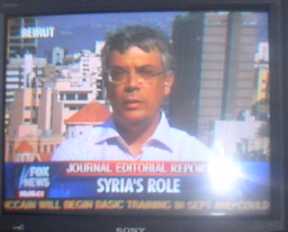
Tonight after work, some errands, book store shopping, and supper at the Church's chicken buffet, I turned on the tube and, not finding any entertainment worth watching I took a look at the cable news stations. Imagine my surprise when I saw Michael Young, editor of the Daily Star being interviewed against a Beirut skyscape. Nary a bomb crater or demolished building in sight.

According to Deborah Gordon, one of Wichita's leading Israel's bashers, Israel is bombing Lebanon back into the stone age.

Some stone age!


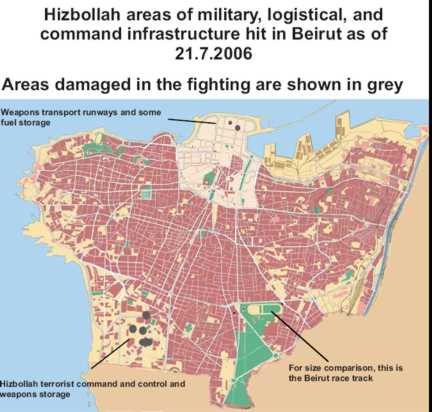
From what I've caught of TV news coverage, it has done a very poor job of putting the bombing in proper perspective. I've seen lots of pictures of bombed buildings, but I've not seen a single map of Beirut showing the areas that have been bombed, nor an aerial survey of the city. Admittedly, I'm not a cable news junkie, so I might have missed it.

But Israeli pharmacist Shimon Zachary Klein, who blogs on the Israel-Palestinian conflict has located a very helpful map. (Hat tip: Jeff Weintraub


Klein writes:
The actual damage is only confined to those areas where the Hisbollah terrorist organization is active: command, military, and logistics locations used for weapons transport....
[The media goal seems to be] to convey the idea that the entire city has been destroyed when 99% is untouched.

only Hizbollah command and weapons centers and weapons transport sites have been attacked. [This is] Less than 1% of the entire city.
I've come across reports in recent days that tend to confirm Klein's analysis.
  • In a radio interview retired Canadian General Lewis MacKenzie said that only a 15 block square area of Beirut had been bombed. Now in my hometown of Winfield, Kansas (population 12,000) that would be an enormous area. In New York city, or Beirut, Lebanon, not so huge. (I'll try to track down the link to the interview.)
  • A NPR report noted that the new conflict had put a halt to the building boom in Beirut. Many buildings and areas had still not been rehabbed from the civil war twenty years ago.
  • A CNN reporter has revealed that he and others are able only to visit and photograph what Hezbollah wants them to.
  • J. Michael Kennedy of the LA Times wrote an article which put things in perspective.
Swaths of the southern suburbs are in ruins after 11 days of Israeli attacks. The main road from the south is bombed out and impassable. The main road to Damascus is knocked out. Hotels have emptied. Electric power comes and goes.

But the main shopping street of Hamra in west Beirut was jammed with cars Saturday morning. Stores were open, at least for a few hours -- even clothing shops that sold no clothes.

"Now is not the time to be buying clothes. Now is the time to buy food," said Fouad Naim, manager of the Antonio Baldan men's store. "But some who have been wearing the same thing for the last 10 days have come to get something new. You can smell them when they come in."

The newly built center of the city, with its fashionable shops and banking center, was eerily empty, save for a smattering of people in what few cafes were open. The tourists who made it one of the busiest parts of the city have long since gone, either by sea or overland to Syria or Jordan.

But on the main highway going north up the coast, more stores and restaurants were open, including fast-food standbys such as Hardee's, KFC, Subway and Burger King.

On Saturday afternoon, the road was jammed with cars as it passed the port and headed north, past modern shopping malls and other developments that are a part of the rebuilt Beirut. A turnoff to the right leads to the mountains above. Virtually all of this territory is home to the Christians of Lebanon, who allied themselves with the Israelis during the invasion of the country in 1982.

In Bikfayya, the roads were more crowded than usual, because this is one of the routes to the Syrian border now that the main highway has been knocked out by Israeli jets.

Even with that, the scene was almost pastoral, with a neat town square surrounded by small, well-kept shops. At her fruit and vegetable stand, Lena Bochebel said that the trauma of the city below was a world away.

"Here there is no war, and all people are happy because we all get along," she said. "We're taking care of people. We are all Lebanese people."

She pointed to the street leading off to the right, where the high school was perched on a hill overlooking the valley below. She said the school, the church and the local hotels were filled, many with people who had fled from the south.
Even though, the media may not be doing a stellar job putting the damage into perspective, there is tremendous human suffering in Lebanon and Israel. Please take a look at my previous post on some ways to help. And, then help.

How to help in the Middle East Crisis

Some suggestions for responding to the humanitarian crises in the current Middle East conflict.

URGENT APPEAL FROM LEBANESE TEACHERS' UNIONS

The Education International, representing teachers' unions around the world, has issued an urgent action appeal in support of requests for humanitarian assistance from two Lebanese teachers' unions.

LabourStart is assisting by providing a secure online way to donate in your own currency using your credit or debit card. Please give generously today:

http://www.labourstart.org/docs/en/000351.html

MeretzUSA recommends three projects in Israel

The Israel Center for the Treatment of Psychotrauma at Herzog Hospital is working with residents of northern Israel to help them cope with the current situation of violence and dislocation. The Center’s trauma psychologists are providing trauma counseling to families in shelters throughout the north, as well as workshops for parents and children who have fled northern Israel and have come to Jerusalem. Plans are underway to use the Trauma Center’s website (www.traumaweb.org ) both as a “moderated forum” to help Israelis deal with the psychological impact of the current security situation, and as a “chatroom”, so that people can feel together, even if they are stuck in their separate shelters or safe rooms.

The Brit Olam organization’s “Mobile Summer Camp” is helping children in northern Israel who are confined to bomb shelters this summer due to the current fighting. Many community shelters in the north are run-down, and often the children lack adult supervision. Brit Olam volunteers – including post-traumatic stress experts, educators, storytellers, and professional childcare workers – are going to the shelters, talking and playing with the children, entertaining them and bringing food and toys. In the Arab sector, which lacks community bomb shelters, Brit Olam is working with social service divisions in towns and villages, providing packages of food and toys for distribution to individual homes. Brit Olam (http://www.britolam.org/), in which many Young Meretz people are active, is a social action partnership of Israelis and Jews around the world, working together to reduce poverty, hardship, and vulnerability in fragile communities and to advance equality of opportunity, freedom, and self-expression.

Wingate Institute for Physical Education and Sport: At the request of the Israeli government and the Jewish Agency, Wingate has been housing, feeding and providing summer activities for 200 children from northern Israel – and is seeking to take in 200 more. For general information about Wingate, go to http://www.wingate.org.il/Index.asp?CategoryID=478&ArticleID=661.

Should you wish to contribute to any of these projects, please send us a check made out to Meretz USA, noting in the memo section which of the projects you would like to donate to. They will make sure that the full amount of your contribution goes to the purpose so designated.

Checks should be mailed to:
Meretz USA
114 West 26th St., Suite 1002
New York, NY 10001