Monday, May 29, 2006

A field trip for David Awbrey and the KBOE

David Awbrey, former editor for the Wichita Eagle, was hired earlier this year as press secretary for the Kansas Board of education. Earlier this month, Awbrey put his foor in his mouth at a Kansas City Press Association event. Awbrey argued that evolution proponents are practicing a religion. Supporting evolution, he said, is metaphysical speculation.

“Anyone see the origin?” he said. “Anyone see the Big Bang? Anyone see the dinosaurs? These are metaphysical speculations.”

Awbrey and the KBOE ought to make a trip to the Sternberg Museum at Fort Hays.

Wednesday, May 17, 2006

Springsteen and Jesse James--and Seeeger

Tom Watson disapproves of one song on Bruce Springsteen's much praised Seeger Sessions CD.

Being both a careful producer and a careful liberal, Springsteen is always controlling about both his musical releases and his statements. But this record is sloppy, haphazard. So is the message, but the results are less joyful. Because there in lineup is that old folk warhorse, the Ballad of Jesse James - and because of it, the calliope crashes to the ground.

Everybody knows the song, and perhaps in its inherent long-standing myth, there's an innocence that calls for forgiveness to actual history, at least for aging rock musicians:

Jesse James was a man
And he killed many men
He robbed the Glendale train
And he took from the rich
And he gave that to the poorer
He'd a hand and a heart and a brain

History tells a different tale. Skip the heart - in history, Jesse James had a hand, and a gun, and a brain - that brain belonged to the lost cause of the Confederacy, to race hatred, and to revenge. And the gun belonged to American terrorism.
It's worth reading the whole thing.

I do have one problem with Watson's critique, leaving aside the most common objection that to sing a song is not to endorse its lyrics. Watson writes "Bruce Springsteen should know better. This pining away for the Confederate past and its post-war terrorist followers shouldn't make his latest record - no matter how traditional the tune is. The hero myth should die."

In doing so, Watson lets Pete Seeger off the hook. According to the fan-site Songs of the Seeger Sessions, Seeger recorded Jesse James on several ocassions, while Allmusic lists five . (Which may well include some recycled items.) Since Springsteen presents his latest project as a tribute to Seeger, it is unfair to criticize him for doing song perfomred by Seeger as Seeger performed it.

If Springsteen is an "aging rock star" who should know better, how about Seeger a long-time political activist? Indeed, Seeger, in fact, was a member of the Communist Party, which prided itself on its advanced views on race.

Tuesday, May 16, 2006

Bush plays politics with the border

Marc Cooper

Let’s get a couple of things straight about the immigration speech President George W. Bush unreeled Monday night from the Oval Office.
His address had nothing to do with actual border policy and everything to do with domestic electoral politics.

The real mission of the 6,000 National Guard troops he has called out is to quell the rebellion on the President’s right flank, the flaring mutiny of his own conservative base. Indeed, if the President were being honest, the newly mobilized troops would be taken off the Federal payroll and moved onto the books of the 2006 national Republican campaign.

They certainly aren’t going to be stopping illegal immigration. Most of the Guard will be unarmed. They will be barred from patrolling the border itself, as well as from confronting, apprehending or even guarding the undocumented. The troops will be given solely behind-the-scenes, low-profile, mostly invisible tasks of pushing paper, driving vans, and manning computers. Bush could have saved the taxpayers a load and sent a few battalions of Boy Scouts to do this job.


House Democrats have a release showing that the GOP has oppposed increased spending for border security.

Friday, May 12, 2006

Egyptian blogger arrested


Egypt has arrested the blogger Alaa for protesting corruption of the country's judicial system.

Sandmonkey provied the basic facts

Egyptian Blogger Alaa Abdel Fatah has been arrested alongside 10 others while demonstrating in support of the independence of the Judiciary in Egypt and the release of previous demonstrators who were detained 2 weeks earlier. The Police entrapped them, cordoning off their peaceful protest and then proceeded to handpick the demonstrators that they wanted to detain, beat them, and then arrested them. ... This is by no means a co-incidence. Government agents handpicked people to arrest from amongst the protesters. They have been wanting to get Alaa for a long time now, precisely because he is high profile, and because he helps organizes the protests and spread the information through the blog aggregat


Here's the email for the Egyptian embassy in Washington embassy@egyptembdc.org

Better, here's an on-line petition to support Alaa by sending emails to

* Egypt's Ambassador to the US Nabil Fahmy
* Egyptian Prime Minister Ahmed Nazif
* Egypt's Interior Minister Habib El Adly
* US Ambassador to Egypt Francis Ricciardone
* US Assistant Secretary of State David Welch

Wednesday, May 10, 2006

The Black String Band Tradition

Scott McLemee

Hurrying from one appointment to another on Thursday, I heard the sound of bluegrass in the air at Grand Central Station. Drawing closer, I saw that it was a couple of African-American guys. Not old men, let's say, but not youngsters either. They were into the flow of what they were playing, just tearing it up on the banjo and fiddle. In other words, this was music they knew and knew well.
That there was once a large black audience for country music (and that hillbillies were sometimes good bluesmen) is one of those realities that's been forgotten, or covered over, by a certain dumbass essentialism that has both reactionary and "leftist" forms. I was really glad to see these guys, and shelled out the money for their CD immediately. It would have been good to stick around and listen some more, but I had to run.
It turns out they are called the Ebony Hilllbillies -- a trio, with a bass player, who wasn't there at the time. They have a website, where you can buy the CD via PayPal. Strongly recommended -- it's a good record.

I haven't bought the CD yet, but there are three selections on-line and they sound great.

Elijah Wald's superb book Escaping the Delta: Robert Johnson and the Invention of the Blues makes much the same point as does Bill Malone, the dean of country music scholarship, in his Don't Get Above Your Raisin': Country Music and the Southern Working Class.

Afro-pop World Wide devoted at leat one program to the African-American string band tradition.

Sankofa Strings is a Carolina-based group that keeps the tradition alive.

There's been a on-line group under the name of Black Banjo Now And Then which organized a "gathering of black banjo and traditional string players in 2005. They've now organized An Association of Traditional Black String Players.

It would be nice if the folks at Winfield's Walnut Valley Festival would reach out to the Ebony Hillbillies, Sankofa Strings, and other African-American traditional string players.

Wednesday, May 03, 2006

More on the Anthem: Bush hypocrisy

Think Progress has this

But Bush’s highly-scripted 2001 inaugural ceremony actually featured a rendition of the national anthem sung in Spanish by Jon Secada. From Cox News Service, 1/18/01:

The opening ceremony reflected that sentiment. A racially diverse string of famous and once famous performers entertained Bush, soon-to-be First Lady Laura Bush, Vice President-elect Richard B. Cheney and his wife, Lynne, who watched on stage from a special viewing area.

Pop star Jon Secada sang the national anthem in English and Spanish.

Apparently, Secada singing the anthem in Spanish was a regular feature of the Bush campaign. From the 8/3/00 Miami Herald:

The nominee, his wife Laura, erstwhile rival John McCain and his wife Cindy joined Bush on a platform where children sang the national anthem - in “Spanglish,” Secada explained.

This morning, ThinkProgress revealed that, according to Kevin Phillip’s book American Dynasty, Bush himself sang the national anthem in Spanish. Looks like Bush’s conviction that “the national anthem ought to be sung in English” was something he acquired very recently.

Senator Lamar Alexander, along with Senator Frist, Senator McConnell, Senator Stevens, Senator Isakson, and Senator Roberts has introduced a resolution affirming that statements of national unity, including the National Anthem, should be recited or sung in English. In the press release for Alexander states that never before has it [the national anthem] been rendered in another language."

This, of course, is false. See my previous post on this.

Meanwhile, in Germany

A Green politician has triggered a debate by calling for an official Turkish translation of the German national anthem to symbolize how multicultural Germany has become.

Fun with TABOR

From the KNEA's "Under the Dome"


TABOR light gets debated; sent back to committee

The “TABOR-light” bill in HCR 5043 – a constitutional amendment requiring a 2/3 majority vote to enact any tax increase – was brought to the floor this afternoon where it was amended up before being referred back to committee, an action that essentially dooms the bill for this session (although, like Lord Voldemort, bad ideas rarely die completely).

The bill had been held in committee where it was apparent it did not have the votes to be sent to the floor. House Speaker Doug Mays, a TABOR supporter, used his position to bring the bill out of committee to give it a floor vote. This action is another “more politics than policy issue” since it simply means that anti-government, anti-tax ideologues can have a recorded vote to put in campaign literature.

The first person to take the bill on was Rep. John Edmonds who offered an amendment to make passage of any bill contingent upon a 2/3 majority vote. Edmonds argued that really great ideas would naturally get a 2/3 majority vote and if an idea had more that 1/3 of the body against it maybe wasn’t such a good idea. The Edmonds amendment passed on a voice vote.

Next up was Rep. Jerry Williams who tacked on an exemption for tax increases to pay for Medicaid. It passed on a vote of 96-24.

Then Rep. Tom Holland did the same thing for highway improvements. His amendment passed 84-32.

Rep. Sidney Carlin’s motion exempting tax increases for higher education passed on a vote of 82-33.

Rep. Bonnie Sharp tacked on an amendment requiring a 2/3 majority for tax decreases or giveaways. It passed on a voice vote.

At that point Rep. Bill Feuerborn moved to refer the bill back to committee; a motion that passed on a 63-57 vote.

The amended bill goes back to the Appropriations Committee where it does not have the votes to be passed out for further floor action.

The House then adjourned for the day.

Monday, May 01, 2006

May Day: The Workers’ Day!

[Here's a really nice column on May Day from the Center for Popular Economics. I couldn't find it on-line, so I'm posted the entire column]

By Gerald Friedman, CPE Staff Economist
May 1, 2006


For over a century May Day has been celebrated throughout Europe, Asia, and Latin America, as a day of labor celebration marked with strikes and with parades flying red flags and waving revolutionary banners. In Europe, May Day has been celebrated in this way since 1890. Answering a call by the newly-formed Socialist International, labor rallies were held throughout Europe on May 1, 1890 to demand the 8-hour day. A quarter million people marched in London’s Hyde Park, joining workers throughout France, Germany, and other countries who joined together in the world’s first international day of labor protest. Two French militants, Raymond Lavigne and Jean Dormoy, suggested May 1, 1890 as the date for this campaign because that was the date chosen by the American Federation of Labor (AFL) for its campaign for the 8-hour day. It might seem odd, but this international celebration of labor’s power was inspired by the American labor movement; May Day, the revolutionary holiday, began in the United States.


The AFL’s call for demonstrations on May Day 1890 was the second time the organization had launched a May Day campaign. The first, the world’s first May Day, was in 1886, and it led to disasters from which the American labor movement has never fully recovered. At the 1884 convention of the AFL’s ancestor, the Federation of Organized Trades and Labor Unions (FOTLU), the 18 delegates in attendance voted a resolution declaring simply that “eight hours shall constitute a legal day's labor from and after May 1, 1886.” The FOTLU was a poor candidate to inaugurate this movement. Formed in 1881 as a counterweight to the more militant Knights of Labor (KOL), the FOTLU had few resources to commit to the campaign; and the KOL jealously refused to join. But the idea of a united national campaign to win a shorter work day was so attractive that it inspired local activists throughout the country. Rallying to the banner of labor unity, workers throughout the country rushed into unions and joined strikes. Union membership almost tripled in 1886, including new unions among African-American sugar workers in Louisiana, migrant timber workers of the Pacific Northwest, and female office clerks in the urban Northeast. The number of strikers in 1886, over 500,000, almost equaled the total for the preceding four years. Half of these strikers were in the first week of May alone. On May 1st, 11,000 Detroiters marched, 5,000 paraded in Troy, New York, 10,000 in Milwaukee, 6,000 white and black in Louisville, Kentucky. The epicenter of the Mayday events and the radical labor movement, Chicago, was nearly closed by the Mayday strikes.

So powerful was the May Day movement that some commentators warned that the Labor Movement would soon transform America. But such forecasts had not counted on American business. In Chicago, employers and the police adopted an aggressive stance against the strikers. On May 3, police killed several strikers while clearing a path for strike-breakers to enter the McCormick Reaper Works. Labor leaders called a protest meeting for the following evening (May 4) was to be held in at the Haymarket Square. Just as the meeting was dispersing, someone threw a bomb at the police, killing seven officers; surviving officers charged the crowd with guns blazing, killing at least seven workers, maybe more.

Hysteria about anarchist bombings went national, provoking the nation’s first red scare. Police and employers took license from the events to arrest and beat up labor activists. The Chicago labor movement was devastated. Public meetings, the life blood of an active labor movement, were banned and police raided union offices, seizing documents and rounding-up activists. Eight Chicago movement leaders were arrested and tried for murder for involvement in the bombing. The trial was a farce--the state never produced evidence directly linking the defendants to the bombing but it still secured convictions of all eight and sentences of death for seven. A travesty of justice, a judicial murder, the convictions were appealed to no avail to the Illinois Supreme Court and then the United States Supreme Court. Four defendants, Albert Parsons, August Spies, George Engel, and Adolph Fischer, were hung on November 11, 1887.

The hanging of the Haymarket martyrs provoked a wave of international indignation. But among practical minded labor activists in the United States, it provoked a reconsideration of the martyrs’ radical political agenda and union program. Instead of labor radicalism and solidarity, American unions learned that to survive in a hostile environment they needed to adopt a more conservative politics and narrow craft-union orientation. European observers noted that the AFL called for another May Day demonstration for 1890; what they missed was that the 1890 demonstrations were to be confined to a single craft, the carpenters, in hopes of avoiding a general strike like 1886 and the subsequent repression.

Today, Haymarket and the events in Chicago 1886 still resonate. The Haymarket rebels left an enduring memory of martyrdom embedded in labor lore around the world. This was predicted by one of the martyrs, August Spies, whose last words are remembered long after his accusers are forgotten: “The day will come when our silence will be more powerful than the voices you are throttling today.”

Sources:
Paul Avrich, The Haymarket Tragedy (Princeton, 1984).
Henry David, The History of the Haymarket Affair: A Study in the American Social-Revolutionary and Labor Movements (New York, 1958).


Philip Foner, May Day: A Short History of the International Workers’ Holiday, 1886-1986 (New York, 1986).
Gerald Friedman, State-Making and Labor Movements: France and the United States, 1886-1914 (Ithaca, New York, 1998).


James Green, Death in the Haymarket: A Story of Chicago, the First Labor Movement, and the Bombing that Divided Gilded Age America (New York, 2006).
© 2006 Center for Popular Economics
Econ-Atrocities are the work of their authors and reflect their author's opinions and analyses. CPE does not necessarily endorse any particular idea expressed in these articles.
The Center for Popular Economics is a collective of political economists based in Amherst, Massachusetts. CPE works to demystify economics by providing workshops and educational materials to activists throughout the United States and around the world. If you would like more information about CPE please visit our website at www.populareconomics.org.


Iyou would like to automatically receive CPE’s Econ-Atrocities by email, subscribe (or unsubscribe) by going to the following link: http://www.populareconomics.org/site_files/subscribe.html

Some Other May Day stuff

Friday, April 28, 2006

Long may it wave

Seems everyone is all excited about a new version of the American national anthem--because the lyrics are sung in Spanish. President Bush has denounced it. "I think the national anthem ought to be sung in English, and I think people who want to be a citizen of this country ought to learn English." Michelle Malkin denounces Bush for having a Spanish language web-site.

Liberal/communitarian sociologist Amitai Etzioni in a TPM Cafe post ("No Affirmative Action for National Anthem" argues that "it has been a long and productive tradition for ethnic groups to sing both the national anthem and that of their country of origin, to celebrate both the 4th of July and --"their" independence day, and--to display both the American and "their' flag. To have ethnic specific NATIONAL anthems, instead of a shared one (which may be modified) cuts into the bone."

According to a Los AngelesHispanic dee-jay intervied on NPR , even Latinos don't like it, he said by a 60-40 margin.

Now I'm a Norman Thomas (wash it, don't burn it) and Todd Gitlin (Intellectuals and the Flag) type of leftist, but I don't see wait the fuss is all about.

After all, there is the Negro National Anthem and "How High the Moon" is the bebop national anthem.

What's wrong with a Spanish version of the SSB, when most of us don't know the English version very well

nearly two-thirds of Americans ... do not know the lyrics of the national anthem's first stanza, according to a recent Harris survey of 2,200 Americans. The song includes four stanzas, but only the first is usually sung.

What's more, of those who claimed to know all the words, only 39 percent knew what follows "whose broad stripes and bright stars," which is "through the perilous fight." One-third answered, "were so gallantly streaming," while a fifth said, "gave proof through the night." Both phrases appear later in the first stanza.
[For a source on the Harris poll, click here--March 29, 2009

Many people feel that the martial spirit of the SSB doesn't reflect the real spirit of America and feel that we deserve better music in our national anthem. Some would prefer "America the Beautiful" or "This Land is My Land." But that's a question for another day. Today, people are talking about whether the SSB should be English only.

It's easy to forget that a century ago, America was multi-lingual and that a lot of cultural diversity was wiped out in the Americanization campaigns that accompanied America's entry into World War I. I had a sneaking suspicion that this Spanish translation of the Star Spangled Banner was not so unique, so I did a little internet searching. Remember that the SSB wasn't even adopted as the official national anthem until 1931.

YIDDISH

Here are the lyrics of the "Star-Spangled Banner" in Yiddish (albeit not in the original Hebrew characters), in a translation of Ber Grin's, which can be found in _In dinst fun folk; almanakh fun yidishn folks-ordn_, New York: Book League of the Jewish People's Fraternal Order I.W.O., 1947, p. 112.
  
Star spengld bener
fun Frensis Skat Ki
O zog! konstu zen in likht fun sof nakht,
Vos mir hobn bagrist in demer-shayn mit freyd?
Di shtrayfn, di shtern -- in flaker fun shlakht
Fun di shuts-vent mir hobn mit bang in blik bagleyt.
Un der blits fun raket, un der knal fun kanon
Durkh der nakht gerufn hobn zey: es lebt di fon.
O zog! di fon mit di shtern iz zi nokh tsehelt
Iber land fun fraye un iber heym fun held?
Afn breg, durkh neplen fun yam fartunklt,
Vu dem soynes makhne iz fartayet in shrek,
Vos iz es, in bloz fun laykhtn vintl fartunken,
Ot halb-farborgn, ot af a helft antplekt?
Es iz di fon mit di shtern, o, af lang zey tsehelt
Iber land fun fraye un der heym fun held.
O, azoy vet es tomed zayn, ven frayer mentsh mit gever in hant
Bashitsn vet zayn libe heym kegn farlend fun krig un zayn shnit!
Gebentsht mit zig un frid, zol dos land
Loybn di kraft, vos hot undz als folk farhit!
Undzer kamf iz a gerekhter -- undzer iz der nitsokhn,
Zol zayn undzer gebot: "In got iz undzer bitokhn!"
Un di fon mit di shtern, in zig vet zi zayn tsehelt
Iber land fun fraye un der heym fun held!

[Update:This is from discussion list of Mendele, a web forum for Yiddish literature and language.Thanks A.L.]

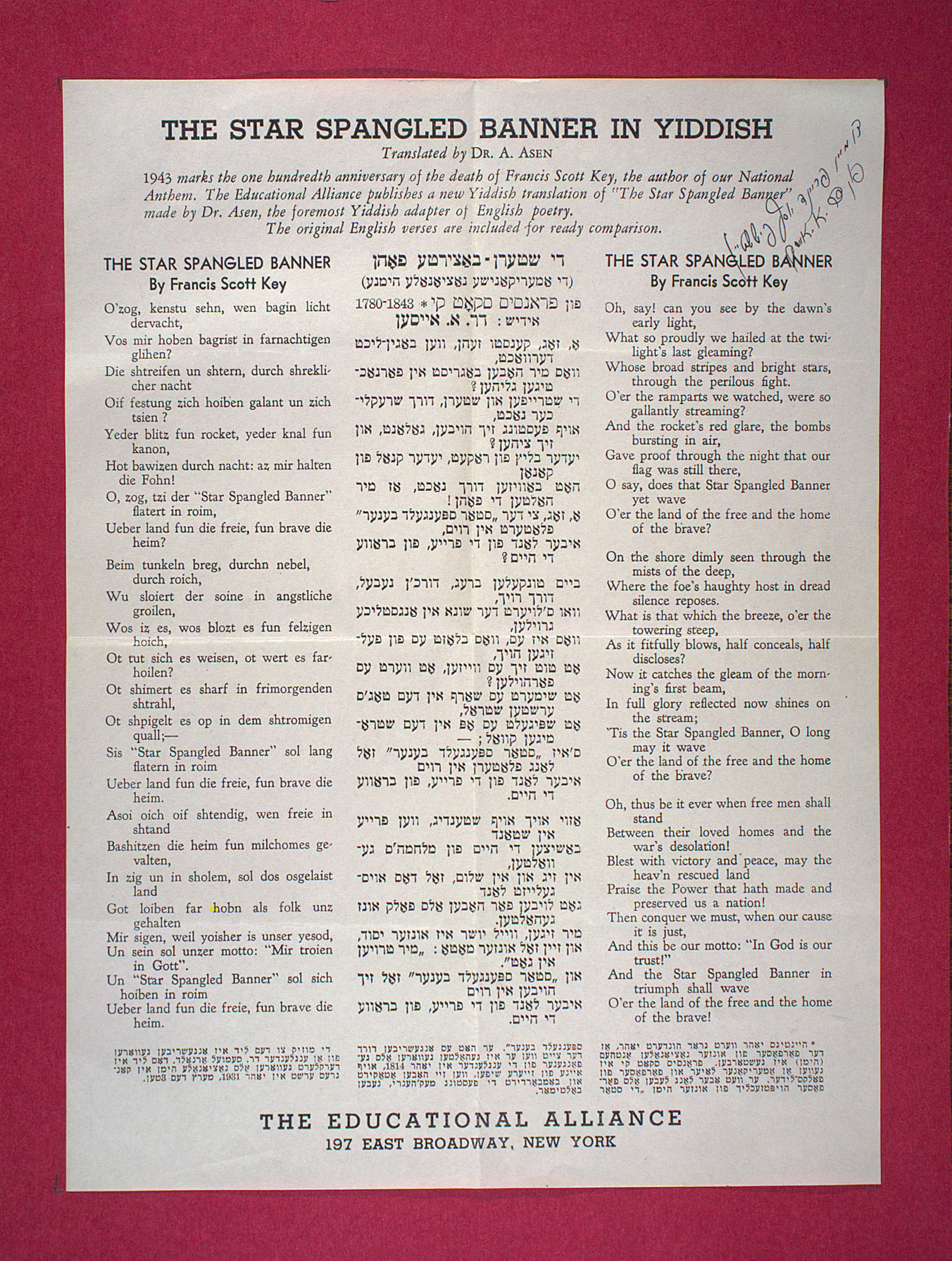
Another Yiddish version can be found here. and which appears below. It was published by the Educational Alliance in 1943 on the 100th anniversary of the death of Francis Scott Keys.
[Thanks A.L.]


SAMOAN

Aue! se'i e vaai, le malama o ataata mai

Na sisi a'e ma le mimita, i le sesega mai o le vaveao

O ai e ona tosi ma fetu, o alu a'e i taimi vevesi tu

I luga o 'Olo mata'utia, ma loto toa tausa'afia

O Roketi mumu fa'aafi, o pomu ma fana ma aloi afi

E fa'amaonia i le po atoa, le fu'a o lo'o tu maninoa

Aue! ia tumau le fe'ilafi mai, ma agiagia pea

I eleele o Sa'olotoga, ma Nofoaga o le au totoa.


A SPANISH version prepared in 1919 by the U.S. Bureau of Education.


It has also been translated into NAVAJO and applauded when sung in public.

In 2002, the Cherokee National Youth Choir sang their English and Cherokee version of the Banner in a performance at the Department of the Interior! The Cherokee nation has actually revised the SSB into their own United Cherokee national anthem which can be heard here. This is the only version I've come across that actually falls under Etizoni's edict against separate ethnic national anthems.

In 1923, an article in the Scientific Monthly complained that when brought into a class to be taught "Americanism" Finnish immigrants wouldn't sing the Star Spangled Banner. Incidentally, the Finns are criticized for their radicalism and described as "Orientals."

In the early 1940s at the height of war-time unity, Metropolitan Opera Chorus & National Broadcasting Company Symphony Orchestra, conducted by Arturo Toscanini performed the Internationale sung in Russian, followed by the US anthem. MP3
There was controversy when Jose Feliciano sang the SSB in 1968 and when Jimi Hendrix turned an instrumental version into an anti-war protest at Woodstock, but those passed.
Translating the Star Spangled Banner into other languages--whether Spanish, Navajo, or Yiddish-- is not un-patriotic. It is part of the process of self-Americanization.

Update: Norm Geras discusses the controversy on Norm's blog. I like his conclusion.

Whether or not US citizens should all learn English and know how to sing the national anthem in English, it's perfectly OK to have a Spanish version. It's the land of the free, isn't it? So people can sing the thing every which way they want. And having a Spanish version is a way for Spanish-speaking US citizens to embrace the anthem to their bosoms. It may not be the only way, but it's a way.
Joshua Rosenau on the anthem (O'zog, kenstu sehn, wenn bagin licht dervacht) at Thoughts from Kansas.

Update March 29, 2009 A couple of minor spelling and grammatical changes made. In the qu ote about Harris poll, an ellipsis was added to make it clearer. A source for the Harris Poll has been added. I don't think it was the original source, but a reference is belatedly provided.

Public outrage growing over Darfur

From Think Progress

Public outrage, sporadic before, is growing over the continuing bloodshed in Darfur,” the New York Times reports. George Clooney, Russell Simmons, U.S. Olympic gold medal winner Joey Cheek, Sen. Barack Obama (D-IL), Rep. Nancy Pelosi (D-CA), and dozens of others will be joining Darfur rallies around the country on Sunday. As Clooney said today, “What we cannot do is turn our heads and look away and hope that this will somehow disappear. It’s the first genocide of the 21st century.

Tuesday, April 25, 2006

Roberts is no Pearson, no Kassebuam

Pat Roberts is showing that he lacks the moral and political stature of past Kansas Republican Senators like James Pearson and Nancy Kassebuam, who on important ocassions placed the national interest above partisan politics.

Joshua Marshall on Kansas Senator Pat Roberts nefarious delaying and obfuscating tactics as chair of the Senate Intelligence Committee.

You'll remember how Sen. Roberts (R-KS), Chairman of the Intel committee, broke up the senate investigation into the Iraq intel debacle into two 'phases' and in so doing managed to push the report about President Bush's role in the bamboozlement out past the 2004 election.

Apparently it worked so well the first time he's going to try it again.

According the to The Hill, Chairman Roberts now wants to take the part of the investigation he split off to get it past the 2004 election and further split up the split off part in to two new pieces. That should help him get it all past the 2006 election.

Got that?

Again, in 2004 Roberts splits the investigation in two, pushing the investigation of the administration's complicity out past 2004, in order to protect President Bush, who instructs Roberts on what to do. He's been sitting on this 'part two' phase ever since.

Now he wants to break up part two into two new parts -- that should provide enough delay to kick it out past 2007. (Actually, The Hill article is a bit unclear about whether Roberts is now proposing two chunks or three. But who's counting. Remember how the Dems shut down the senate last fall and forced the Roberts to move ahead with phase two? Guess that didn't pan out.)

Must reading for progressive Dems

American Prospect is bringing, in installments, an important paper by Ruy Texira and John Halpin. Michael Tomasky, TAP's editor describes it this way

John Halpin of the Center for American Progress Action Fund and Ruy Teixeira of CAP and the Century Foundation (and co-author of The Emerging Democratic Majority) undertook research on the state of the Democratic Party and progressive politics in America. Their chief concern: To get to the bottom of the question of why so many Americans don’t have a firm sense of what progressives and the Democratic Party stand for today.

The result of their efforts is this paper, The Politics of Definition: The Real Third Way. The paper can be read in part as a 2006 answer to The Politics of Evasion, the landmark 1989 study by William Galston and Elaine Kamarck, which described a more centrist politics and helped lay the groundwork for Bill Clinton’s ascendancy (and which they updated last year in The Politics of Polarization).


Part I looks at the basic problem facing progressives and the Democratic Party -- the “identity gap” faced within many specific voter groups -- and then surveyed electoral areas of Democratic and progressive strength.

Part II discusses areas of Democratic and progressive weakness.

I'll post links to Parts III and IV when they are available. There's already a vigorous discussion of the paper underway and sure to be more.

Keep your eyes open. Happy reading.


The other Iraq

Labour Friends of Iraq has a report on a recent fact-finding trip of British trade unionists.

Dave Anderson MP (Chair Labour Friends of Iraq) and Sue Rogers (TUC General Council) give an initial report of the recent LFIQ fact-finding trip to Iraq where we met the leadership of the Iraqi and Iraqi Kurdistan trade union movements.

Iraq may be on the knife edge of full-scale civil war but there is another Iraq and a non-sectarian future through its growing labour movement.

A million trade unionists are on the march throughout Iraq. A network of non-sectarian union federations, professional associations and civil society groups has emerged in Iraq and Iraqi Kurdistan.

They could hold the key to uniting the country in peace and prosperity but only if the federal government's repressive efforts to ban independent activity using Saddam's anti-union laws and by seeking to create sectarian client unions is reversed.

Iraqi unions want urgent assistance to retrieve their independence and to boost their clout as a social partner in reconstructing Iraq. This is a huge task.

Thursday, April 20, 2006

Boyda seeks rematch

The Lawrence Journal World reports that Nancy Boyda is going to run against Jim Ryun again but plans an entirely different campaign.

Democrat Boyda says Iraq war was mistake, announces House seat rematch Scott Rothschild — Democrat Nancy Boyda said Wednesday that she had figured out how to beat U.S. Rep. Jim Ryun, a five-term Republican incumbent.

Boyda, of Topeka, said she would turn down any help from Washington consultants, and she wouldn’t spend time talking about GOP campaign finance scandals.

Instead, she said she would focus on health care, closing tax loopholes that currently benefit “mega corporations,” and getting the money-changers out of Congress.

“Nothing is going to change until we change Congress,” she said.

In setting up a rematch against Ryun, of Lawrence, Boyda told approximately 200 supporters at a Capitol rally, “My Momma did not raise a quitter, and we are going to get it done this time.”

Wednesday, April 19, 2006

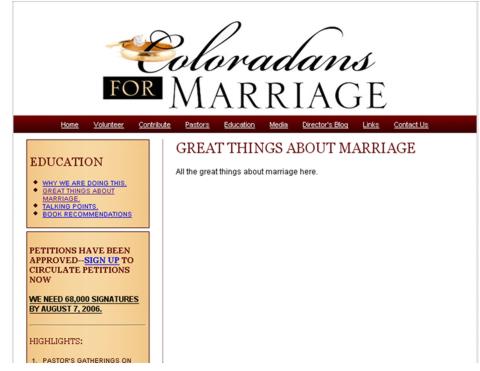
Coloradans for Marriage Draws a Blank


"GREAT THINGS ABOUT MARRIAGE
All the great things about marriage here"

Not a comedians joke. Not a parody.

This is a screen shot of a page on the website of the Colorado group pushing for a constituional amendment. http://www.marriageforcolorado.com/educationgreatthings.jsp

Wichita gets and doesn't get beat culture

Believe it or not Wichita, Kansas had a real connection to the beats. Allen Ginsberg came through Doo-Dah several times and wrote what I am told is one of his better poems ("Wichita Vortex Sutra") here. Several folks with Wichita or Kansas roots were significant players in the beat art scene. There's a website devoted to the Beats and Kansas Local musician and historian Pat O'Conner has preserved some of this history in his book Moody's Skidrow Beanery.

(Info on MSB and other books by O'Conner is here and a chapter is available on-line here.)

So it is cool that the Ulrich Museum at WSU is hosting from April 21 to July 9, the international traveling exhibition "Semina Culture: Wallace Berman and His Circle."

Berman was "the quintessential visual artist of the Beat era. Showcasing the artists and poets who contributed to "Semina", Berman's free-form journal published in California in the 1950s and 60s, this multimedia exhibition includes rarely seen collages, paintings, assemblages and films by Toni Basil, Jay DeFeo, Allen Ginsberg, Walter Hopps, Michael McClure, Dean Stockwell, and Berman himself."

Even better the Ulrich is has a program devoted to the films of McPherson born Bruce Conner (May 11-12) and partnering with the Murdock Theatre to show a number of movies with "beat" themes.

But just when you think Wichita gets it, the town's cultural mavens once again show that there is just about nobody more hick and gauche hereabouts than our cultural "elite."

On Thursday night April 20 there's an exclusive $20 a person for members only preview party. Bad enough. I happen to think it might make an authentic beat--or anyone with a genuine respect for the beats--a little queasy. But then there's this part of the invite

Beatnik attire encouraged

"Beatnik" is, of course, a derogative term. Years ago Wichita's beats gathered at Moody's Skidrow Beanery. It is hard to imagine a greater gulf between the Beanery and this reception at the Ulrich. Is it written somewhere that every exhibit has to have a big-donor reception. This come dressed up as a "freak" invite is just plain disgusting. It's rich folk slumming. It reminds me of the crude stereotyping of beatniks and hippies in TV shows like Dragnet and Dobbie Gillis.

Not that much has changed. Here's a paragraph from O'Conner

The artists, musicians, and poets who gathered at the Beanery were involved in expressing ideas for the betterment of society. The symbols chosen, modern art and Beat poetry, were to serve a "new generation." The humble cast of the dwelling and the shabbiness of those who went in acted as clear indictments of an insensitive majority. This same majority labeled the Wichita Beats and folk singers as deviant.

So even when Wichita recognizes the beats, it really doesn't get it.

(And, here's another question. Why hasn't the Ulrich invited Pat O'Conner to give a talk on the beats in Wichita. I imagine he knows more about this subject than just about anyone.)


Defeat for Kline in teen sex inquisition

AP reports

WICHITA, Kan. (AP) -- In a victory for an abortion rights group, a federal judge ruled Tuesday that abortion clinic doctors and other professionals are not required under Kansas law to report underage sex between consenting youths.

The ruling by U.S. District Judge J. Thomas Marten was a setback for Kansas Attorney General Phill Kline, an abortion foe.

Kline contended a 1982 Kansas law requiring doctors, teachers and others to alert the state and law enforcement about potential child abuse covers consensual sex between minors. He argued that the law applies to abortion clinics, and later extended that to other health professionals and teachers.

The Center for Reproductive Rights challenged that interpretation in court, and the judge sided with the organization. Kline said he had not decided whether to appeal.

"It's not unexpected," Kline said. "It's what we've been predicting."

Marten ruled that a plain reading of the Kansas law gives health care providers discretion to determine whether there is reason to suspect a child has been injured as a result of sexual abuse.


Kline's position was actually more extreme than this AP story conveys. He argued that even under-16 teen sexual contact even far short of intercourse had to be reported. According to Kline, what used to be called "second base" is required to be reported as illegal sexual activity between minors.

There's a better, more accurate story from the Wichita Eagle's Ron Sylvester

Marten, however, also ruled that Klines efforts to narrow the interpretation of the law wasn't proper, r. A legal opinion offered by Kline in 2003 could have forced health care professionals to report most sexual activity among their patients under the age of 16.

That opinion prompted a lawsuit against Kline and prosecutors such as Sedgwick County District Attorney Nola Foulston by a group that included doctors, nurses, social workers and psychologists from the Wichita and Kansas City areas. They contended Kline's opinion, if enforced, would invade the privacy of their young adult patients.

Marten pointed out that both sides conceded that mandatory reporting should include all cases of incest, sexual abuse of a child by an adult and sexual activities involving a child under age 12.

"Therefore," Marten wrote, "the only issue presented is whether consensual underage sexual activity must be reported (under Kansas law)."

The Eagle has the judge's opinion on-line in a PDF.

Tuesday, April 18, 2006

Umansky Doesn't Believe Hersh

There has been a lot of excitement in peace and left circles about Seymour Hersh's report that the Bush adminstration is planning nuclear war against Iran. But one of the best writters on the left has some questions. Eric Umansky has doubts about Hersh's story.

I have little faith in Hersh's story to begin with. I don't know he's wrong, but I'm far from convinced he's right.

Why do I say that? Let's look at his sources. There are four, or perhaps only three, backing up his main contentions. Here is how Hersh introduces them:

  • "A former senior intelligence official"
  • "A senior Pentagon adviser on the war on terror"
  • "One former defense official"
  • "A former high-level Defense Department official" [Note: I'm listing this as a different source than the one above it, but Hersh doesn't clearly signal that they're different. For example, he could have written, "another former defense official"]

So number of "current" officials cited: 1--if you count the "adviser." The "Pentagon adviser," I suspect, is a member of the Defense Science Board, members of whom are also cited in the story. The DSB are civilians who work part-time advising the SecDef. They are not involved in nuts-and-bolts planning.

Sunday, April 16, 2006

Lame ideas from Richard Lamm

An organization called Kansas Health Ethics brought in former Colorado Governor Richard Lamm for their annual conference last week.

According to the Speakers Platform website, Lamm's speaking fee is from $5,000 to $10,000. Let's see what KHE got for their money.

He said some loony things. But that is to be expected. Because he is a former three-term Democratic governor, he has become a favorite vehicle to deliver right-wing messages-- whether on immigration or health care. I'm not saying that is what KHE wanted but that's what they got. (It might, of course, be what Charles Koch, a big contributor to KHE wants.)

Te headline in the Eagle blars "Health care should require moral choices"

At a time when 40 million Americans have no health insurance, when America spends more for health care and get far worse health care than any other industrial country, Lamm's message is "Our current system maximizes the demand for medical services paid for with pooled resources that insulate people from cost."

According to Eagle reporter

Richard Lamm is not suggesting you kill your ailing elderly mother to save health care costs.

But he is suggesting that health care reform will require Americans to make moral decisions based on priorities that impact the greater good -- and that might mean no more transplants for 85-year-olds.

Maybe it's time to let grandpa die peacefully and naturally...
Moreover,
Perhaps it's time, Lamm said, for a national health policy that denies, for example, care to obese patients until they lose weight, or denies coronary bypass surgery to patients who won't quit smoking.

People need to take responsibility for their health -- and their health care costs, he said.
And this, too,
40 percent to 70 percent of deaths from the most common diseases -- like heart disease and cancer -- are attributable to individual lifestyle choices such as smoking, diet and inactivity.

Where does America draw the line at supporting these bad habits by paying for health costs once the damage is done?

Not a very precise estimate, is it?

Although, Lamm says he is for universal health care, his message is a reactionary one, right in sync with the attempts of Bush and right wing think tanks to push Health Savings Accounts.

In short, Kansas Health Ethics paid big bucks to have an expert tell highly-paid doctors that the problem with medical care is the patients.

This analysis is completely mistaken. Kansas Health Ethics would have done a better job if they had simply reprinted and discussed the recent New York Review of Books article by Paul Krugman and Robin Wells.

Krugman and Wells note that
"Comparing common benefits," says the Kaiser Family Foundation,
changes in Medicare spending in the last three decades has largely tracked the growth rate in private health insurance premiums. Typically, Medicare increases have been lower than those of private health insurance.
Moreover,
why does US health care cost so much? Part of the answer is that doctors, like other highly skilled workers, are paid much more in the United States than in other advanced countries.

[Wonder how that would have gone over with the doctors and movers and shakers cultivated by KHE. ]

But the main source of high US costs is probably the unique degree to which the US system relies on private rather than public health insurance, reflected in the uniquely high US share of private spending in total health care expenditure.
In fact,
if the United States were to replace its current complex mix of health insurance systems with standardized, universal coverage, the savings would be so large that we could cover all those currently uninsured, yet end up spending less overall. That's what happened in Taiwan, which adopted a single-payer system in 1995: the percentage of the population with health insurance soared from 57 percent to 97 percent, yet health care costs actually grew more slowly than one would have predicted from trends before the change in system.

(For more on health care options, see Ezra Klein fine web essay on the health of nations.)


Lamm's Ties to Anti-Immigrant and Racists

Lamm is coauthor of the 1986 book The Immigration Time Bomb: The Fragmenting of America. In recent years he has worked closely with Colorado Congressman Tom Tancredo, the most rapid anti-immigrant politician in Washington, D.C.

("[w]hen The Denver Post profiled an illegal immigrant high school student with a 3.9 grade point average, Tancredo tried to have the boy deported," as well as his family. The New Republic article also quotes Tancredo saying that keeping immigrants out of the United States is a question of national identity and accusing his opponents of nihilistic cultural relativism and anti-americanism

In 2004, Lamm was part of an unsuccessful attempt by anti-immigrant activists to take over the Sierra Club, the nation's largest environmental group. Lamm had never been active in the Club. In fact, he joined the Sierra Club at the same time he filed as a petition candidate for the national board .

In a letter to Sierra Club President Larry Fahn, dated October 21, 2003, Mark Potok, the editor of the Southern Poverty Law Center's Intelligence Report warned: "Without a doubt, the Sierra Club is the subject of a hostile takeover attempt by forces allied with [John] Tanton and a variety of right-wing extremists. By taking advantage of the welcoming grassroots democratic structure of the Sierra Club, they hope to use the credibility of the Club as a cover to advance their own extremist views. We think members should be alert to this."

Lamm is chair of the national advisory board of the Federation of American Immigration Reform.

Here's a Southern Poverty Law Center Report on John Tanton, the key figure in FAIR and the anti-immigrant movement. It details Tanton's close ties to racists and white supremacists.

Another revealing report is from the Center for New Community.

Here are a few of the disturbing facts about FAIR
  • FAIR has received over $1 million in donations from the notorious racist Pioneer Fund.
  • Tanton started a publishing house/magazine called "Social Contract Press." He hired as editor Wayne Lutton who has published over a dozen articles in the holocaust denial publication, The Journal for Historical Review. Lutton is on the editorial board for the New Century Foundation which publishes the racist magazine American Renaisance. He also sits on the editorial advisory board of the Citizen Informer, the magazine of the neo-confederate Council of Conservative Citizens, the successor organization to the White Citizen's Council.
  • At a 1997 anti-immigrant rally in Alabama, FAIR West Coast staffer Rich Oltmann shared the platform with leaders of the CCC and William Burchfield, a one-time leader of Thom Robb's Knights of the Ku Klux Klan.
  • FAIR's weekly television show"Borderlines" has featured white nationalist leaders including Sam Francis and Jared Taylor.
  • In a 1988 memo in support of immigration control (never intended to be made public), FAIR founder John Tanton wrote, "As Whites see their power and control over their lives declining, will they simply go quietly into the night?"
  • Garrett Hardin, a member of FAIR's board of directors, has been quoted as saying that sending food to Africa encourages people to overpopulate, and that infanticide is a valid population-control method.
And, less you think that Lamm is an innocent dupe of extremists, take a look at this 2004 speech about the "plot to destroy America" by promoting multiculturalism.

FAIR and Kansas

FAIR has done some mischief in Kansas. In 2001, using a front group called the Coalition for the Future American Worker, placed anti-immigrant radio, television, and newspaper ads in Wichita and Kansas City These ads falsely sought to create the impression that they have the support of labor unions and environmental groups.

Similar ads and direct mailings appeared in the Kansas City area in 2004 in support of Congressional candidate Chris Kobach, who attempted fan anti-immigrant sentiments in his campaign to unseat Democratic Congressman Dennis Moore. Kobach was hired by FAIR to bring a lawsuit to overturn the Kansas law permitting Kansas-educated immigrants to qualify for in-state tuition.

Ethics Suggestions

Maybe next year KHE can have a session on the ethics of hosting a fradulent analysis of health care by windbags who actively work with racists and extremists and who promote division and hatred.

Here's the email for Patresa Ebersole, Executive Director of Kansas Health Ethics: pebersole@kansashealthethics.org