Wednesday, July 19, 2006

Wichita Sit-ins Recognized by NAACP

Sit-ins at lunch counters are a well-known part of the civil rights movement. There is a an important part of that story is almost unknown.

During the 1940s, CORE, the Congress on Racial Equality, an organization of socialists, pacificists, and others, used sit-ins to desegregate a number of restaurants in the Chicago area. Almost two decades later, sit-ins by Negro students in Nashville, Tennessee, and then to hundreds of communities across the South caught the nation's attention and helped intensify the modern civil rights movement.

But, the first student sit-ins of the modern civil rights movement took place, not in Nashville, not in Greensboro, North Carolina, but in Wichita, Kansas and Oklahoma City.

Today the national NAACP is recognizing those pioneers.

Christina Woods writes about it in the Wichita Eagle

It was 48 years ago today that Ron Walters and other members of the local NAACP Youth chapter sat down inside Dockum Drugstore in downtown Wichita.
By silently sitting to demand service, the youths, ages 15 to 22, were protesting the discriminatory practice that pushed black people outside to eat while white people dined inside.
Less than four weeks later, the business agreed on Aug. 11, 1958, to desegregate all nine of its Wichita locations.
Wichita's sit-in story is largely unknown outside of Wichita, even though it sparked sit-ins by the NAACP youth chapter in Oklahoma City.
But much of that anonymity should change today.
The National NAACP is officially recognizing Wichita's sit-in as the first youth-led lunch counter sit-in that brought about widespread changes.
Walters and a representative from the Oklahoma sit-in, Clara Luper, will accept the honor tonight during the organization's annual convention in Washington D.C.
"They're going to be recognized as the youth councils that led some of the first protests," said John C. White, the NAACP's national spokesman.
The Eagle also has a very nice multimedia feature on the sit-ins.

After looking at the multimedia stuff, I thought, "gee, the Eagle should have reprinted some of their articles and photos from the period. Woods explains why they didn't.
The Eagle carried just one article on the local demonstration. No photos were published.
"Those stories never got in," said Mary Cooley Gardner, a former Eagle columnist and reporter from 1957 to 1961.
Staff was instructed not to write articles that would upset the downtown business community.
For more about the Wichita sit-ins and civil rights movement, read Gretchen Cassel Eick's Dissent in Wichita.

"Disproportionality" in Perspective

Most people acknowledge that Israel had a right to react militarily to armed attacks by Hezbollah from Lebanese territory. But it is said that Israel's response is "disproportionate. "

Becuase of diplomatic concerns and "oil," some criticism is necessary. But this has led to some confusion. Some simple-minded people think "proportionality" means that acting in self-defense, a nation can respond only on a tit for tat basis. To this way of thinking, if the enemy kills one of your soldiers, killing two in response is disproportionate. This is, of course, nonsense. The proportionality requirement is that military actions "should remain strictly proportional to the objective desired." (Source)

I'm not going to attempt that analysis today, instead I'd like to focus on a slightly different question.

Is the number of deaths in the current conflicts in Gaza and Lebanon disproportionate?

For the moment, let's leave aside places like Darfur and the Congo, Bosnia and Chechneya and look at deaths in conflicts in the Middle East not involving Israel and two cases of persecution of Muslims in China and Bulgaria. This is by no mean a comprehensive list


Middle East Casualties

Lebanese Civil War 1958 4000 killed
Source

Lebanese Civil War 1975-1976 44,000 killed

"deaths may have approached 44,000, with about 180,000 wounded; many thousands of others were displaced or left homeless, or had migrated. Much of the once-magnificent city of Beirut was reduced to rubble and the town divided into Muslim and Christian sectors, separated by the so-called Green Line."
Source

Algerian Civil War 1993-1998 70,000 civilians killed

"the Armed Islamic Group, was believed largely responsible for the series of village massacres that characterized the war. About 70,000 civilians were butchered (1993-98) in surprise raids throughout the country, especially in places where members of civil defense groups were believed by the militants to be located."
Source

Black September PLO vs. Jordan 1970-1971 3,500 killed
Source

Druze Revolt 1924-1927 9, 000 killed

4000 French, 5000 Druze

"News of the Druze rebellion spread throughout Syria and ignited revolts in Aleppo and Damascus among Syrian nationalists, who pleaded with Atrash to attack the Syrian capital. In October the Druzes invaded the Damascus region; nationalist leaders led their own demonstrations; and the French began systematic bombardment of the city, resulting in the death of 5,000 Syrians. The rebellion collapsed by the end of the year, and reluctant order replaced open revolt."
Source

Syrian Baath Vs. Muslim Brotherhood 1980-1982 20,000-50,000 killed

"The armed conflict between the Muslim Brethren and the regime culminated in full-scale insurrection in Aleppo in 1980 and in Hamah in February 1982. The government responded to the Hamah revolt with brutal force, crushing the rebellion by killing between 10,000 and 25,000 civilians and leveling large parts of the city...

"In February 1982, the Muslim Brotherhood ambushed government forces who were searching for dissidents in Hamah. Several thousand Syrian troops, supported by armor and artillery, moved into the city and crushed the insurgents during two weeks of bloodshed. When the fighting was over, perhaps as many as 10,000 to 25,000 people lay dead, including an estimated 1,000 soldiers.
Source


Turkey Vs. The Kurds 15,000 killed

"...between 1982 and 1995 some 15,000 people were killed, the great majority of whom were Kurdish civilians. Dozens of villages were destroyed and many of the inhabitants driven from their homes. Turkish forces also attacked PKK bases in Iraq, first from the air and then with ground forces; in an operation in late 1992 about 20,000 Turkish troops entered the safe havens, and in 1995 some 35,000 were employed in a similar campaign..."
Source

Bulgaria vs. Turkish Minority 1984-1985 500-1,500 killed

"500 to 1,500 people were killed when they resisted assimilation measures, and thousands of others went to labor camps or were forcibly resettled."
Source

Armenian Genocide 1915-1917 600,000-2,000,000 killed

"In the early stages of World War I, in 1915 Russian armies advanced on Turkey from the north and the British attempted an invasion from the Mediterranean. Citing the threat of internal rebellion, the Ottoman government ordered large-scale roundups, deportations, and systematic torture and murder of Armenians beginning in the spring of 1915. Estimates vary from 600,000 to 2 million deaths out of the prewar population of about 3 million Armenians. By 1917 fewer than 200,000 Armenians remained in Turkey."
Source

China: Shadian Incident 1975 5,000 killed

“....the Chinese army used artillery to crush a Muslim uprising in the village of Shadian in Yunnan, killing as many as 5,000 people."

Source: James Miles, The Legacy of Tiananmen: China in Disarray. Ann Arbor: University of Michigan Press,1997. p. 180.

UPDATE (Aug) 2, 2006

Turkey: Kurdish (PKK) Conflict 1984-2006 37,000 killed

More than 37,000 people have been killed 1984 since the PKK, listed as a terrorist group by Turkey, the European Union and the United States, took up arms to fight for self-rule in the mainly Kurdish southeast.

Source: AFP: Turkish President Signs Controversial Law, July 17, 2006

Tuesday, July 18, 2006

The Poor Pay More

A new study from the Brookings Institute shows that the poor in 13 major cities in the US tend to pay substantially more for the same consumer services.

By taking out higher-interest mortgages, shopping at rent-to-own furniture stores, using check-cashing businesses instead of banks and buying groceries at convenience stores, the nation’s working poor households pay much more than moderate- and high-income households for life’s essentials…

The report — “From Poverty, Opportunity: Putting the Market to Work for Lower-Income Families” — calls on government officials to create laws to curb services that gouge low-income consumers, and it proposes reproducing fledgling programs the authors found across the country.

The report finds that:

Reducing the costs of living for lower income families by just one percent would add up to over $6.5 billion in new spending power for these families. This would enable lower and modest-income families to save for, and invest in, incoming-growing assets, like homes and retirement savings, or to pay for critical expenses for their children, like education and health care.

To download the report go here.

Support Perscuted Gay Iranians

From Doug Ireland


COME OUT TOMORROW TO SUPPORT PERSECUTED GAY IRANIANS

A reminder: Tomorrow (Wednesday, July 19) is the International Day of Action Iran_noose_16 Against Homophobic Persecution in Iran, called on the first anniversary of the public hanging of two teenagers, Mahmoud Asgari and Ayaz Marhoni, for homosexuality.

There will be vigils and demonstrations on July 19 in 25 cities around the world -- including 10 in the U.S.

Three Views of Middle East Crisis

David Hirsch

Since before it even existed, Israel has been engaged in two wars with its neighbours. One is a just war, waged by Palestinian Arabs for freedom - which became a demand for Palestinian national independence; the other is a genocidal war that aims to end Jewish life in the Middle East.

The job of the left is to insist on the reality of this distinction and to stand against those who recognise the reality of only one or other of these two separate wars.


we must keep fighting against those who think that the only real war is an Israeli war of survival, as we keep fighting against those who think that the only real war is against the Israeli oppressor. The left has to think differently, and it has to create a different reality. We have to know which side we are on. We're on the side of the Palestinian struggle for independence and we're on the side of the Israeli struggle against the jihadists (not to mention the Palestinian, Iranian, Syrian, Egyptian and Lebanese struggle against the jihadists, as well as the trade union, socialist, democratic, lesbian and gay, feminist and secular struggles against them).


Eric Lee
No socialist group in Britain is saying what needs to be said today about the crisis in the Middle East. All the groups on the organised Left are busy denouncing Israel for its "aggression" against Gaza and Lebanon. Many are expressing their solidarity with the Palestinian and Lebanese peoples. None are saying that Israel needs and deserves the support of the Left.

But that is exactly what they should be saying.


Israel is under attack -- unprovoked, brutal attack. Attack by forces such as Hamas and Hizbollah with which socialists have nothing in common.

And Israel is responding in the way that any state, even a state with a workers' government, even an ideal socialist state, would respond. It is hitting back with all the firepower at its disposal, but doing so in a way to minimize civilian casualties. That is why it decided to flatten Hamas' foreign ministry building at 2:00 in the morning, when it was unoccupied. Or used targetted aerial bombardment to create craters in the runways of Beirut airport, rather than bombing terminals crammed with people. (Either way, they would have shut down the airport -- but they chose a way that saved innocent lives.)

Jo Ann Mort

As the well-respected Israeli journalist Avi Shavit recently wrote in Haaretz, the experiment of unilateral disengagement succeeded in confirming both that a majority of Israelis desire to end the occupation and that the republic is capable of acting on that majorities’ desire; but for the Palestinians and other Muslim populations in the area, the disengagement failed. “It strengthened the extremists among them, and weakened the moderates,” wrote Shavit. “It bolstered the ethos of an armed struggle, and brought Hamas to power; it undermined Israel's deterrence, and prompted Hezbollah to attack.” There are still voices of moderation in the region -- but they are not as moderate as Israel would like, nor as moderate as they once were. And they are in unlikely places.

Just as the situation in Gaza was escalating, many Palestinians were voicing support for a joint document, negotiated between factions of prisoners representing Hamas and Fatah, calling for a Palestinian state alongside Israel, set by the pre-1967 borders. The Fatah leader involved in the proposal is Marwan Barghouti, who was sentenced to five life terms for his role in the 2nd Intifada. These days, his name is on the tongues of many politicians, observers, and journalists, Israeli and Palestinian alike. There is hope that he may be someone with the capability to control the street while opening a political horizon for the Palestinians. Many are suggesting that the most useful prisoner exchange Israel could make would be one that frees Barghouti. One Palestinian businessman, close to the Fatah faction around Barghouti, told me that he thought the reason that actors in Syria -- and now Lebanon and perhaps Iran -- currently felt emboldened to strike was precisely because of the complete political vacuum in the Palestinian territories.

The dream of peace achieved unilaterally is clearly dead. Israel -- with international support -- must seek out voices in the region with which to engage, even ones that can’t quite accurately be described as “moderate,” and that discomfort Israelis. After all, an escalation of the current situation in the absence of such engagement -- with Hezbollah, Hamas, Syria, and Iran all involved in the mix -- offers an array of possible scenarios that are considerably worse than discomforting.

Monday, July 17, 2006

NAACP Honors John Brown

Harper's Ferry was the site of the second annual meeting of the Niagra Movement, the predecessor to the NAACP. In 1932, the NAACP attempted to place a plaque honoring Brown at a College in Harper's Ferry, but they were rebuffed. This year the NAACP honored Brown during a trip to West Virginia during their convention.

Here's the very moving speech by Julian Bond.

We are here today because this place and the martyrs who died here are inextricably tied to the NAACP and the unending struggle for freedom. There is an unbroken line leading from this place until today – a line and lineage we are come to commemorate and honor so that future generations will never forget.

John Brown’s biographer David S. Reynolds argues that no other white person, including President Lincoln, has been so widely admired among American blacks as John Brown.

One of our founders, Dr. W. E. B. DuBois wrote of Brown as "the man who of all Americans has perhaps become nearest to touching the real souls of black folk. John Brown worked not simply for black men – he worked with them; he was a companion of their daily life, knew their faults and virtues, and felt, as few white Americans have felt, the bitter tragedy of their lot."


Friday, July 14, 2006

Lop-sided Growth

Ezra Klein on the TAPPED blog riffs on Paul Krugman's look at the peculiar nature of the Bush recovery.

FOREHEAD GROWTH. Paul Krugman returns to the economics beat with an invaluable look at how our economy is growing:

Here’s what happened in 2004. The U.S. economy grew 4.2 percent, a very good number. Yet last August the Census Bureau reported that real median family income — the purchasing power of the typical family — actually fell. Meanwhile, poverty increased, as did the number of Americans without health insurance. So where did the growth go?

The answer comes from the economists Thomas Piketty and Emmanuel Saez, whose long-term estimates of income equality have become the gold standard for research on this topic, and who have recently updated their estimates to include 2004. They show that even if you exclude capital gains from a rising stock market, in 2004 the real income of the richest 1 percent of Americans surged by almost 12.5 percent. Meanwhile, the average real income of the bottom 99 percent of the population rose only 1.5 percent. In other words, a relative handful of people received most of the benefits of growth.


We should probably talk this one out for a moment. Growth is almost a misleading word for this phenomenon: When we think of growth, we imagine what happens to us during adolescence -- we get bigger. But imagine if all the growth happened in your forehead. Limbs, torso, weight -- all the exact same. But your forehead was now six inches long. Would you be excited about that change? Would you celebrate your newfound height? Would you categorize that as normal "growth"?

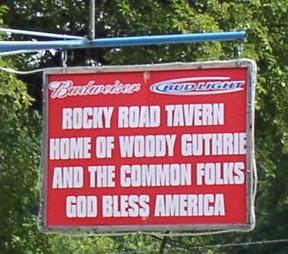
Woody Guthrie

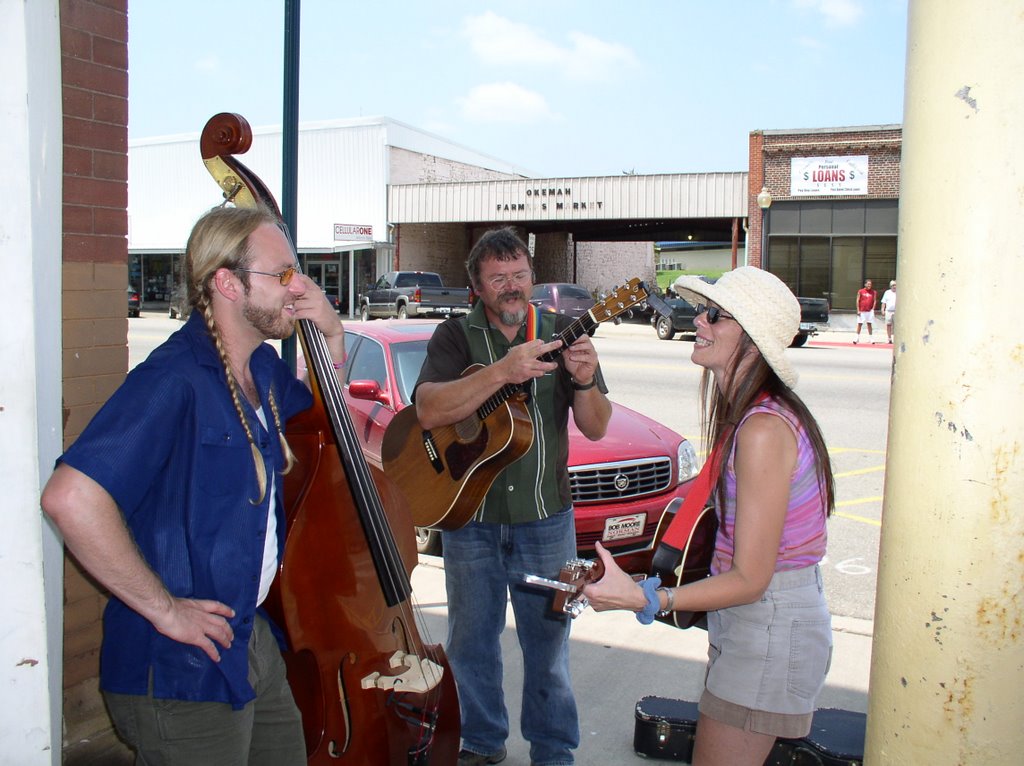
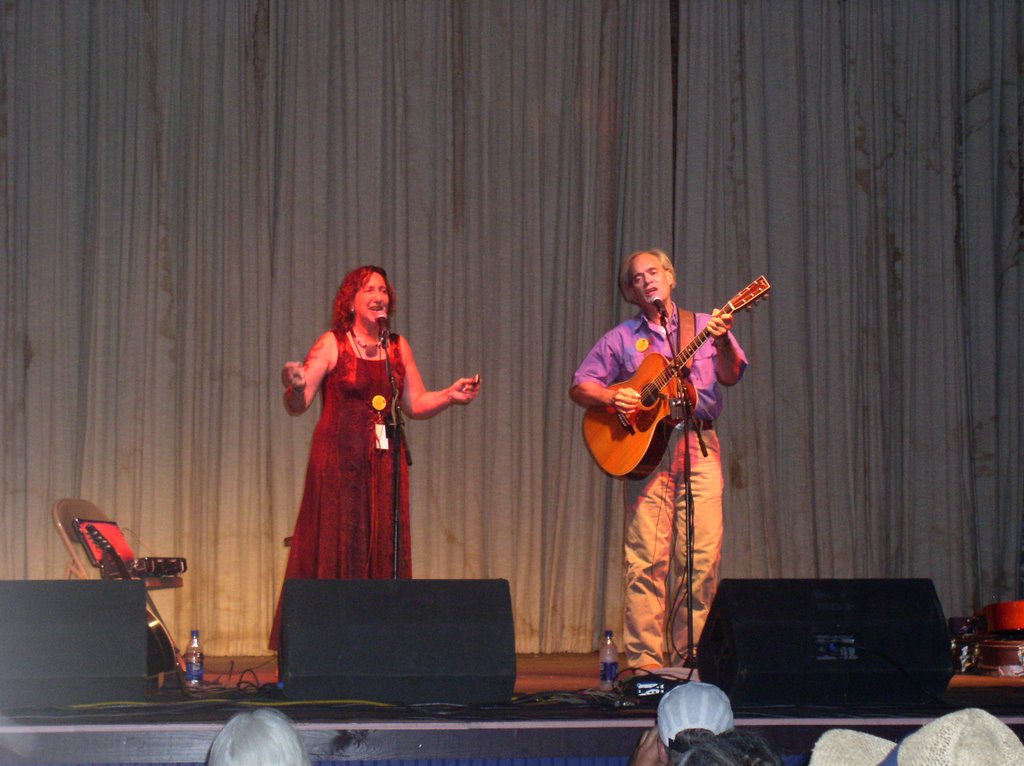
This is a photo from the 2005 Woody Guthrie Festival in Okemah, Oklahoma.

Essentially every American who has listened to the radio, or gone to summer camp, knows Woody Guthrie's “This Land is Your Land.”Public television’s “American Masters” series was devoted to Woody Guthrie this week. Wichita’s KPTS (Channel 8) aired the program this Wednesday July 11. I was only able to catch bits and pieces , but I was able to tape the program for close viewing later on.


And if you want a more contemporary take on Woody visit Woody's hometown of Okemah, Oklahoma sometime during annual Woody Guthrie Free Folk Music Festival. (July 12-16 this year.) With one exception everything about the festival is free. The exception is a Wednesday night fundraiser. This year features Arlo Guthrie's 40th Anniversary Alice's Restaurant Massacree Tour. Every event Thursday through Saturday is free. The musicians perform for free, but they are no amateurs. And don't let the July heat keep you away. Morning and afternoon sessions are held in the legendary Crystal Theater and the Brick Street Cafe in downtown Okemah.

I was able to go last year on Saturday and found it most enjoyable and I'm far from being a folk music fanatic. To top things off, I bought a raffle ticket and won a Taylor guitar.

If you’d like to know more about Woody, there’s a very nice article by Rob Collins from the Oklahoma Gazette or biographies by Joe Klein (Woody Guthrie: A Life) and Ed Cray (Ramblin’ Man). Two good sources for Woody CDs are Smithsonian Folkways and the Woody Guthrie Foundation.


Wednesday, July 12, 2006

Jack Krebs Responds to ID Smear Campaign

Red State Rabble. one of the two or three best blogs focusing on the wacky Kansas Board of Education and their attacks on the science of evolution has a statement that merits being posted in toto.


Jack Krebs, the president of Kansas Citizens for Science, has responded to a smear campaign against supporters of science education launched by John Calvert of the ID Network. Here's what Krebs had to say at the open forum session of the Kansas State Board of Education meeting in Topeka this morning:

Last month, the day after I spoke here, I was told that Kathy Martin handed out an article entitled “The Truth of Science and of Revelation” from the Catholic magazine “Columbia.”

I would like to thank Mrs. Martin for distributing this article, because it supports a major point that we at Kansas Citizens for Science believe: that there is not a conflict between accepting the theory of evolution and believing in God.

Here is what the article says about Catholic doctrine:

“Believing that God designed the world doesn’t mean you have to reject Darwinism or any other scientific explanation… The Church has always taught that natural processes and the laws that govern them are themselves part of God’s design. … It is quite acceptable to say that evolution by natural selection is the way God did it.”

However, the Intelligent Design advocates claim that one cannot accept both evolution and God. Currently, John Calvert is distributing a pamphlet entitled “Character Assassination and Denigration of Theism.” In it, he says that Kansas Citizens for Science has been a “tool” used to “promote a materialist world view that seeks to demean the idea of creation, … effectively promoting non-theistic religions and world views over traditional theistic views.”

This is categorically false. Kansas Citizens for Science does not promote any particular religious view. We do not promote materialism, nor do we promote non-theistic over theistic religions.

Board members of KCFS include an evangelical Christian, a Presbyterian minister, mainstream Protestants and Catholics, Unitarians, agnostics and atheists. Science can and does accommodate all those religious beliefs, and more. We believe that science is a limited form of knowledge, and that many essential matters of morals, values and spiritual belief fall outside the realm of science.

Calling us materialists and atheists just because we support mainstream evolutionary theory is a blatant falsehood, and we object to being characterized as such.

John Calvert has been instrumental in developing and promoting your science standards. Therefore, I want to go on public record here, in front of you, in asking that Calvert quit making these false accusations that those of us who accept modern science and evolutionary theory can’t also accept God. Many tens of thousands of religious Kansans are being painted as “tools of atheism” by these accusations, and they have a right to be insulted.

Kansas Citizens for Science firmly believes that science, as the “activity of seeking natural explanations about what we observe in the world around us,” is both the best way of learning about the physical world and is fully compatible with a wide diversity of religious beliefs, including traditional Christian beliefs about God.

Things I learned from Bill O'Reilly This Week

From just listening for less than one-hour on Monday and Tuesday.

"Christianity isn't a religions."

(Monday: It's a philosophy so it's okay for government buildings or war memorials to prominently display a cross. According to Bill, Catholicism, Presbyterianism, etc. are religions.)

"The New York Times isn't a newspaper"

(Tuesday.)

Sunday, July 09, 2006

Making the Case for US Grant

Nathan Newman

In 1854, abolitionist William Lloyd Garrison led a crowd celebrating Independence Day by burning the Constitution, denouncing it as "A Convenant With Death and an Agreement with Hell." His worthy point was that the founding fathers of the nation had make a mockery of their own words with the stain of slavery and deserved scorn for the constitutional product of their labors.

So as we celebrate the founding of our nation, maybe we should think more about the true founding of a nation with the Civil War where all men were to be "truly created equal" and the President who worked to make it so. No not Lincoln-- who didn't live to finish the job--but the General, Ulysses Grant, who won the Civil War and went on to be the President who would oversee the ratification of the 15th Amendment and enactment of the civil rights enforcement laws that -- after the interregnum of disuse under Jim Crow -- to this day are a backbone of civil rights in this nation.

It is odd that when liberals list the greatest Presidents, Grant rarely makes the list. Roosevelt of course is a worthy option, Kennedy gets the charisma-addict vote and Lincoln deserves respectable mention.


Tuesday, July 04, 2006

The Myth of a "Censored" Jungle

In 2003 See Sharp Press, a small Tucson publisher came out with what was billed as "the Uncensored Version" of Upton Sinclair classic The Jungle. The only problem is that the claims appear to have been overblown. Historian Christopher Phelps discusses the issues in great depth on the History New Network.

Is it any wonder that reviewers have found it impossible to resist the romance of a forgotten, authentic, suppressed version of The Jungle? Library Journal, in classifying the See Sharp edition as “essential,” deplores the novel’s “butchering” and claims “Sinclair later wanted to reinsert the expurgated material for a full-length version but that never came to fruition” (April 15, 2003). The People’s Weekly World, newspaper of the Communist Party USA, states, “If you have never read The Jungle, don’t waste your time on the 1906 censored version. Go right to the original, now available, at a reasonable price, and feel and experience the real message that Upton Sinclair so deeply desired to convey to his readers” (May 29, 2004).

Just one problem: none of the sensational claims made on behalf of the See Sharp edition is true. The Jungle was not censored. Sinclair did not revise the text to meet the coercive demands of a commercial publisher. He never wanted the 1905 serial version to become the standard edition. And the novel, as eventually published in book form, has a political message that is perfectly clear.

Phelps discusses the history of The Jungle in great depth and makes a most convincing case.

Before the Phelps posted his essay on HNN, Earl Lee defended the See Sharp edition from earlier criticisms from Phelps and others. But it seems to doesn't he doesn't really have much of case when he argues that The Jungle was "censored." Now, it is possible that the serialized version originally published in The Appeal to Reason in 1905--the basis for the See Sharp edition, is artistically superior, as Lee contends, but that's a different argument. Maybe the "original" version is the version that Sinclair should have preferred, but he didn't.

As Phelps notes there is value in having the 1905 version available. Moreover, See Sharp Press has made some important historical and current books available to the public. And, from reading the intro material to the See Sharp edition, it think it is easy to understand why that "censored" story resonated with Lee and Kathy DeGrave who prepared the edition.

Some Fourth Thoughts

Rich Shenkman, an editor at History News Network, points out that flag worship is a relatively recent development and not a measure of real patriotism.

No doubt the founders would be pleased to see that the flag is respected today. But they would not understand it being worshiped. Worship of the flag is strictly a modern development. A hundred years or so ago only a few self-appointed flag defenders conceived of it as a sacred object. Schools were not required to fly the flag until 1890. Americans did not begin pledging allegiance to the flag until 1892. They did not begin saluting the flag until around the Spanish-American War in 1898. Flag Day was not nationally observed until 1916. The flag code, prescribing the proper way to treat a flag and dispose of it, was not approved by Congress until 1942 and did not become part of federal law until 1976. The interesting thing is not that the rituals of flag worship go back only as far as the late nineteenth century but that Americans think they go back further. We have become so used to the idea that the flag is a sacred object that we cannot imagine a time when it was not considered one. However, there was a time when patriotism needed no such artificial braces. During the Revolution, when men were fighting and dying on the battlefield to establish a new nation, saluting the flag would have been regarded as an empty gesture. The thing to do was to go out and join the fighting. That was patriotism.
Frederick Douglass: What to the Slave Is the Fourth of July?

Fellow-citizens, I will not enlarge further on your national inconsistencies. The existence of slavery in this country brands your republicanism as a sham, your humanity as a base pretense, and your Christianity as a lie. It destroys your moral power abroad; it corrupts your politicians at home. It saps the foundation of religion; it makes your name a hissing and a byword to a mocking earth. It is the antagonistic force in your government, the only thing that seriously disturbs and endangers your union. It fetters your progress; it is the enemy of improvement; the deadly foe of education; it fosters pride; it breeds insolence; it promotes vice....

Allow me to say, in conclusion, notwithstanding the dark picture I have this day presented, of the state of the nation, I do not despair of this country.... While drawing encouragement from the "Declaration of Independence," the great principles it contains and the genius of American Institutions, my spirit is also cheered by the obvious tendencies of the age.
Rock historian Greil Marcus

It doesn't matter that, well, yes, of course, on the fourth of July, 1776, when the Declaration of Independence was presented, everyone understood that all men meant men, not women; whites, not blacks; Christians, not Jews or Hindi or heathen; decent people, not Sodomites. The idea that "all men are created equal" was not a "self-evident truth," Sen. John Pettit said on the floor of the Senate in 1853: it was "a self-evident lie." It was in the midst of the debates over the Kansas-Nebraska Act; Pettit was arguing for voiding the Missouri Compromise of 1820 and opening the territories to slavery. It was a debate: "The great declaration cost our forefathers too dear," Sen. Benjamin Franklin Wade of Ohio replied to Pettit, "to be so lightly thrown away by their children."

Abraham Lincoln read these debates from his oblivion in Springfield, Ill.; he was a 44-year-old lawyer who had served one term in Congress before being turned out of office. Pettit's words and the words against him brought Lincoln back to the world. Soon he was speaking as if the Declaration of Independence contained all the words the nation ever needed to hear -- and in a certain sense, it didn't matter that Lincoln did not believe that, once men and women left the hand of their creator, they were equal on earth. "Pettit called the Declaration of Independence a lie," Lincoln said in Peoria in 1854, answering a speech by Stephen Douglas. "If it had been said in old Independence Hall 78 years ago, the doorkeeper would have thrown him into the street." That might have been a fairy tale; the Declaration of Independence itself might be a fairy tale, but not one that can be given an ending, happy or not. The charge in the Declaration was boundless; no limits placed upon it hold.

Friday, June 23, 2006

Sam Farber's new book on Cuba

Paul Hampton has a review of Samuel Farber, The Origins of the Cuban Revolution Reconsidered (University of North Carolina Press, 2006) on his blog at the Alliance for Workers Liberty.

Farber grew up in Cuba, but has lived in the United States since the 1960s. He has been associated with "third camp" socialism, including the journal New Politics, the organization Solidarity, and its magazine Against the Current.

Hampton writes

... Farber’s book is exceptionally useful, dispelling the veil of romanticism that surrounds Castro’s Cuba on the left. It is vital contribution towards reorienting the left and a tremendous contribution towards understanding the nature of the Cuban regime today. With Fidel Castro’s death likely to set off a chain reaction inside and outside Cuba, Marxists have a substantial task in seeking to understand the Cuban social formation and its direction. This book helps us to do that work.
[Not only "Marxists." This book should be valuable to a wide spectrum of the democratic left.]

Hampton's review is divided into several parts. I've linked to them indivually below. The most critical is Part Six.
Farber's book is not an analyis of the Stalinist system that Castro created after 1961. But the basis of the Castro system is defined by Farber in these terms
The mass rally, in which leaders control the podium and speak and spell out policies while the masses applaud, not daring to amend or object, became emblematic of the regime. Such manipulative methods, together with the spying functions of the Committees for the Defence of the Revolution, the activities of the newly-established state security apparatus, the purging of many individuals and groups, and the elimination of all opposition and independent newspapers (which occurred during the summer of 1960, when most of the printed and visual media supported the regime and the government faced no clear and present danger), completed the tripod on which Castro consolidated his power: popular support, manipulation pf that support, and repression.
Earlier this month U.S. labor leaders appealed to Castro to release imprisoned trade unionists

Cuban workers given lengthy jail sentences for efforts to form free trade unions

Campaign for Free and Independent Trade Unions in Cuba, June 5, 2006.

WASHINGTON - A petition urging Cuban President Fidel Castro to release eight workers imprisoned for attempting to form free trade unions was delivered to the U.S. Cuban Interest Section today. The petition, signed by leaders of 23 U.S. unions, calls on Castro to restore fundamental workers' rights guaranteed by international conventions long ignored by the Cuban regime.

"Cuba is obligated as a member of the International Labor Organization and as a state which has ratified Conventions No. 87 and 98 to guarantee freedom of association - the right of workers to form organizations of their own choosing and to bargain collectively. But these rights have long been repressed in Cuba," the petition states. The ILO is the oldest UN organization.

The workers were among scores of journalists, human rights activists and pro-democracy reformers who were rounded up and imprisoned in Cuba in 2003 for terms up to 26 years. While some of the others have been released, the trade unionists remained locked in walled-in cells "filled with vermin and rats," according to a report by the International Confederation of Free Trade Unions. Some are gravely ill because of the harsh prison conditions and lack of medical attention.

Those jailed include Pedro Pablo Alvarez Ramos, Alfredo Felipe Fuentes, Miguel Galván, Ivan Hernandez Carrillo, Nelson Molinet Espino and Hector Raúl Valle Fernández. Another, Carmelo Díaz Fernández, has been granted leave status because of failing health. Lázaro González Adán, has been in prison since October 2004 without charges or trial.

"The only 'crime' they committed was talking with other workers about organizing to bargain with their employers," said Thomas R. Donahue, the former president of the AFL-CIO who is spearheading the campaign. "What Castro is doing to these men not only is inhumane, but it also is a violation of international law."

The ILO's Committee on Freedom of Association in June 2005 issued a report finding that Cuba was in violation for imposing a trade union monopoly controlled by the state, and urged the immediate release of the imprisoned workers:

"The Committee can only express the firm hope that the Government will take steps to ensure a climate free of violence, pressures or threats of any kind so that trade union activities can be carried out freely, even by organizations which do not share the same economic and social objectives," the report concluded.

Union leaders signing the petition submitted [June 5] to the Cuban government represent millions of American workers in both the AFL-CIO and Change To Win labor federations. They include: Leo W. Gerard, president of the United Steelworkers; Edward J. McElroy, president of the American Federation of Teachers; James P. Hoffa, president of the International Brotherhood of Teamsters; Edwin D. Hill, president of the International Brotherhood of Electrical Workers; R. Thomas Buffenbarger, president of the International Association of Machinists and Aerospace Workers; William Lucy, secretary-treasurer of the American Federation of State, County and Municipal Employees and chairman of the AFL-CIO International Affairs Committee; Stuart Appelbaum, president of the Retail, Wholesale and Department Store Union/United Food and Commercial Workers; William Burrus, president of the American Postal Workers Union; and Capt. Duane E. Woerth, president of the Air Line Pilots Association.

In response to the Campaign for Free and Independent Trade Unions in Cuba, AFL-CIO President John Sweeney added his voice in April, sending a letter to Castro urging the release of the imprisoned trade unionists. The AFL-CIO's International Affairs Committee also has endorsed the campaign to insist on freedom of association and freedom of expression in Cuba.

Full list of signers:

  • Paul E. Almeida, President, Department for Professional Employees, AFL-CIO
  • Stuart Appelbaum, President, Retail, Wholesale and Department Store Union,UFCW
  • Baxter M. Atkinson, President, American Federation of School Administrators
  • Dana A. Brigham, General President, International Union of Elevator Constructors
  • R. Thomas Buffenbarger, International President, International Association of M achinists & Aerospace Workers
  • William Burrus, President, American Postal Workers Union
  • Thomas R. Donahue, Former President, AFL-CIO
  • John J. Flynn, President, International Union of Bricklayers & Allied Craftworkers
  • Warren S. George, President, Amalgamated Transit Union
  • Leo W. Gerard, International President, United Steelworkers
  • Edwin D. Hill, President, International Brotherhood of Electrical Workers
  • James P. Hoffa, General President, International Brotherhood of Teamsters
  • Joseph J. Hunt, President, Iron Workers International
  • Frank Hurt, President, Bakery, Confectionary, Tobacco Workers and Grain Millers International Union
  • Thomas F. Lee, President, American Federation of Musicians
  • James C. Little, International President, Transport Workers Union
  • William Lucy, International Secretary-Treasurer, American Federation of State, County & Municipal Employees; Chairman, AFL-CIO International Affairs Committee
  • Edward J. McElroy, President, American Federation of Teachers
  • Patrick Quinn, President, Actors' Equity Association
  • Kinsey M. Robinson, International President, United Union of Roofers, Waterproofers, & Allied Workers
  • Michael Sacco, President, Seafarers International Union
  • Michael J. Sullivan, General President, Sheet Metal Workers International Association
  • Capt. Duane E. Woerth, President, Air Line Pilots Association, International
Campaign for Free and Independent Trade Unions in Cuba
1925 K Street, NW, Suite 401, Washington, DC 20006

Wednesday, June 21, 2006

Raise Oklahoma

NewsOK.com reports

More than 60 Oklahomans rallied at the state Capitol on Monday to urge legislators to pass legislation increasing the state minimum wage while they're in special session this week.

The rally was organized by Raise Oklahoma, a group circulating an initiative petition for an election to increase the state's $5.15 per hour minimum wage by $1, beginning Jan. 1, 2007, and by another $1 per hour beginning Jan. 1, 2008. The petition with a minimum of 117,101 valid signatures must be filed with the secretary of state June 28.

Speakers at Monday's rally urged Oklahomans to contact their legislators about getting a minimum wage bill on the special session agenda and passing it this week.

However, Gov. Brad Henry, who set the agenda for the special session, has wanted it limited strictly to appropriations.

"As he has said many times in recent weeks, Gov. Henry believes the special session agenda should be focused entirely on the most pressing issue at hand, the state budget. With a July 1 deadline looming on budget actions, the governor does not want lawmakers to be distracted or delayed by other issues, no matter how worthy they may be," said Paul Sund, the governor's communications director. "Certainly Gov. Henry wants to raise wages for Oklahomans and thinks the minimum wage issue is worthy of debate, but again, he believes the special session's focus must remain on the state budget."

Some who attended Monday's rally carried signs that said, "Why agree 1997 wages in 2006 are OK for citizens but not legislators?" and "Unions Raise Everyone's wage."

Linda Gray Murphy, campaign manager for Raise Oklahoma, told those gathered at the south steps of the state Capitol that most Oklahomans think the minimum wage should be increased.

"Over 30 percent on minimum wage are single working mothers," she said.

She also told the group not to believe the opponents' argument that the minimum wage increase would hurt business.

Those speaking at the rally included some legislators and clergy.

Rep. Richard Morrissette, D-Oklahoma City, author of a bill to raise the minimum wage in Oklahoma, said it is morally wrong not to increase the minimum wage.

"Those who oppose it know it's wrong," he said.

The Rev. Bruce Prescott, a Baptist minister from Norman, said the minimum wage is a moral issue, and refusing to fairly compensate workers for their time and energy is "an egregious injustice."

"Why must Oklahoma be an economic dust bowl for working people?" Prescott said.

Rabbi Barry Cohen of Temple B'nai Israel, said, "Raising the minimum wage is a simple act to help restore justice in our nation and our land."

Sen. Debbe Leftwich, D-Oklahoma City, said people deserve a fair day's pay.

"What is fair about $5.15?" she said.

VISIT THE RAISE OKLAHOMA WEB-SITE

House Republicans Block Voting Rights Extension

CNN reports

Republican leaders on Wednesday postponed a vote on renewing the 1965 Voting Rights Act after GOP lawmakers complained it unfairly singles out nine Southern states for federal oversight.

"We have time to address their concerns," Republican leaders said in a joint statement. "Therefore, the House Republican Leadership will offer members the time needed to evaluate the legislation."

It was unclear whether the legislation would come up this year. The temporary provisions don't expire until 2007, but leaders of both parties had hoped to pass the act and use it to further their prospects in the fall's midterm elections.

The statement said the GOP leaders are committed to renewing the law "as soon as possible."

The four-decade-old law enfranchised millions of black voters by ending poll taxes and literacy tests during the height of the civil rights struggle. A vote on renewing it for another 25 years had been scheduled for Wednesday, with both Republican and Democratic leaders behind it.

The dramatic shift came after a private caucus meeting earlier Wednesday in which several Republicans also balked at extending provisions in the law that require ballots to be printed in more than one language in neighborhoods where there are large numbers of immigrants, said several participants.

A majority of the majority' required

"The speaker's had a standing rule that nothing would be voted on unless there's a majority of the majority," said Rep. Lynn Westmoreland, R-Georgia, who led the objections. "It was pretty clear at the meeting that the majority of the majority wasn't there."

A New Progressive magazine "Democracy"

This may not have been the best week to have come across a new progressive journal. For some reason, the mail piled up and in my mail box on Monday, there was the latest Nation, Dollars and Sense, Rolling Stone,In These Times and Sierra Club's magazine.

I haven't begun to make my way through these, when I learned about a new progressive journal.

Democracy is a quarterly and befitting the internet age, it appears in both print and web versions. You can register on-line and read the journal on-line. The editors write

we launch this endeavor at a time when American politics has grown profoundly unserious. As they have amassed more power for themselves than at any point in nearly a century, conservatives have grown tired in their thinking as it's become clear that their ideas have failed. But instead of stepping into the breach with a coherent response, many progressives have adopted a compulsive fixation on electoral posturing and crafting the message of the day. Progressives too often have come to eschew bold ambition, preferring to take shelter in the safe harbor of "realism" and "competence."

The times demand more. We are undergoing a profound transformation in our economy, in the nature of global realities and national security threats, and the character of American democracy and society. This transformation has rendered obsolete the comfortable assumptions of the 1930s, the 1960s, the 1980s–and even the 1990s. As progressives have during previous times of similar flux, we must craft a response that moves beyond the mere criticism of the right wing or a rigid adherence to the past. We need a twenty-first-century progressivism that builds on our proud history, is true to our central values, and is relevant to our times.

Democracy will serve as a place where ideas can be developed and important debates can be spurred. We see our role as upsetting accepted assumptions and pushing the boundaries of what is accepted by, and expected from, progressives. We believe that many of the old cleavages that divided progressives in the last century have been rendered irrelevant and, if you agree, we hope you’ll comment on the pieces you read here, offer new ideas and arguments, and enter the debate. Now is the time to fashion a new progressivism for the twenty-first century and we welcome all who are willing to join in this conversation.


Here are the features and book reviews from the first issue. Descriptions are from Demoracy's TOC.
  • The New Biopolitics Jedediah Purdy:
In a time of globalization and terrorism, Americans have learned to worry about what happens in foreign schools, on foreign battlefields, and in foreign houses of worship. With a male baby boom in Asia and a baby bust in Europe, Americans now may need to worry about what's happening in foreign bedrooms, as well.

  • Our Unhealthy Tax Code Jason Furman
The federal government spends more subsidizing Americans' health insurance than on anything except for Social Security, Medicare, and the military. It is the single biggest tax subsidy in the budget-more than twice as large as the mortgage interest deduction. With 46 million uninsured, does anyone think we're really getting our money's worth?

  • The Progressive Case for Military Service Kathryn Roth-Douquet
Progressives are fine sending their kids to the Peace Corps. Now it's time to send them to the Marine Corps.

  • The Wealth of Neighborhoods Gar Alperovitz
What does it mean when more workers own their companies than belong to labor unions?

  • A City on a Hill Michael Signer:
Neoconservatism has failed. Realism compromises our identity. Why exemplarism is the right choice for a post-Bush foreign policy.

There 's als oa reviews by former Oklahoma Congressman Brad Carson of new book on the House of Represenatives and Sarah Wildman looks at books on the European-Muslim conflict. Efraim Karsh (Islamic Imperialism: A History) and Bruce Bawer (While Europe Slept: How Radical Islam Is Destroying the West from Within).

Take a look.

Wednesday, June 14, 2006

Three items on immigration

Progressive Economist Thomas Palley offers a "workers' rights" solution to the immigration issue.

a comprehensive “worker rights” approach can tackle the painful problem of illegal immigration. It includes giving undocumented workers the full protection of labor law, creating pathways to legal status for such workers, legal and policy measures deterring firms from hiring undocumented workers, and robust border enforcement. The minimum wage should also be raised to compensate for the depressing wage effect of illegal immigration.

This comprehensive approach is currently missing. The House bill makes progress on penalizing employers who hire undocumented workers, but its categorization of these workers as felons is cruel and will increase exploitation by driving them further underground. The Senate bill makes progress with its pathways to citizenship proposal, but this comes at the cost of a guest worker program. This placates business by promising a continued guaranteed supply of cheap labor, but it will continue placing downward pressure on wages. Neither addresses the issue of worker rights of undocumented workers.

What is needed is to keep the employer penalties, expand the pathways to citizenship program, improve border security, address worker rights, and raise the minimum wage, while jettisoning the felon provisions and guest worker program.

Liberal pollster Ruy Teixeira on What Does the Public Want on Immigration?

5. But there is little enthusiasm for an enforcement approach that focuses exclusively on illegal immigrants themselves and removing them from the country, especially when posed against alternatives. In the Pew poll, only 27 percent said illegal immigrants already here should be required to return home, compared to 32 percent who said they should be allowed to stay permanently and 32 percent who said they should be granted temporary worker status. And, in the same poll, 49 percent said the best way to reduce illegal immigration from Mexico was to penalize employers, compared to 33 percent who chose increasing border patrols and 9 percent who favored building more fences.

6. The public is open to a guest worker program for illegal immigrants and to making it easier for them to obtain citizenship, but only if certain strict conditions are met. For example, if you just ask, with no further specifications, whether we should make it easier for illegal immigrants to become legal workers, as Quinnipiac University recently did, you get a negative response, 54 percent against/41 percent for. And you get an even more negative response on whether we should make it easier for illegal immigrants to become citizens, 62 percent against/32 percent for.

But that initial reaction turns around, if it sounds like helping illegal immigrants to get legal worker status or to become citizens isn’t a free lunch for those who broke the law. In the Time magazine poll, they described making it easier for illegal immigrants to become legal workers as “Allowing illegal immigrants already working in the United States to register as guest workers for a fixed period of time, so the government could keep track of them”. That gets a 79-18 positive response.

Similarly, the Time poll framed making it easier for illegal immigrants to become citizens as “Allowing illegal immigrants now in this country to earn U.S. citizenship if they learn to speak English, have a job and pay taxes". That’s supported by the public by a very wide 78-21 margin

Much of the discussion of Mexican immigrant issues is not fact-based. The Mexican Migrant Project at Princeton University is an exception. Unfortunately, the results of their research are not on the web site that I could find. But one of their academic studies, Crossing the Border published by Russel Sage Foundation is described on the RS website and has some interesting observations.

Crossing the Border dispels two primary myths about Mexican migration: First, that those who come to the United States are predominantly impoverished and intend to settle here permanently, and second, that the only way to keep them out is with stricter border enforcement. Nadia Flores, Rubén Hernández-León, and Douglas Massey show that Mexican migrants are generally not destitute but in fact cross the border because the higher comparative wages in the United States help them to finance homes back in Mexico, where limited credit opportunities makes it difficult for them to purchase housing. William Kandel’s chapter on immigrant agricultural workers debunks the myth that these laborers are part of a shadowy, underground population that sponges off of social services. In contrast, he finds that most Mexican agricultural workers in the United States are paid by check and not under the table. These workers pay their fair share in U.S. taxes and—despite high rates of eligibility—they rarely utilize welfare programs. Research from the project also indicates that heightened border surveillance is an ineffective strategy to reduce the immigrant population. Pia Orrenius demonstrates that strict barriers at popular border crossings have not kept migrants from entering the United States, but rather have prompted them to seek out other crossing points. Belinda Reyes uses statistical models and qualitative interviews to show that the militarization of the Mexican border has actually kept immigrants who want to return to Mexico from doing so by making them fear that if they leave they will not be able to get back into the United States.

Monday, May 29, 2006

A field trip for David Awbrey and the KBOE

David Awbrey, former editor for the Wichita Eagle, was hired earlier this year as press secretary for the Kansas Board of education. Earlier this month, Awbrey put his foor in his mouth at a Kansas City Press Association event. Awbrey argued that evolution proponents are practicing a religion. Supporting evolution, he said, is metaphysical speculation.

“Anyone see the origin?” he said. “Anyone see the Big Bang? Anyone see the dinosaurs? These are metaphysical speculations.”

Awbrey and the KBOE ought to make a trip to the Sternberg Museum at Fort Hays.

Wednesday, May 17, 2006

Springsteen and Jesse James--and Seeeger

Tom Watson disapproves of one song on Bruce Springsteen's much praised Seeger Sessions CD.

Being both a careful producer and a careful liberal, Springsteen is always controlling about both his musical releases and his statements. But this record is sloppy, haphazard. So is the message, but the results are less joyful. Because there in lineup is that old folk warhorse, the Ballad of Jesse James - and because of it, the calliope crashes to the ground.

Everybody knows the song, and perhaps in its inherent long-standing myth, there's an innocence that calls for forgiveness to actual history, at least for aging rock musicians:

Jesse James was a man
And he killed many men
He robbed the Glendale train
And he took from the rich
And he gave that to the poorer
He'd a hand and a heart and a brain

History tells a different tale. Skip the heart - in history, Jesse James had a hand, and a gun, and a brain - that brain belonged to the lost cause of the Confederacy, to race hatred, and to revenge. And the gun belonged to American terrorism.
It's worth reading the whole thing.

I do have one problem with Watson's critique, leaving aside the most common objection that to sing a song is not to endorse its lyrics. Watson writes "Bruce Springsteen should know better. This pining away for the Confederate past and its post-war terrorist followers shouldn't make his latest record - no matter how traditional the tune is. The hero myth should die."

In doing so, Watson lets Pete Seeger off the hook. According to the fan-site Songs of the Seeger Sessions, Seeger recorded Jesse James on several ocassions, while Allmusic lists five . (Which may well include some recycled items.) Since Springsteen presents his latest project as a tribute to Seeger, it is unfair to criticize him for doing song perfomred by Seeger as Seeger performed it.

If Springsteen is an "aging rock star" who should know better, how about Seeger a long-time political activist? Indeed, Seeger, in fact, was a member of the Communist Party, which prided itself on its advanced views on race.

Tuesday, May 16, 2006

Bush plays politics with the border

Marc Cooper

Let’s get a couple of things straight about the immigration speech President George W. Bush unreeled Monday night from the Oval Office.
His address had nothing to do with actual border policy and everything to do with domestic electoral politics.

The real mission of the 6,000 National Guard troops he has called out is to quell the rebellion on the President’s right flank, the flaring mutiny of his own conservative base. Indeed, if the President were being honest, the newly mobilized troops would be taken off the Federal payroll and moved onto the books of the 2006 national Republican campaign.

They certainly aren’t going to be stopping illegal immigration. Most of the Guard will be unarmed. They will be barred from patrolling the border itself, as well as from confronting, apprehending or even guarding the undocumented. The troops will be given solely behind-the-scenes, low-profile, mostly invisible tasks of pushing paper, driving vans, and manning computers. Bush could have saved the taxpayers a load and sent a few battalions of Boy Scouts to do this job.


House Democrats have a release showing that the GOP has oppposed increased spending for border security.

Friday, May 12, 2006

Egyptian blogger arrested


Egypt has arrested the blogger Alaa for protesting corruption of the country's judicial system.

Sandmonkey provied the basic facts

Egyptian Blogger Alaa Abdel Fatah has been arrested alongside 10 others while demonstrating in support of the independence of the Judiciary in Egypt and the release of previous demonstrators who were detained 2 weeks earlier. The Police entrapped them, cordoning off their peaceful protest and then proceeded to handpick the demonstrators that they wanted to detain, beat them, and then arrested them. ... This is by no means a co-incidence. Government agents handpicked people to arrest from amongst the protesters. They have been wanting to get Alaa for a long time now, precisely because he is high profile, and because he helps organizes the protests and spread the information through the blog aggregat


Here's the email for the Egyptian embassy in Washington embassy@egyptembdc.org

Better, here's an on-line petition to support Alaa by sending emails to

* Egypt's Ambassador to the US Nabil Fahmy
* Egyptian Prime Minister Ahmed Nazif
* Egypt's Interior Minister Habib El Adly
* US Ambassador to Egypt Francis Ricciardone
* US Assistant Secretary of State David Welch

Wednesday, May 10, 2006

The Black String Band Tradition

Scott McLemee

Hurrying from one appointment to another on Thursday, I heard the sound of bluegrass in the air at Grand Central Station. Drawing closer, I saw that it was a couple of African-American guys. Not old men, let's say, but not youngsters either. They were into the flow of what they were playing, just tearing it up on the banjo and fiddle. In other words, this was music they knew and knew well.
That there was once a large black audience for country music (and that hillbillies were sometimes good bluesmen) is one of those realities that's been forgotten, or covered over, by a certain dumbass essentialism that has both reactionary and "leftist" forms. I was really glad to see these guys, and shelled out the money for their CD immediately. It would have been good to stick around and listen some more, but I had to run.
It turns out they are called the Ebony Hilllbillies -- a trio, with a bass player, who wasn't there at the time. They have a website, where you can buy the CD via PayPal. Strongly recommended -- it's a good record.

I haven't bought the CD yet, but there are three selections on-line and they sound great.

Elijah Wald's superb book Escaping the Delta: Robert Johnson and the Invention of the Blues makes much the same point as does Bill Malone, the dean of country music scholarship, in his Don't Get Above Your Raisin': Country Music and the Southern Working Class.

Afro-pop World Wide devoted at leat one program to the African-American string band tradition.

Sankofa Strings is a Carolina-based group that keeps the tradition alive.

There's been a on-line group under the name of Black Banjo Now And Then which organized a "gathering of black banjo and traditional string players in 2005. They've now organized An Association of Traditional Black String Players.

It would be nice if the folks at Winfield's Walnut Valley Festival would reach out to the Ebony Hillbillies, Sankofa Strings, and other African-American traditional string players.

Wednesday, May 03, 2006

More on the Anthem: Bush hypocrisy

Think Progress has this

But Bush’s highly-scripted 2001 inaugural ceremony actually featured a rendition of the national anthem sung in Spanish by Jon Secada. From Cox News Service, 1/18/01:

The opening ceremony reflected that sentiment. A racially diverse string of famous and once famous performers entertained Bush, soon-to-be First Lady Laura Bush, Vice President-elect Richard B. Cheney and his wife, Lynne, who watched on stage from a special viewing area.

Pop star Jon Secada sang the national anthem in English and Spanish.

Apparently, Secada singing the anthem in Spanish was a regular feature of the Bush campaign. From the 8/3/00 Miami Herald:

The nominee, his wife Laura, erstwhile rival John McCain and his wife Cindy joined Bush on a platform where children sang the national anthem - in “Spanglish,” Secada explained.

This morning, ThinkProgress revealed that, according to Kevin Phillip’s book American Dynasty, Bush himself sang the national anthem in Spanish. Looks like Bush’s conviction that “the national anthem ought to be sung in English” was something he acquired very recently.

Senator Lamar Alexander, along with Senator Frist, Senator McConnell, Senator Stevens, Senator Isakson, and Senator Roberts has introduced a resolution affirming that statements of national unity, including the National Anthem, should be recited or sung in English. In the press release for Alexander states that never before has it [the national anthem] been rendered in another language."

This, of course, is false. See my previous post on this.

Meanwhile, in Germany

A Green politician has triggered a debate by calling for an official Turkish translation of the German national anthem to symbolize how multicultural Germany has become.

Fun with TABOR

From the KNEA's "Under the Dome"


TABOR light gets debated; sent back to committee

The “TABOR-light” bill in HCR 5043 – a constitutional amendment requiring a 2/3 majority vote to enact any tax increase – was brought to the floor this afternoon where it was amended up before being referred back to committee, an action that essentially dooms the bill for this session (although, like Lord Voldemort, bad ideas rarely die completely).

The bill had been held in committee where it was apparent it did not have the votes to be sent to the floor. House Speaker Doug Mays, a TABOR supporter, used his position to bring the bill out of committee to give it a floor vote. This action is another “more politics than policy issue” since it simply means that anti-government, anti-tax ideologues can have a recorded vote to put in campaign literature.

The first person to take the bill on was Rep. John Edmonds who offered an amendment to make passage of any bill contingent upon a 2/3 majority vote. Edmonds argued that really great ideas would naturally get a 2/3 majority vote and if an idea had more that 1/3 of the body against it maybe wasn’t such a good idea. The Edmonds amendment passed on a voice vote.

Next up was Rep. Jerry Williams who tacked on an exemption for tax increases to pay for Medicaid. It passed on a vote of 96-24.

Then Rep. Tom Holland did the same thing for highway improvements. His amendment passed 84-32.

Rep. Sidney Carlin’s motion exempting tax increases for higher education passed on a vote of 82-33.

Rep. Bonnie Sharp tacked on an amendment requiring a 2/3 majority for tax decreases or giveaways. It passed on a voice vote.

At that point Rep. Bill Feuerborn moved to refer the bill back to committee; a motion that passed on a 63-57 vote.

The amended bill goes back to the Appropriations Committee where it does not have the votes to be passed out for further floor action.

The House then adjourned for the day.

Monday, May 01, 2006

May Day: The Workers’ Day!

[Here's a really nice column on May Day from the Center for Popular Economics. I couldn't find it on-line, so I'm posted the entire column]

By Gerald Friedman, CPE Staff Economist
May 1, 2006


For over a century May Day has been celebrated throughout Europe, Asia, and Latin America, as a day of labor celebration marked with strikes and with parades flying red flags and waving revolutionary banners. In Europe, May Day has been celebrated in this way since 1890. Answering a call by the newly-formed Socialist International, labor rallies were held throughout Europe on May 1, 1890 to demand the 8-hour day. A quarter million people marched in London’s Hyde Park, joining workers throughout France, Germany, and other countries who joined together in the world’s first international day of labor protest. Two French militants, Raymond Lavigne and Jean Dormoy, suggested May 1, 1890 as the date for this campaign because that was the date chosen by the American Federation of Labor (AFL) for its campaign for the 8-hour day. It might seem odd, but this international celebration of labor’s power was inspired by the American labor movement; May Day, the revolutionary holiday, began in the United States.


The AFL’s call for demonstrations on May Day 1890 was the second time the organization had launched a May Day campaign. The first, the world’s first May Day, was in 1886, and it led to disasters from which the American labor movement has never fully recovered. At the 1884 convention of the AFL’s ancestor, the Federation of Organized Trades and Labor Unions (FOTLU), the 18 delegates in attendance voted a resolution declaring simply that “eight hours shall constitute a legal day's labor from and after May 1, 1886.” The FOTLU was a poor candidate to inaugurate this movement. Formed in 1881 as a counterweight to the more militant Knights of Labor (KOL), the FOTLU had few resources to commit to the campaign; and the KOL jealously refused to join. But the idea of a united national campaign to win a shorter work day was so attractive that it inspired local activists throughout the country. Rallying to the banner of labor unity, workers throughout the country rushed into unions and joined strikes. Union membership almost tripled in 1886, including new unions among African-American sugar workers in Louisiana, migrant timber workers of the Pacific Northwest, and female office clerks in the urban Northeast. The number of strikers in 1886, over 500,000, almost equaled the total for the preceding four years. Half of these strikers were in the first week of May alone. On May 1st, 11,000 Detroiters marched, 5,000 paraded in Troy, New York, 10,000 in Milwaukee, 6,000 white and black in Louisville, Kentucky. The epicenter of the Mayday events and the radical labor movement, Chicago, was nearly closed by the Mayday strikes.

So powerful was the May Day movement that some commentators warned that the Labor Movement would soon transform America. But such forecasts had not counted on American business. In Chicago, employers and the police adopted an aggressive stance against the strikers. On May 3, police killed several strikers while clearing a path for strike-breakers to enter the McCormick Reaper Works. Labor leaders called a protest meeting for the following evening (May 4) was to be held in at the Haymarket Square. Just as the meeting was dispersing, someone threw a bomb at the police, killing seven officers; surviving officers charged the crowd with guns blazing, killing at least seven workers, maybe more.

Hysteria about anarchist bombings went national, provoking the nation’s first red scare. Police and employers took license from the events to arrest and beat up labor activists. The Chicago labor movement was devastated. Public meetings, the life blood of an active labor movement, were banned and police raided union offices, seizing documents and rounding-up activists. Eight Chicago movement leaders were arrested and tried for murder for involvement in the bombing. The trial was a farce--the state never produced evidence directly linking the defendants to the bombing but it still secured convictions of all eight and sentences of death for seven. A travesty of justice, a judicial murder, the convictions were appealed to no avail to the Illinois Supreme Court and then the United States Supreme Court. Four defendants, Albert Parsons, August Spies, George Engel, and Adolph Fischer, were hung on November 11, 1887.

The hanging of the Haymarket martyrs provoked a wave of international indignation. But among practical minded labor activists in the United States, it provoked a reconsideration of the martyrs’ radical political agenda and union program. Instead of labor radicalism and solidarity, American unions learned that to survive in a hostile environment they needed to adopt a more conservative politics and narrow craft-union orientation. European observers noted that the AFL called for another May Day demonstration for 1890; what they missed was that the 1890 demonstrations were to be confined to a single craft, the carpenters, in hopes of avoiding a general strike like 1886 and the subsequent repression.

Today, Haymarket and the events in Chicago 1886 still resonate. The Haymarket rebels left an enduring memory of martyrdom embedded in labor lore around the world. This was predicted by one of the martyrs, August Spies, whose last words are remembered long after his accusers are forgotten: “The day will come when our silence will be more powerful than the voices you are throttling today.”

Sources:
Paul Avrich, The Haymarket Tragedy (Princeton, 1984).
Henry David, The History of the Haymarket Affair: A Study in the American Social-Revolutionary and Labor Movements (New York, 1958).


Philip Foner, May Day: A Short History of the International Workers’ Holiday, 1886-1986 (New York, 1986).
Gerald Friedman, State-Making and Labor Movements: France and the United States, 1886-1914 (Ithaca, New York, 1998).


James Green, Death in the Haymarket: A Story of Chicago, the First Labor Movement, and the Bombing that Divided Gilded Age America (New York, 2006).
© 2006 Center for Popular Economics
Econ-Atrocities are the work of their authors and reflect their author's opinions and analyses. CPE does not necessarily endorse any particular idea expressed in these articles.
The Center for Popular Economics is a collective of political economists based in Amherst, Massachusetts. CPE works to demystify economics by providing workshops and educational materials to activists throughout the United States and around the world. If you would like more information about CPE please visit our website at www.populareconomics.org.


Iyou would like to automatically receive CPE’s Econ-Atrocities by email, subscribe (or unsubscribe) by going to the following link: http://www.populareconomics.org/site_files/subscribe.html

Some Other May Day stuff

Friday, April 28, 2006

Long may it wave

Seems everyone is all excited about a new version of the American national anthem--because the lyrics are sung in Spanish. President Bush has denounced it. "I think the national anthem ought to be sung in English, and I think people who want to be a citizen of this country ought to learn English." Michelle Malkin denounces Bush for having a Spanish language web-site.

Liberal/communitarian sociologist Amitai Etzioni in a TPM Cafe post ("No Affirmative Action for National Anthem" argues that "it has been a long and productive tradition for ethnic groups to sing both the national anthem and that of their country of origin, to celebrate both the 4th of July and --"their" independence day, and--to display both the American and "their' flag. To have ethnic specific NATIONAL anthems, instead of a shared one (which may be modified) cuts into the bone."

According to a Los AngelesHispanic dee-jay intervied on NPR , even Latinos don't like it, he said by a 60-40 margin.

Now I'm a Norman Thomas (wash it, don't burn it) and Todd Gitlin (Intellectuals and the Flag) type of leftist, but I don't see wait the fuss is all about.

After all, there is the Negro National Anthem and "How High the Moon" is the bebop national anthem.

What's wrong with a Spanish version of the SSB, when most of us don't know the English version very well

nearly two-thirds of Americans ... do not know the lyrics of the national anthem's first stanza, according to a recent Harris survey of 2,200 Americans. The song includes four stanzas, but only the first is usually sung.

What's more, of those who claimed to know all the words, only 39 percent knew what follows "whose broad stripes and bright stars," which is "through the perilous fight." One-third answered, "were so gallantly streaming," while a fifth said, "gave proof through the night." Both phrases appear later in the first stanza.
[For a source on the Harris poll, click here--March 29, 2009

Many people feel that the martial spirit of the SSB doesn't reflect the real spirit of America and feel that we deserve better music in our national anthem. Some would prefer "America the Beautiful" or "This Land is My Land." But that's a question for another day. Today, people are talking about whether the SSB should be English only.

It's easy to forget that a century ago, America was multi-lingual and that a lot of cultural diversity was wiped out in the Americanization campaigns that accompanied America's entry into World War I. I had a sneaking suspicion that this Spanish translation of the Star Spangled Banner was not so unique, so I did a little internet searching. Remember that the SSB wasn't even adopted as the official national anthem until 1931.

YIDDISH

Here are the lyrics of the "Star-Spangled Banner" in Yiddish (albeit not in the original Hebrew characters), in a translation of Ber Grin's, which can be found in _In dinst fun folk; almanakh fun yidishn folks-ordn_, New York: Book League of the Jewish People's Fraternal Order I.W.O., 1947, p. 112.
  
Star spengld bener
fun Frensis Skat Ki
O zog! konstu zen in likht fun sof nakht,
Vos mir hobn bagrist in demer-shayn mit freyd?
Di shtrayfn, di shtern -- in flaker fun shlakht
Fun di shuts-vent mir hobn mit bang in blik bagleyt.
Un der blits fun raket, un der knal fun kanon
Durkh der nakht gerufn hobn zey: es lebt di fon.
O zog! di fon mit di shtern iz zi nokh tsehelt
Iber land fun fraye un iber heym fun held?
Afn breg, durkh neplen fun yam fartunklt,
Vu dem soynes makhne iz fartayet in shrek,
Vos iz es, in bloz fun laykhtn vintl fartunken,
Ot halb-farborgn, ot af a helft antplekt?
Es iz di fon mit di shtern, o, af lang zey tsehelt
Iber land fun fraye un der heym fun held.
O, azoy vet es tomed zayn, ven frayer mentsh mit gever in hant
Bashitsn vet zayn libe heym kegn farlend fun krig un zayn shnit!
Gebentsht mit zig un frid, zol dos land
Loybn di kraft, vos hot undz als folk farhit!
Undzer kamf iz a gerekhter -- undzer iz der nitsokhn,
Zol zayn undzer gebot: "In got iz undzer bitokhn!"
Un di fon mit di shtern, in zig vet zi zayn tsehelt
Iber land fun fraye un der heym fun held!

[Update:This is from discussion list of Mendele, a web forum for Yiddish literature and language.Thanks A.L.]

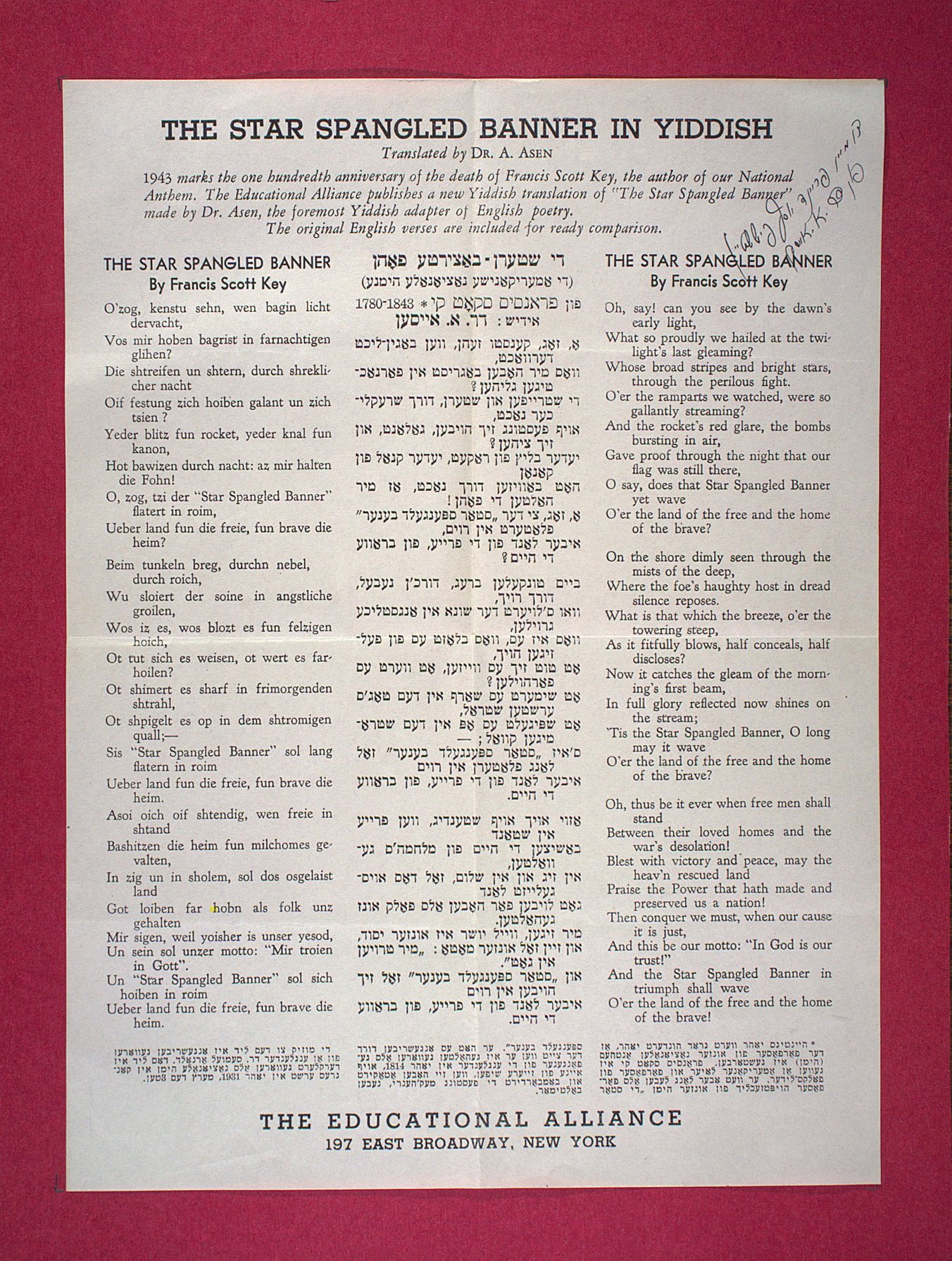
Another Yiddish version can be found here. and which appears below. It was published by the Educational Alliance in 1943 on the 100th anniversary of the death of Francis Scott Keys.
[Thanks A.L.]


SAMOAN

Aue! se'i e vaai, le malama o ataata mai

Na sisi a'e ma le mimita, i le sesega mai o le vaveao

O ai e ona tosi ma fetu, o alu a'e i taimi vevesi tu

I luga o 'Olo mata'utia, ma loto toa tausa'afia

O Roketi mumu fa'aafi, o pomu ma fana ma aloi afi

E fa'amaonia i le po atoa, le fu'a o lo'o tu maninoa

Aue! ia tumau le fe'ilafi mai, ma agiagia pea

I eleele o Sa'olotoga, ma Nofoaga o le au totoa.


A SPANISH version prepared in 1919 by the U.S. Bureau of Education.


It has also been translated into NAVAJO and applauded when sung in public.

In 2002, the Cherokee National Youth Choir sang their English and Cherokee version of the Banner in a performance at the Department of the Interior! The Cherokee nation has actually revised the SSB into their own United Cherokee national anthem which can be heard here. This is the only version I've come across that actually falls under Etizoni's edict against separate ethnic national anthems.

In 1923, an article in the Scientific Monthly complained that when brought into a class to be taught "Americanism" Finnish immigrants wouldn't sing the Star Spangled Banner. Incidentally, the Finns are criticized for their radicalism and described as "Orientals."

In the early 1940s at the height of war-time unity, Metropolitan Opera Chorus & National Broadcasting Company Symphony Orchestra, conducted by Arturo Toscanini performed the Internationale sung in Russian, followed by the US anthem. MP3
There was controversy when Jose Feliciano sang the SSB in 1968 and when Jimi Hendrix turned an instrumental version into an anti-war protest at Woodstock, but those passed.
Translating the Star Spangled Banner into other languages--whether Spanish, Navajo, or Yiddish-- is not un-patriotic. It is part of the process of self-Americanization.

Update: Norm Geras discusses the controversy on Norm's blog. I like his conclusion.

Whether or not US citizens should all learn English and know how to sing the national anthem in English, it's perfectly OK to have a Spanish version. It's the land of the free, isn't it? So people can sing the thing every which way they want. And having a Spanish version is a way for Spanish-speaking US citizens to embrace the anthem to their bosoms. It may not be the only way, but it's a way.
Joshua Rosenau on the anthem (O'zog, kenstu sehn, wenn bagin licht dervacht) at Thoughts from Kansas.

Update March 29, 2009 A couple of minor spelling and grammatical changes made. In the qu ote about Harris poll, an ellipsis was added to make it clearer. A source for the Harris Poll has been added. I don't think it was the original source, but a reference is belatedly provided.

Public outrage growing over Darfur

From Think Progress

Public outrage, sporadic before, is growing over the continuing bloodshed in Darfur,” the New York Times reports. George Clooney, Russell Simmons, U.S. Olympic gold medal winner Joey Cheek, Sen. Barack Obama (D-IL), Rep. Nancy Pelosi (D-CA), and dozens of others will be joining Darfur rallies around the country on Sunday. As Clooney said today, “What we cannot do is turn our heads and look away and hope that this will somehow disappear. It’s the first genocide of the 21st century.“

Tuesday, April 25, 2006

Roberts is no Pearson, no Kassebuam

Pat Roberts is showing that he lacks the moral and political stature of past Kansas Republican Senators like James Pearson and Nancy Kassebuam, who on important ocassions placed the national interest above partisan politics.

Joshua Marshall on Kansas Senator Pat Roberts nefarious delaying and obfuscating tactics as chair of the Senate Intelligence Committee.

You'll remember how Sen. Roberts (R-KS), Chairman of the Intel committee, broke up the senate investigation into the Iraq intel debacle into two 'phases' and in so doing managed to push the report about President Bush's role in the bamboozlement out past the 2004 election.

Apparently it worked so well the first time he's going to try it again.

According the to The Hill, Chairman Roberts now wants to take the part of the investigation he split off to get it past the 2004 election and further split up the split off part in to two new pieces. That should help him get it all past the 2006 election.

Got that?

Again, in 2004 Roberts splits the investigation in two, pushing the investigation of the administration's complicity out past 2004, in order to protect President Bush, who instructs Roberts on what to do. He's been sitting on this 'part two' phase ever since.

Now he wants to break up part two into two new parts -- that should provide enough delay to kick it out past 2007. (Actually, The Hill article is a bit unclear about whether Roberts is now proposing two chunks or three. But who's counting. Remember how the Dems shut down the senate last fall and forced the Roberts to move ahead with phase two? Guess that didn't pan out.)

Must reading for progressive Dems

American Prospect is bringing, in installments, an important paper by Ruy Texira and John Halpin. Michael Tomasky, TAP's editor describes it this way

John Halpin of the Center for American Progress Action Fund and Ruy Teixeira of CAP and the Century Foundation (and co-author of The Emerging Democratic Majority) undertook research on the state of the Democratic Party and progressive politics in America. Their chief concern: To get to the bottom of the question of why so many Americans don’t have a firm sense of what progressives and the Democratic Party stand for today.

The result of their efforts is this paper, The Politics of Definition: The Real Third Way. The paper can be read in part as a 2006 answer to The Politics of Evasion, the landmark 1989 study by William Galston and Elaine Kamarck, which described a more centrist politics and helped lay the groundwork for Bill Clinton’s ascendancy (and which they updated last year in The Politics of Polarization).


Part I looks at the basic problem facing progressives and the Democratic Party -- the “identity gap” faced within many specific voter groups -- and then surveyed electoral areas of Democratic and progressive strength.

Part II discusses areas of Democratic and progressive weakness.

I'll post links to Parts III and IV when they are available. There's already a vigorous discussion of the paper underway and sure to be more.

Keep your eyes open. Happy reading.